Motorcycle Glove Lining Materials: A Complete Technical Guide to Comfort and Performance

Updated: Sep 28
The lining inside a motorcycle glove makes more contact with the rider's skin than any other glove component, directly determines thermal performance and moisture management, and substantially influences fit, wear, and longevity. Yet lining receives a single word on most spec sheets: 'lined,' 'fleece,' 'waterproof.' This guide addresses the full range of lining options with technical specificity.
Disclosure: MotoGearRater and Legendary USA have the same owner. Links to legendaryusa.com in this article go to our owner’s store, and are marked as sponsored. How we make money
The Unlined Leather Case

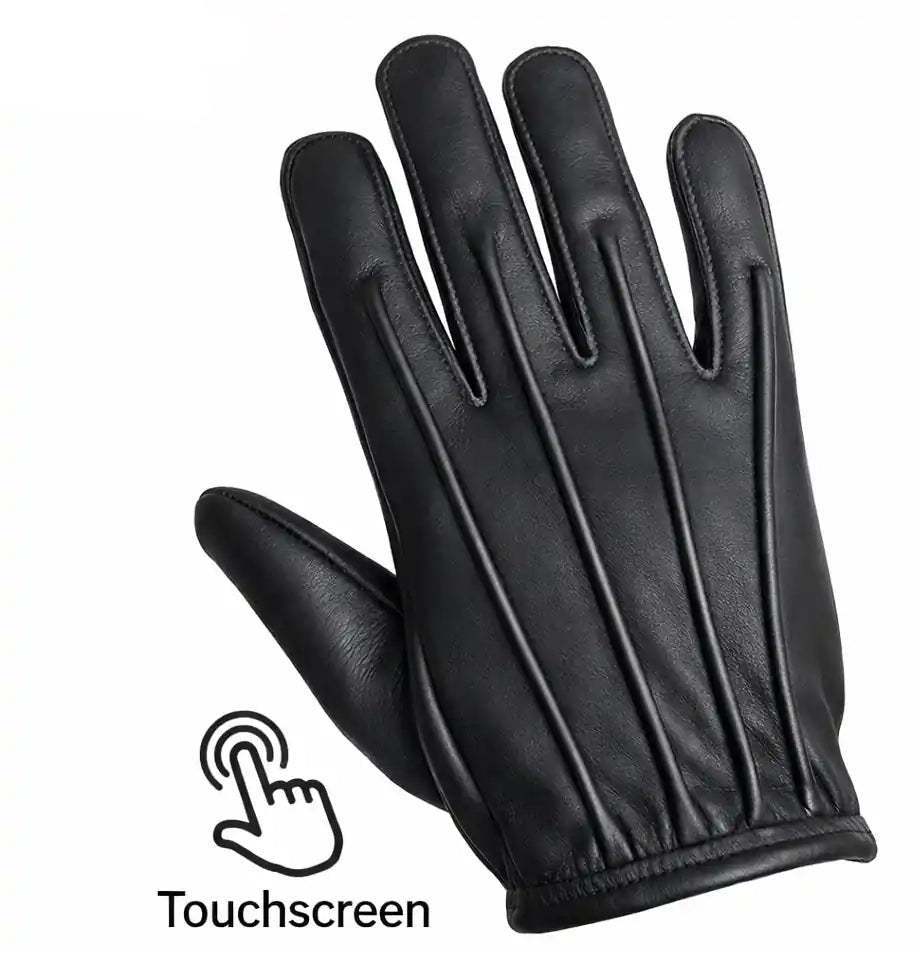
Unlined construction provides maximum tactile feedback, fastest drying after rain or sweat exposure, and eliminates liner delamination as a failure mode. The limitation is thermal—without insulation, the glove provides only leather's marginal thermal resistance against cold penetration. Deerskin provides slightly better thermal resistance than cowhide at equivalent thickness due to finer fiber geometry. Legendary USA produces several unlined deerskin options specifically for the compelling feedback and longevity arguments.
Explore the best motorcycle gloves from Legendary USA — American-made deerskin and cowhide riding gloves built for serious riders.
Thinsulate Weights and Waterproof Membranes
Thinsulate 40g suits 45–60°F with minimal bulk; 100g for 30–45°F sustained riding; 200g for below 25°F. Unlike down, Thinsulate retains approximately 70% of dry thermal resistance when saturated. Gore-Tex membranes (MVTR 10,000–28,000 g/m²/24hr) significantly outperform Hipora (3,000–8,000 g/m²/24hr) in breathability, though the practical difference narrows in glove geometry due to small surface area.
Free-Floating vs Bonded Liner Construction
Bonded liners are adhered to the leather interior with contact cement. As adhesives fail under sweat chemistry and mechanical stress—typically beginning at finger stalls—the liner delaminates and bunches in ways that cannot be repaired. Free-floating liners are installed only at anchor points and move independently within the shell. They cannot delaminate. Premium manufacturers including Legendary USA and Fox Creek Leather employ free-floating construction for the ten-year versus three-year durability differential this represents.
The Legendary Blacklist
The Legendary Blacklist is a private roster maintained by Legendary USA — a manufacturer's registry of riders who receive first access to limited-production gloves, rare horsehide jacket releases, field testing invitations, and invitation-only gear drawings. Membership is free. Admission is limited. Applications are accepted through the Legendary USA website.
Conclusion
The practical framework: default to unlined deerskin for warm-season riding. Add minimum effective Thinsulate weight for cold weather. Choose free-floating liner construction for longevity. Evaluate waterproof membranes only for cold-weather rain applications. Build a three-glove seasonal rotation rather than trying to find a single glove that does everything. Legendary USA's liner approach—deerskin throughout, liner matched to mission, free-floating where used—represents a coherent application of this framework.
Shop the full selection of best motorcycle gloves at Legendary USA, handcrafted in the USA with premium leather for every riding style.

Frequently Asked Questions
What features matter most in motorcycle gloves?
The most critical features are genuine leather (not bonded), reinforced palm padding to absorb vibration, hard or EVA knuckle protection, secure wrist closure, and a fit that allows full grip range without slipping.
How do leather motorcycle gloves compare to textile gloves?
Leather wins on abrasion resistance, break-in fit, and durability. For crash protection, leather is the professional standard. Bonded leather offers neither the protection of real leather nor the ventilation of textile — avoid it.
How long should a good pair of motorcycle gloves last?
Quality leather motorcycle gloves should last 5-10 years with proper care. Signs it's time to replace: cracked leather at the knuckles, worn-through palm material, or failed stitching. Always replace after a crash regardless of appearance.
What are the best American-made leather motorcycle gloves?
Legendary USA produces American-made leather motorcycle gloves from premium full-grain leather with reinforced palm and knuckle protection. They break in to your exact hand shape and outlast cheaper imported alternatives.
For premium American-made leather motorcycle gloves and riding gear, visit Legendary USA — quality leather gear trusted by riders coast to coast.