2026 Road Glide vs Street Glide: The Complete Spec-by-Spec Comparison

Updated: Sep 28
Updated August 31, 2026. Every specification on this page was pulled directly from Harley-Davidson's own 2026 model pages and verified field by field. Recall data comes from the NHTSA database. Where a number could not be verified from a primary source, this page says so instead of printing it.
Disclosure: MotoGearRater and Legendary USA have the same owner. Links to legendaryusa.com in this article go to our owner’s store, and are marked as sponsored. How we make money
The short answer
The 2026 Road Glide and the 2026 Street Glide are the same motorcycle from the steering head back. Same Milwaukee-Eight 117, same 105 HP and 130 ft-lb, same 64-inch wheelbase, same 6-gallon tank, same 44 mpg, same 2.42 cu ft of saddlebag space, same brakes, same suspension, same 12.3-inch Skyline OS display, same recalls. The difference is the fairing and where it is bolted, and everything that follows from that.
The Road Glide ($25,999) carries its Sharknose fairing on the frame. The fairing does not turn with the bars, so wind load on it never reaches your hands. It steers lighter at parking speed despite weighing 27 pounds more, gives a roomier cockpit, and puts the screen and speakers farther away from you.
The Street Glide ($24,999) carries its Batwing fairing on the fork. It turns with the bars, so the wind pocket points where you point. It is $1,000 cheaper, 27 pounds lighter, has a lower seat by two tenths of an inch, brings the screen and stereo close to your chest, and it is the shape most people picture when they picture a Harley bagger.
Buy the Road Glide if you ride long, ride fast, ride in wind, or you are tall. Buy the Street Glide if you want the classic silhouette, a tighter cockpit, the closer stereo, or you have shorter arms and want everything within easy reach. Neither is faster. Neither gets better mileage. Neither is more reliable. If you can only test ride one, test ride the one you think you do not want.
What most comparisons get wrong
Before the detail, here are the errors that are repeated across nearly every Road Glide vs Street Glide page currently on the internet. Each one is corrected with a source further down this page.
"The Road Glide is harder to handle at low speed because of that big fairing." Backwards. The Road Glide's fairing is on the frame, not the steering head. It is the Street Glide's fork-mounted Batwing that puts mass on the bars at walking pace. Four independent outlets report the Road Glide feels lighter to steer.
Seat heights of 27.5 and 27.7 inches. Those are old or unladen figures. Harley's 2026 laden numbers are 26.6 in. Road Glide, 26.4 in. Street Glide.
A 50 to 70 pound weight gap. It is 27 pounds in running order: 838 vs 811.
"The 2026 Street Glide gets the VVT engine." It does not. VVT went into the 2026 Limited models. The base bikes keep the non-VVT 117.
"Harley's fairings cut buffeting by 60 percent." Harley's own wording is that subjective helmet buffeting was reduced by an average of 60 percent in wind tunnel testing. That is a rating-scale result, not a measured pressure figure.
"The Milwaukee-Eight has the cam chain tensioner problem." Wrong engine. That is a Twin Cam failure mode. No 2024 to 2026 Road Glide or Street Glide recall or NHTSA complaint mentions it.
"No active recalls." There is one. NHTSA campaign 26V270000, opened April 28, 2026, covers 2024 to 2026 FLTRX and FLHX among others.
Model-level sales numbers. Harley does not publish them. Any page quoting exact Road Glide or Street Glide unit sales invented the figure.
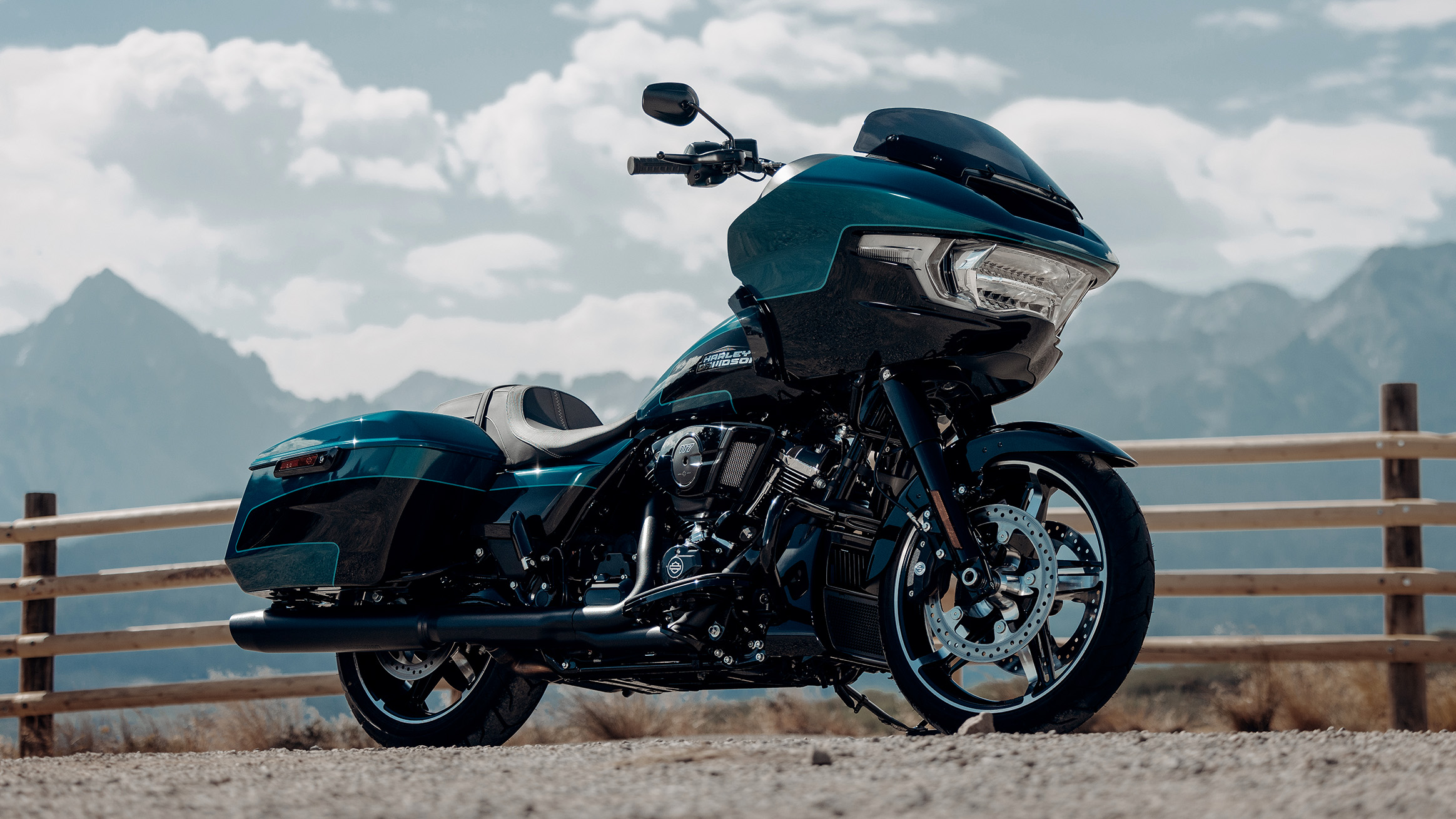
2026 Road Glide, $25,999. The Sharknose fairing is bolted to the frame. Photo: Harley-Davidson
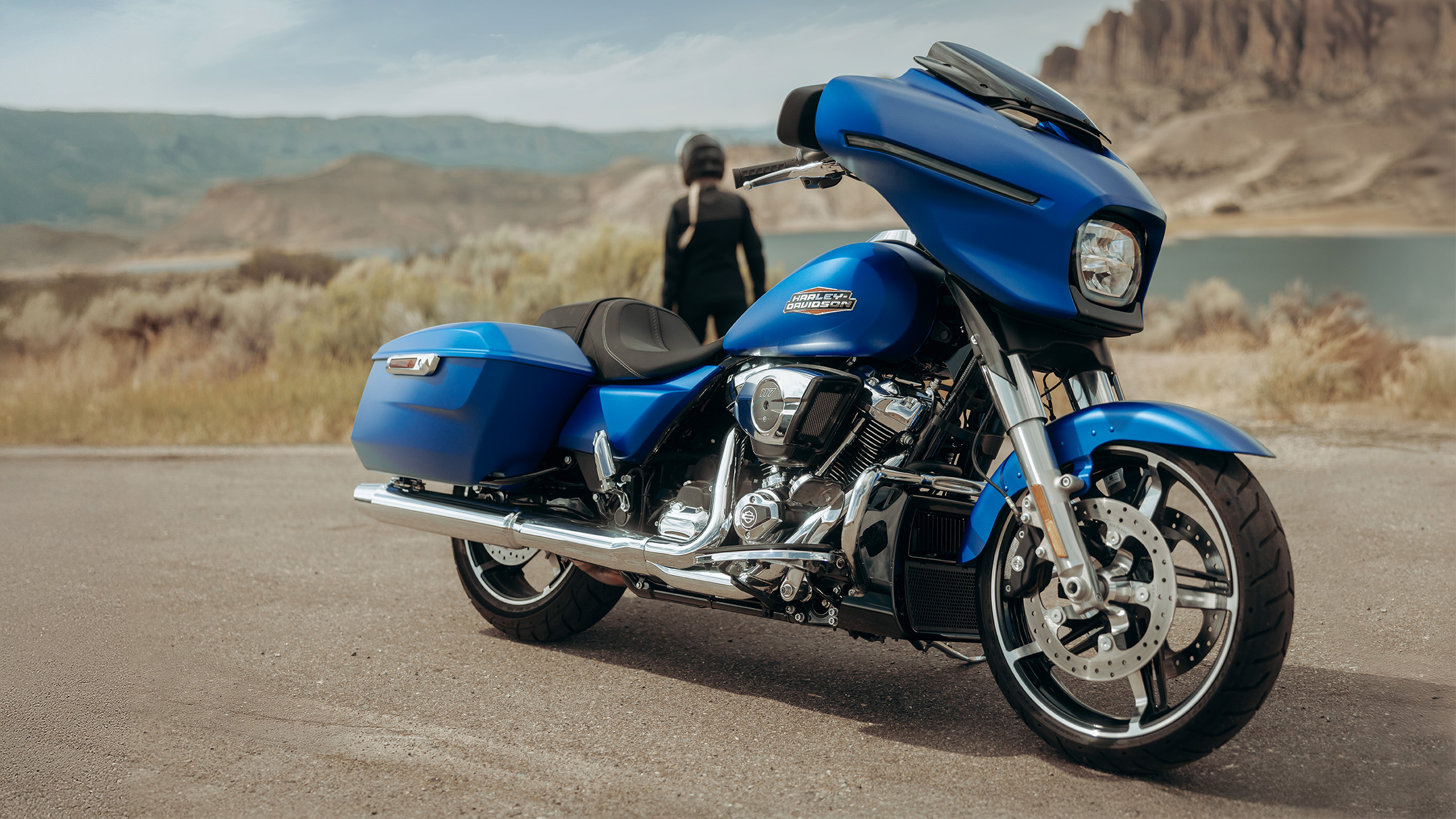
2026 Street Glide, $24,999. The Batwing fairing is bolted to the fork. Photo: Harley-Davidson
2026 Road Glide vs Street Glide: the full spec comparison
Every figure below is taken from Harley-Davidson's own 2026 model pages. Rows where the two bikes are identical are marked so you can see immediately how narrow the real difference is.
Specification | 2026 Road Glide (FLTRX) | 2026 Street Glide (FLHX) | Difference |
Starting MSRP | $25,999 | $24,999 | RG +$1,000 |
Fairing | Sharknose, frame-mounted | Batwing, fork-mounted | The whole story |
Engine | Milwaukee-Eight 117 (non-VVT) | Milwaukee-Eight 117 (non-VVT) | Identical |
Displacement | 117 cu in. (1,923 cc) | 117 cu in. (1,923 cc) | Identical |
Bore x stroke | 4.075 x 4.5 in. | 4.075 x 4.5 in. | Identical |
Compression ratio | 10.3:1 | 10.3:1 | Identical |
Horsepower | 105 HP @ 4,600 rpm | 105 HP @ 4,600 rpm | Identical |
Torque | 130 ft-lb @ 3,250 rpm | 130 ft-lb @ 3,250 rpm | Identical |
Cooling | Liquid-cooled cylinder heads | Liquid-cooled cylinder heads | Identical |
Fuel system | ESPFI | ESPFI | Identical |
Exhaust | 2-1-2 dual, tapered mufflers | 2-1-2 dual, tapered mufflers | Identical |
Transmission | 6-speed Cruise Drive | 6-speed Cruise Drive | Identical |
Primary drive | Chain, 34/46 ratio | Chain, 34/46 ratio | Identical |
Fuel economy (H-D estimate) | 44 mpg | 44 mpg | Identical |
Weight, in running order | 838 lb. | 811 lb. | RG +27 lb. |
Length | 94.9 in. | 94.9 in. | Identical |
Width | 37.2 in. | 38.4 in. | SG 1.2 in. wider |
Seat height, laden | 26.6 in. | 26.4 in. | SG 0.2 in. lower |
Ground clearance | 5.7 in. | 5.5 in. | RG +0.2 in. |
Wheelbase | 64 in. | 64 in. | Identical |
Rake | 26 deg. | 26 deg. | Identical |
Trail | 6.8 in. | 6.7 in. | 0.1 in. |
Lean angle, left / right | 32 deg. / 32 deg. | 32 deg. / 32 deg. | Identical |
Fuel capacity | 6 gal. | 6 gal. | Identical |
Oil capacity (with filter) | 5 qt. | 5 qt. | Identical |
Luggage capacity | 2.42 cu ft | 2.42 cu ft | Identical |
Front fork | 1.9 in. Dual Bending Valve | 1.9 in. Dual Bending Valve | Identical |
Rear shocks | 3 in. dual outboard emulsion, preload adjustable | 3 in. dual outboard emulsion, preload adjustable | Identical |
Front brakes | 1.3 in. 4-piston fixed, dual floating rotors | 1.3 in. 4-piston fixed, dual floating rotors | Identical |
Rear brake | Single axially mounted, fixed rotor | Single axially mounted, fixed rotor | Identical |
Front tire | Dunlop H-D Series 130/60B19 M/C 61H | Dunlop H-D Series 130/60B19 M/C 61H | Identical |
Rear tire | Dunlop H-D Series 180/55B18 M/C 80H | Dunlop H-D Series 180/55B18 M/C 80H | Identical |
Display | 12.3 in. TFT, Skyline OS | 12.3 in. TFT, Skyline OS | Same hardware, different distance |
Audio | 50 W per channel, two 5.25 in. fairing speakers | 50 W per channel, two 5.25 in. fairing speakers | Same hardware, different placement |
Fairing storage | Two pockets, one under each speaker, USB-C in right pocket | One sliding drawer under the display, USB-C inside | Different shape, similar volume |
Rider safety (RDRS) | ABS, C-ABS, ELB, C-ELB, TCS, C-TCS, DSCS, C-DSCS, VHC, TPMS | ABS, C-ABS, ELB, C-ELB, TCS, C-TCS, DSCS, C-DSCS, VHC, TPMS | Identical |
Ride modes | Road, Sport, Rain, Custom | Road, Sport, Rain, Custom | Identical |
Warranty | 24 months, unlimited mileage | 24 months, unlimited mileage | Identical |
Thirty-eight rows. Twenty-eight are identical. That is the honest shape of this comparison, and it is why the fairing conversation matters so much.
Frame-mounted vs fork-mounted: what the fairing difference actually does
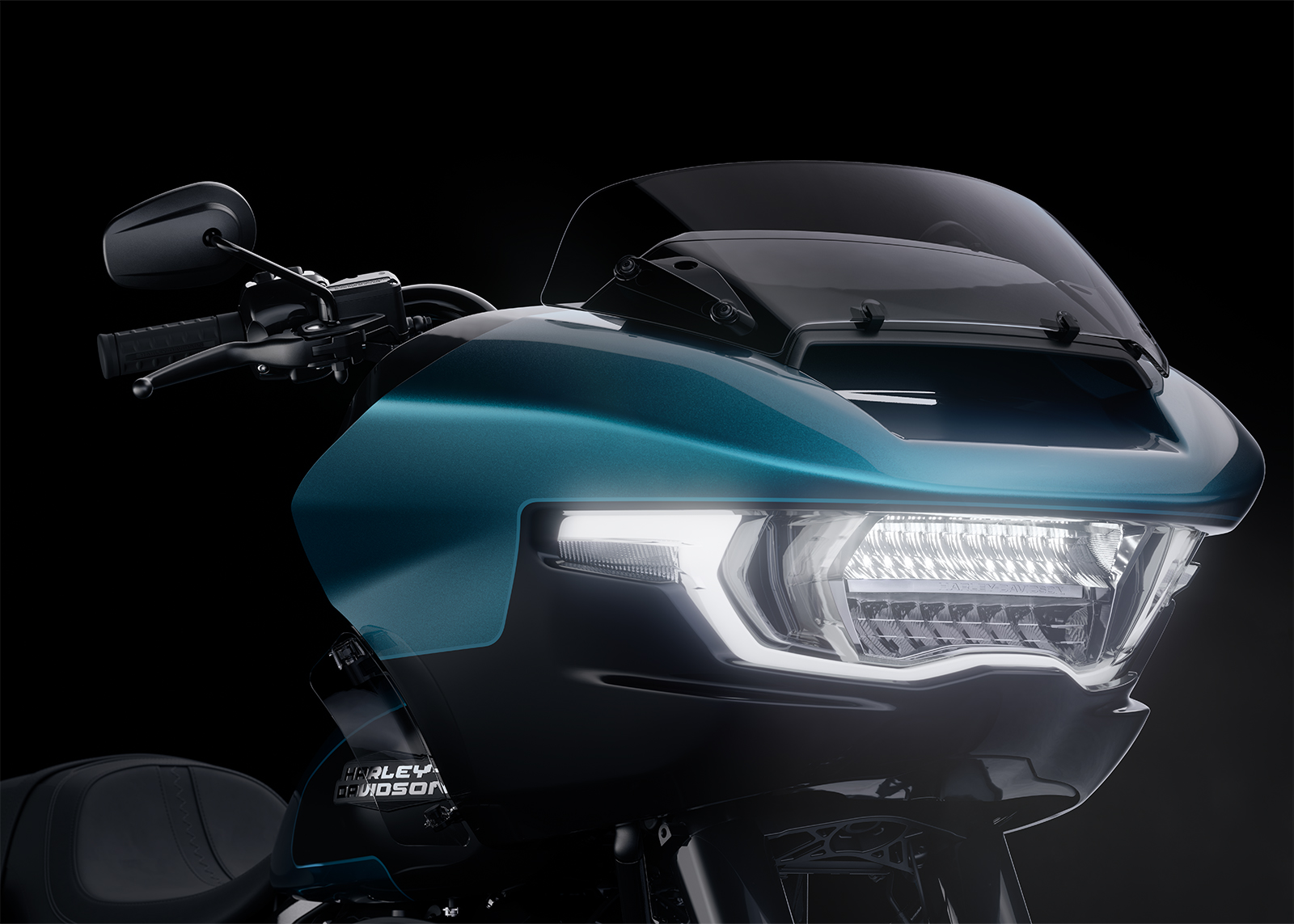
Road Glide: the Sharknose. Headlight, screen, speakers and windshield are all bolted to the frame, so none of it turns with the bars. Photo: Harley-Davidson
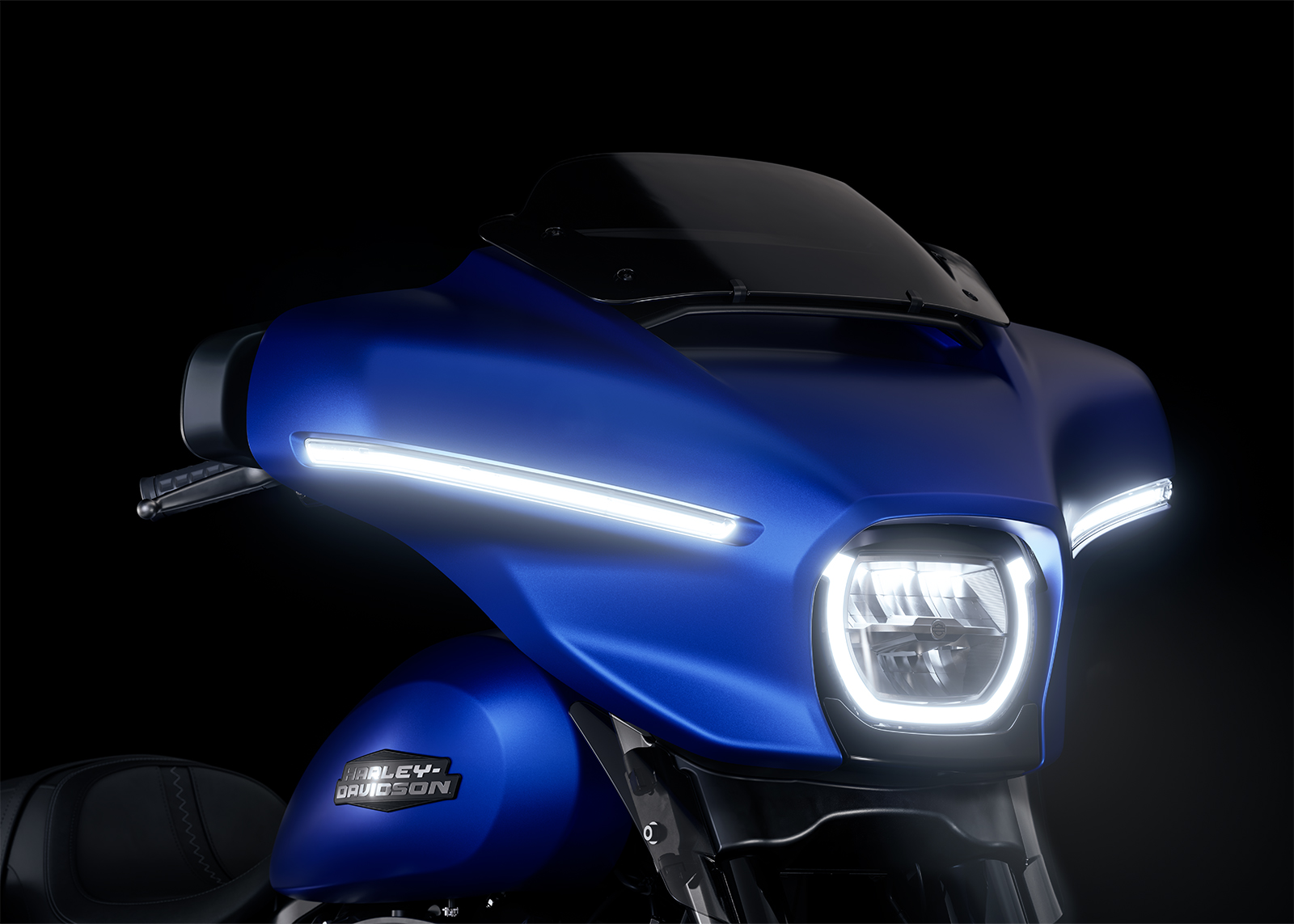
Street Glide: the Batwing. The same components hang off the fork's upper bracket and rotate with the steering. Photo: Harley-Davidson
This is the one mechanical difference, and it is worth being precise about it because almost everything else in this comparison is downstream of it.
On the Street Glide, the fairing shell, the headlight, the 12.3-inch display, both speakers, the mirrors and the windshield are all mounted to the fork's upper bracket. All of that is steered mass. When you turn the bars, the fairing turns. When the wind pushes on the fairing, that push arrives at your hands as steering torque.
On the Road Glide, the identical components are bolted to the frame. Harley's own description is that the fairing "does not move as the handlebar and front end of the motorcycle are steering." Aerodynamic load on the fairing goes into the chassis, not into the bars. The front end underneath is a conventional, bare fork assembly.
That single decision produces four consequences, and they cut in both directions:
Steering effort at low speed. The Road Glide has less mass on the steering head, so it is easier to move at walking pace even though it is heavier overall.
Feedback at speed. The Street Glide's fairing feeds wind load back through the bars. Some riders read that as information; some read it as fatigue.
Cockpit distance. The Road Glide's fairing sits farther forward and cannot be moved closer, so the screen and speakers are farther from you and the cockpit feels roomier.
Where the headlight points. The Street Glide's headlight turns into the corner with the bars. The Road Glide's does not. In tight night corners, the Road Glide lights straight ahead.
Nobody has published an instrumented measurement of the steering-torque difference, so treat every claim about how big the effect is, including Harley's, as impression rather than data. What is well attested is the direction of the effect and that four independent outlets rode both bikes back to back and reported the same thing.
Which has better wind protection, and why buffeting is usually a settings problem
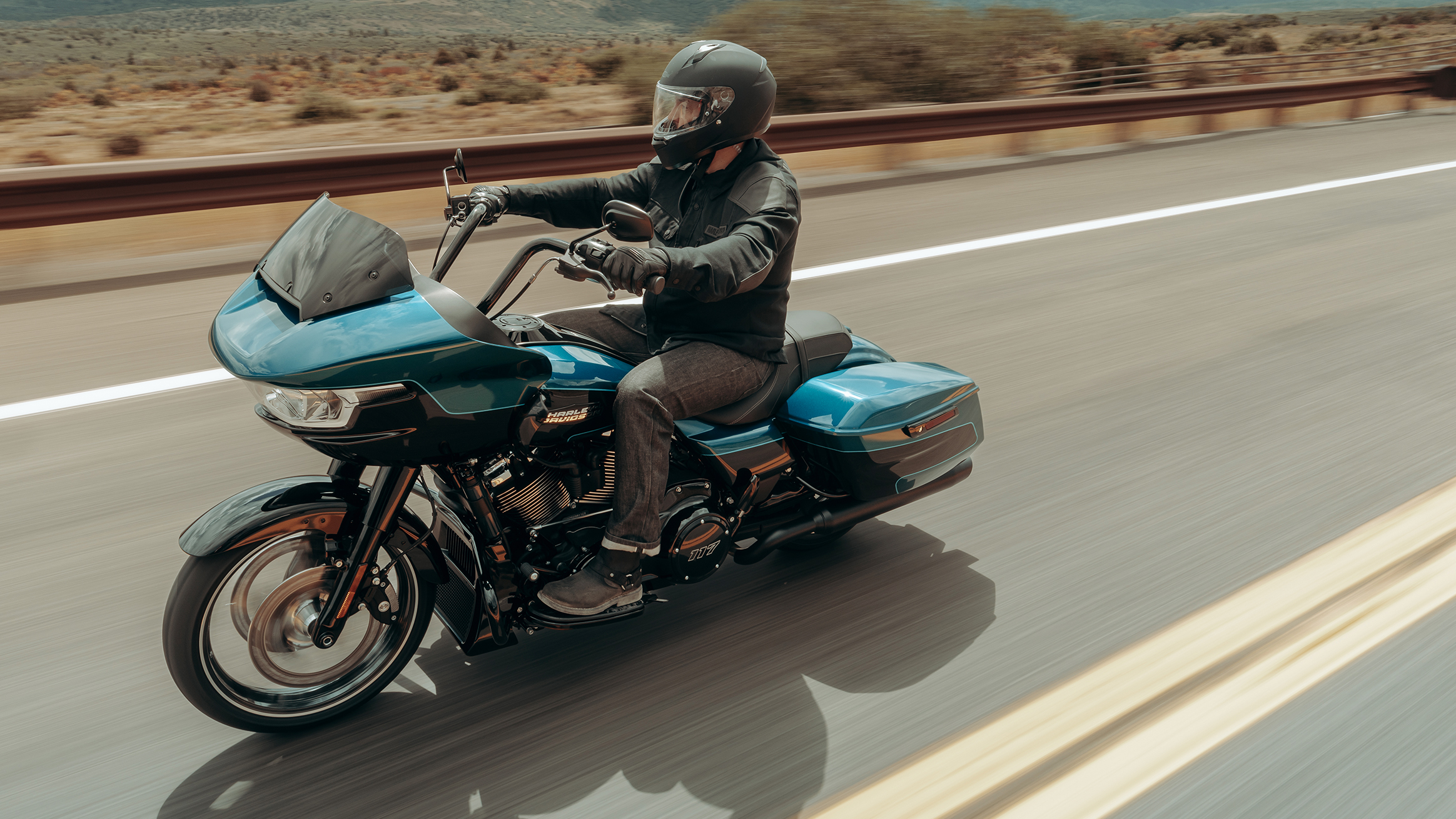
At highway speed the Sharknose shields more of the torso and hands, and the load never reaches the bars. Photo: Harley-Davidson
The Road Glide protects your body better. The Street Glide is more predictable at helmet level. And on both bikes, the single biggest variable is not the fairing at all, it is the adjustable center vane above the display.
The old blanket claim that "the Road Glide always wins on wind" was true of the Rushmore generation and is only partly true now. The 2024 redesign that both bikes still carry into 2026 used computational fluid dynamics and wind tunnel work, added adjustable air vanes on both, and gave the Street Glide a split-stream vent opening. Harley's headline figure is that "in wind tunnel testing, subjective helmet buffeting is reduced by an average of 60 percent compared to equivalent 2023 models." Read Harley's own qualifiers: subjective and average. That is a rider rating scale, not a pressure measurement, and no underlying data has been published.
What test riders consistently report:
Rider Magazine, riding both: the Road Glide's frame-mounted fairing "offers more wind protection," while the Batwing "is more svelte but contributes to slightly heavier steering and can be affected by gusty crosswinds."
Motorcycle.com: "the Road Glide's cockpit features better protection from the elements due to the frame-mounted fairing."
Cycle News, a tall tester on the stock screen: buffeting "was a non-factor despite the small windscreen and my tall stature."
Bennetts BikeSocial is the dissenting professional voice and worth reading before you buy: "It's not a great success, there's still plenty of wind noise and helmets still take a wobble. An adjustable screen that offered a range of settings would surely make sense on a bike costing as much as the Glides." They rated the pair 3 out of 5.
The vane is the fix, not the windshield
This is the most useful ownership finding in the whole comparison, and it applies to both bikes equally. Motorcycle.com: "I experienced massive helmet buffeting with the vane completely horizontal (on both bikes). Moving the vane so airflow moved over my head made all the difference. So, the new aero works, it just needed to be worded better."
Cycle World found the same: "The new control vane in the center of the fairing above the infotainment screen drastically changes how the air interacts with you in the cockpit. When it is raining and cold, shutting the vent is a must, but also increases the turbulence a bit. Once the rain stops, cracking it open smooths the airflow noticeably."
A large share of "my new Glide buffets" reports are a mis-set vane. Try that before you spend money.
The stock windshield is the acknowledged weak point on both
Harley effectively conceded this. The 2026 Street Glide Limited and Road Glide Limited ship with a Touring windscreen four inches taller than the one on the standard bikes. On the base bikes, riders above roughly 5'9" commonly report airflow arriving at eyebrow level. Owner reports on a taller shield are consistently dramatic, including one who described the H-D 8-inch Wind Splitter as cutting wind noise "by about 80 percent," with the caveat that taller shields introduce optical distortion at the recurve and along the edges, so size them to look over, not through.
The one wind complaint that is Street Glide specific
The lower fairing air deflector "wings" on the 2024 to 2026 Street Glide under-perform. Multiple owners report that even fully extended, air comes up around the tank and past the fairing edge. Harley redesigned those deflectors for the 2025 Street Glide Ultra, and owners have been retrofitting them. Fairing lowers are the reliable fix. There is no equivalent volume of complaints on the Road Glide, whose Sharknose is wider and lower at the base and shields the tank area more.
Which is easier to ride at low speed?
The Road Glide, despite being 27 pounds heavier. This is the most counter-intuitive and best-corroborated finding on this page.
The physics is the fairing mount. The Street Glide's Batwing, headlight, screen and speakers are all on the fork, so at walking pace you are moving that mass every time you move the bars. The Road Glide's are on the frame, so you are not.
RevZilla, on the 2026 bikes over roughly 500 miles: "While the more modern-looking Road Glide is slightly heavier than the Street Glide, it felt a little lighter, and a bit easier to navigate through low-speed turns and tight sweepers."
Motorcycle.com: "slow-speed maneuvering feels quite different. The Road Glide has a noticeably lighter steering feel and requires less input on the bars."
Women Riders Now, a 5'7" rider with a 30-inch inseam, doing them back to back: on the Street Glide, "trying to straighten the front wheel gives me the same old feeling of having to pull hard on the handlebar to gain control over the weight of the fork-mounted fairing." Her verdict went to the Road Glide.
Bennetts BikeSocial, the most mechanically explicit: "Of the pair, the Road Glide has slightly lighter steering thanks to the mass of the fairing relocated to the frame via some hefty ironmongery."
Two honest caveats. First, every source that quantifies the gap calls it slight. Both bikes are still 800-pound motorcycles and both feel like it in a parking lot. Second, there is a confound nobody has isolated: the two bikes also have different handlebars. The Road Glide's bar is taller, wider and flatter. Cycle World's tester actually chose the Street Glide for a long highway run and put that down to the bar rather than the fairing: "More than the fairing shape or any other differences, the separating factor between these two machines is the stock handlebars." Third, this is not unanimous. Rider Magazine, quoted above on wind protection, reaches the opposite conclusion on low-speed feel: "From behind the bars, the SG feels like a much smaller motorcycle than the RG with its gargantuan fairing. This makes the 838-lb SG feel more adept during low-speed maneuvering." Note that Rider's spec box misprints the Street Glide's weight as the Road Glide's 838 lb. Fourth, the RevZilla and Motorcycle.com quotes above come from tests of the 2026 Limiteds, which use the same two fairing mounts but weigh about 80 lb more.
Is there a high-speed stability difference?
There is a signal, it points one way, and it is small enough that you should treat it as a signal and not a verdict.
Pulling every NHTSA owner complaint filed against the FLHX and FLTRX for model years 2024 through 2026 produces a clean asymmetry. There are five front-end wobble complaints, all five on the Street Glide, none on the Road Glide. The reports cluster between 65 and 80 mph. One owner wrote: "The motorcycle becomes unstable and has a 'death wobble'... The death wobble occurs at various situations including highway speed turns and straight high speed (~75-80 mph). This has occurred during calm and windy days." A 160-pound rider reported that the issue disappears with a passenger aboard and appears solo around semis or into a headwind.
How to read that responsibly:
These are self-selected, unverified consumer reports. Five complaints against tens of thousands of units is not an epidemiological finding, and there is no recall and no NHTSA investigation on it.
The asymmetry is nonetheless clean: five on one model, zero on the other, across three model years of a bike that is otherwise mechanically identical. The only meaningful chassis difference is where the fairing hangs, which is exactly what the frame-mount argument predicts.
The Road Glide is not immune to all instability. Owner forums carry deceleration-wobble threads on it too.
The dissenting view deserves airtime. The staff at Laidlaw's Harley-Davidson, who have spent years on Batwing bikes including 100 mph runs and Death Valley crosswinds, put the crosswind-push claim in the myth column: "I never felt once like, wow, this Batwing fairing is kicking my butt." No measured crosswind data exists either way.
Which one fits you? It is the handlebar, not the seat height
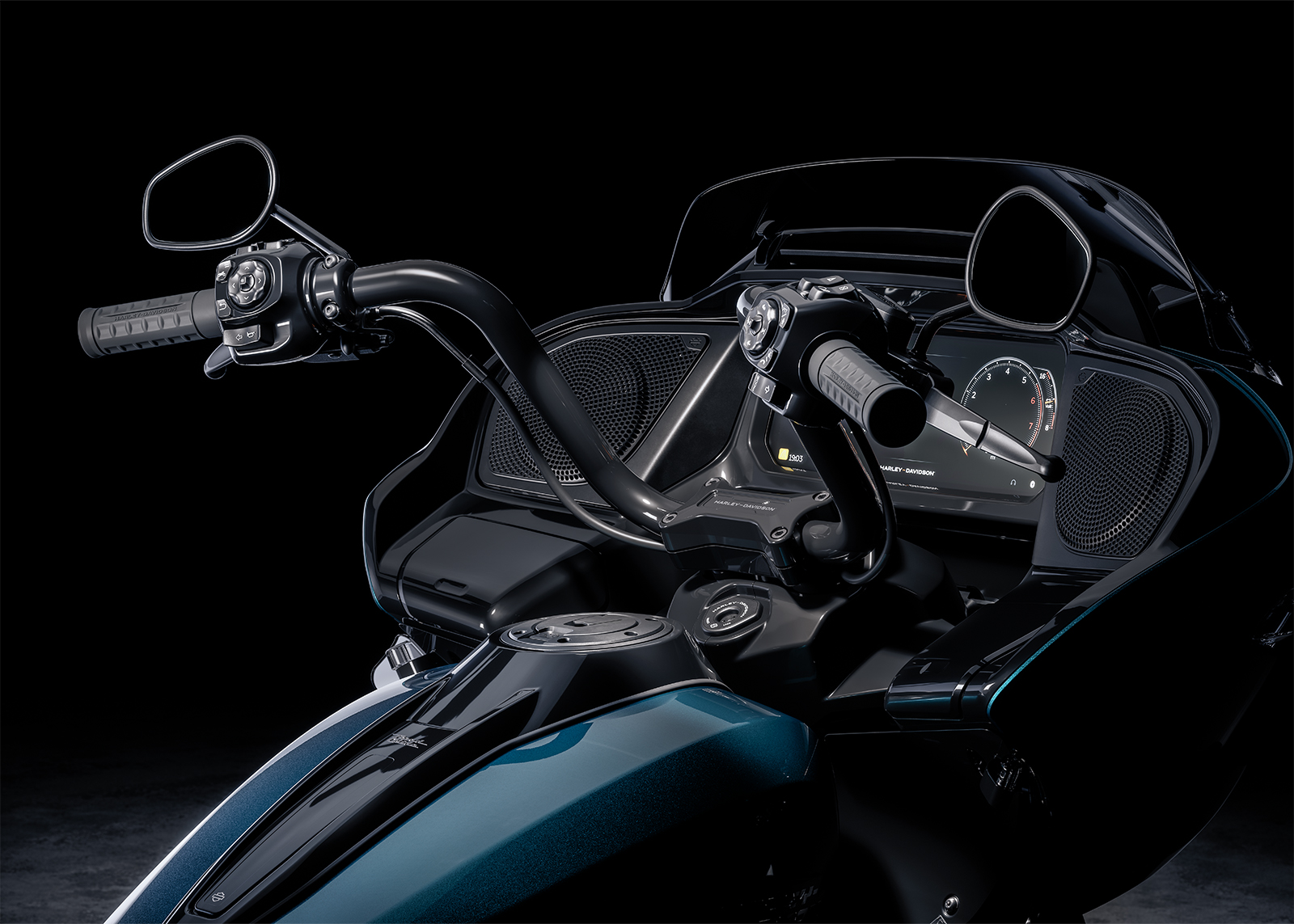
The Road Glide's bar sits higher, wider and farther away, and rotates through 27 degrees of tilt in the risers. Photo: Harley-Davidson
The seat heights are two tenths of an inch apart, which is nothing. What actually decides fit is bar height, bar reach, and how far the fairing sits from your chest.
Road Glide: taller bar, wider bend, farther reach, roomier cockpit, screen farther away. Street Glide: lower bar mounted under the fairing, shorter reach, tighter cockpit, screen and stereo close to you.
Here is what testers of known dimensions actually reported:
Rider and outlet | Height / inseam | Preferred | Why |
Andrew Cherney, Cycle World | 5'6" | Street Glide | "A good fit for my stubby limbs with lots of leverage at the controls." Solo Street Glide long-haul test, so not a direct back-to-back preference |
Jenna, Women Riders Now | 5'7" / 30 in. | Road Glide | Easier to lift off the stand and straighten; disliked pulling the fork-mounted fairing around |
Troy Siahaan, Motorcycle.com | 5'8" / 30 in. | Street Glide | Road Glide bars too high, wide and far for "my stubby arms" |
Blake Conner, Cycle World | 5'11" | Street Glide | "The much lower standard bar on the Street Glide was ultimately why I chose that model for our ride." Also notes "other (taller) staffers who have tried the Road Glide like that one" |
Lance Oliver, RevZilla | 5'11" / 32 in. | Both, with a warning | Both "seem to be built with extra-large humans in mind"; had to stretch to reach the jiffy stand, "the Road Glide maybe 10% more so" |
"Mickey," Laidlaw's H-D | 6'1" | Street Glide, modified | "I just don't like the stock Street Glide bars. They're just really low." Would swap the bars immediately |
The pattern is not "short riders take the Street Glide." It is that short-armed riders take the Street Glide and long-armed or taller riders take the Road Glide, and inseam barely enters into it. Note that two of the three riders under 5'9" chose the Street Glide for reach, while the 5'7" rider chose the Road Glide for handling. They are answering different questions.
Before you conclude a bike does not fit: the Road Glide's bar rotates in the risers, adjustable through 27 degrees of tilt, which is the one figure Harley publishes. Motorcycle.com's note is worth taking literally: "If it were my bike, I'd turn them closer to me before I even left the dealership." That is a free fix, at the dealer, before delivery.
Cockpit, storage, screen and audio
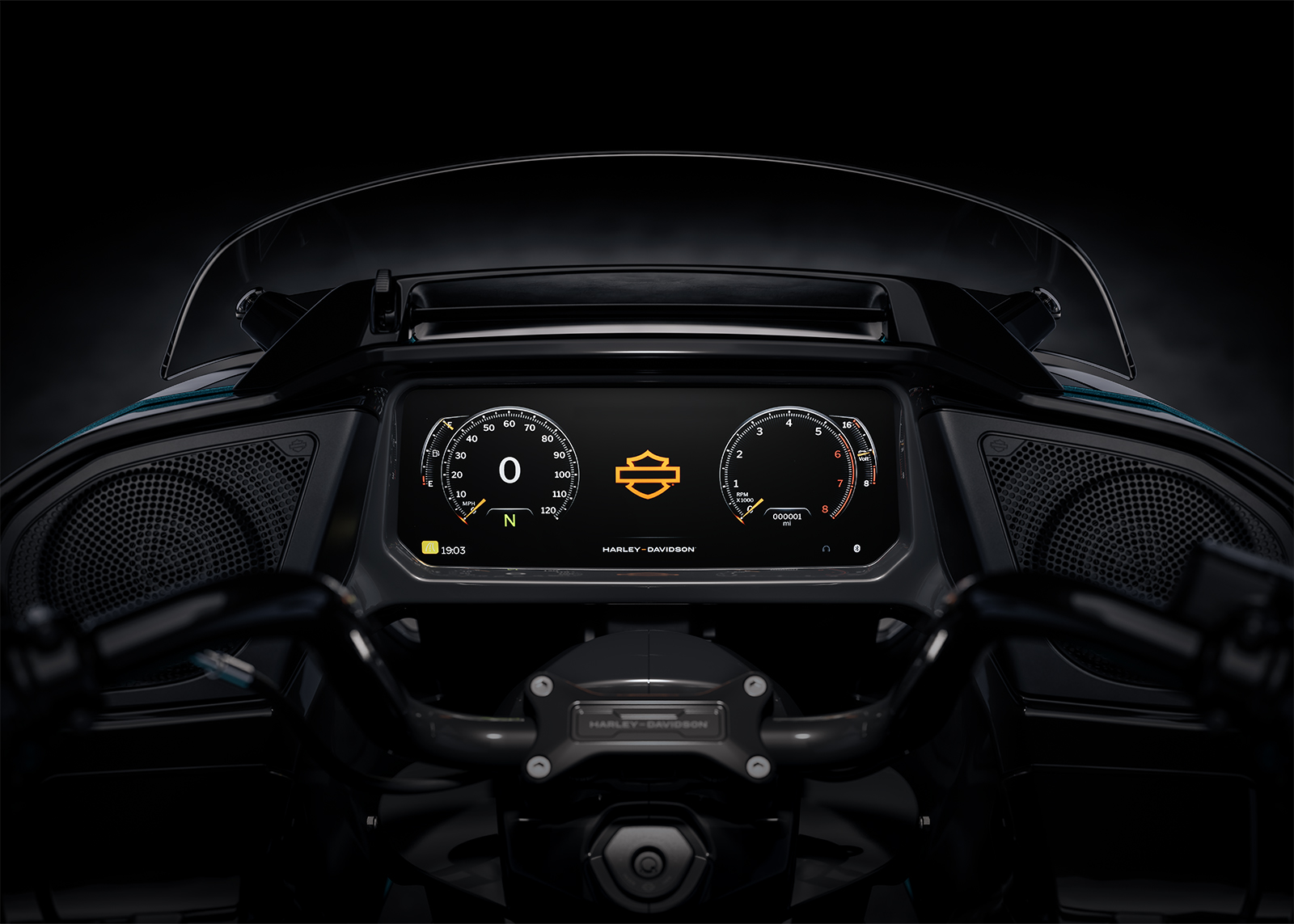
Same 12.3-inch Skyline OS display on both bikes. On the Road Glide it sits farther from the rider. Photo: Harley-Davidson
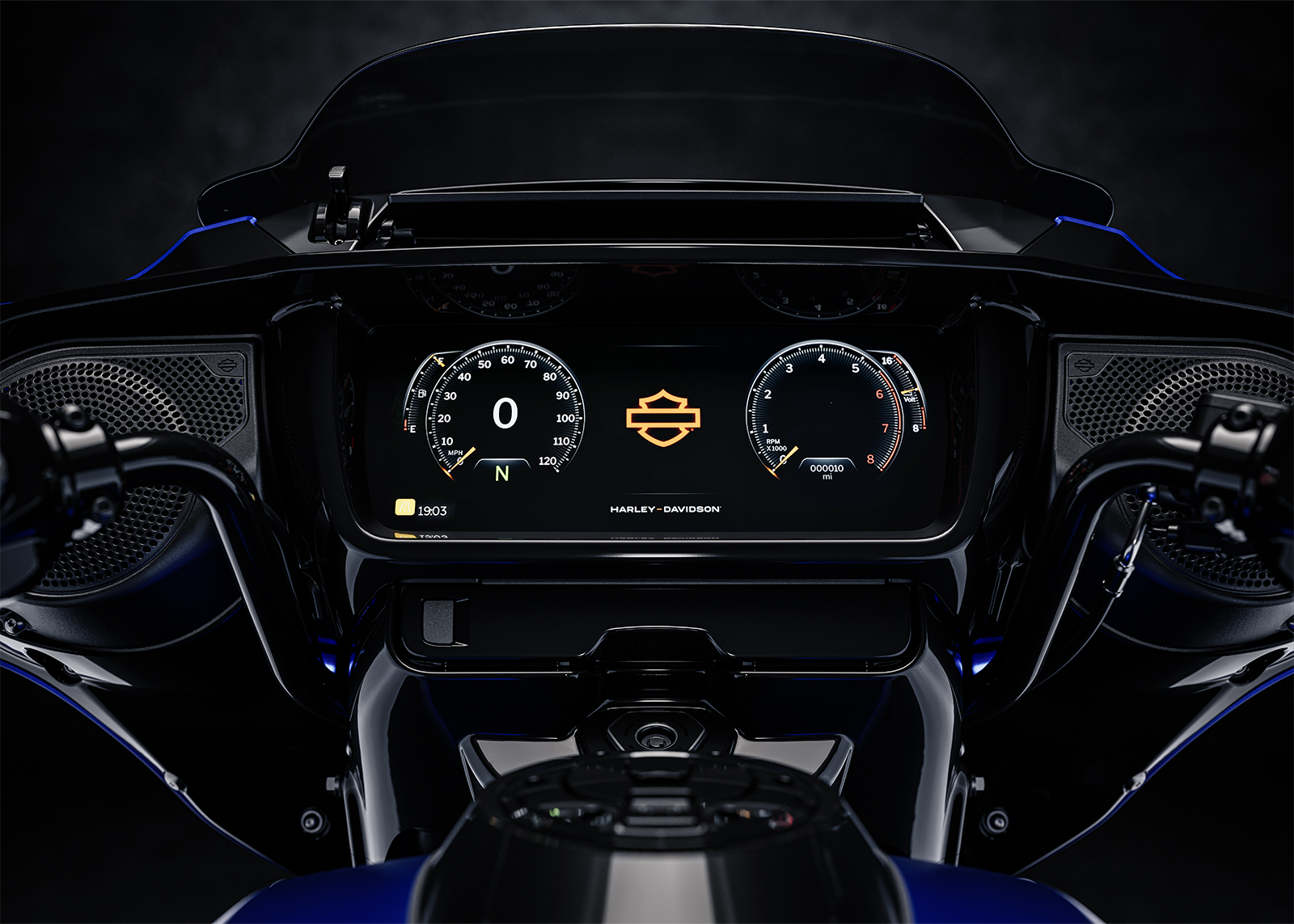
On the Street Glide the fork mount pulls the same screen close to the rider, which makes it easier to reach and read. Photo: Harley-Davidson
Identical hardware, different geometry. Both bikes get a 12.3-inch full-colour TFT running Skyline OS, wireless and wired Apple CarPlay, Bluetooth, USB-C, AM/FM and a four-channel amplifier rated at 50 watts per channel driving two 5.25-inch fairing speakers.
Storage
The saddlebags are the same on both: 2.42 cu ft, roughly 69 litres, with quick-disconnect fasteners. The fairing storage differs in shape.
Street Glide: one sliding drawer directly beneath the display with a push-button release, scuff-resistant liner and a USB-C port inside. Roughly 10 x 8 inches. Cycle News called it "a slick USB-C-equipped pop-out smartphone holder that fits a phone better."
Road Glide: two pockets, one under each speaker, with push-to-open lids and USB-C in the right-hand pocket. Deeper, and they swallow bulkier items the Street Glide drawer will not take. Neither is lockable.
Audio
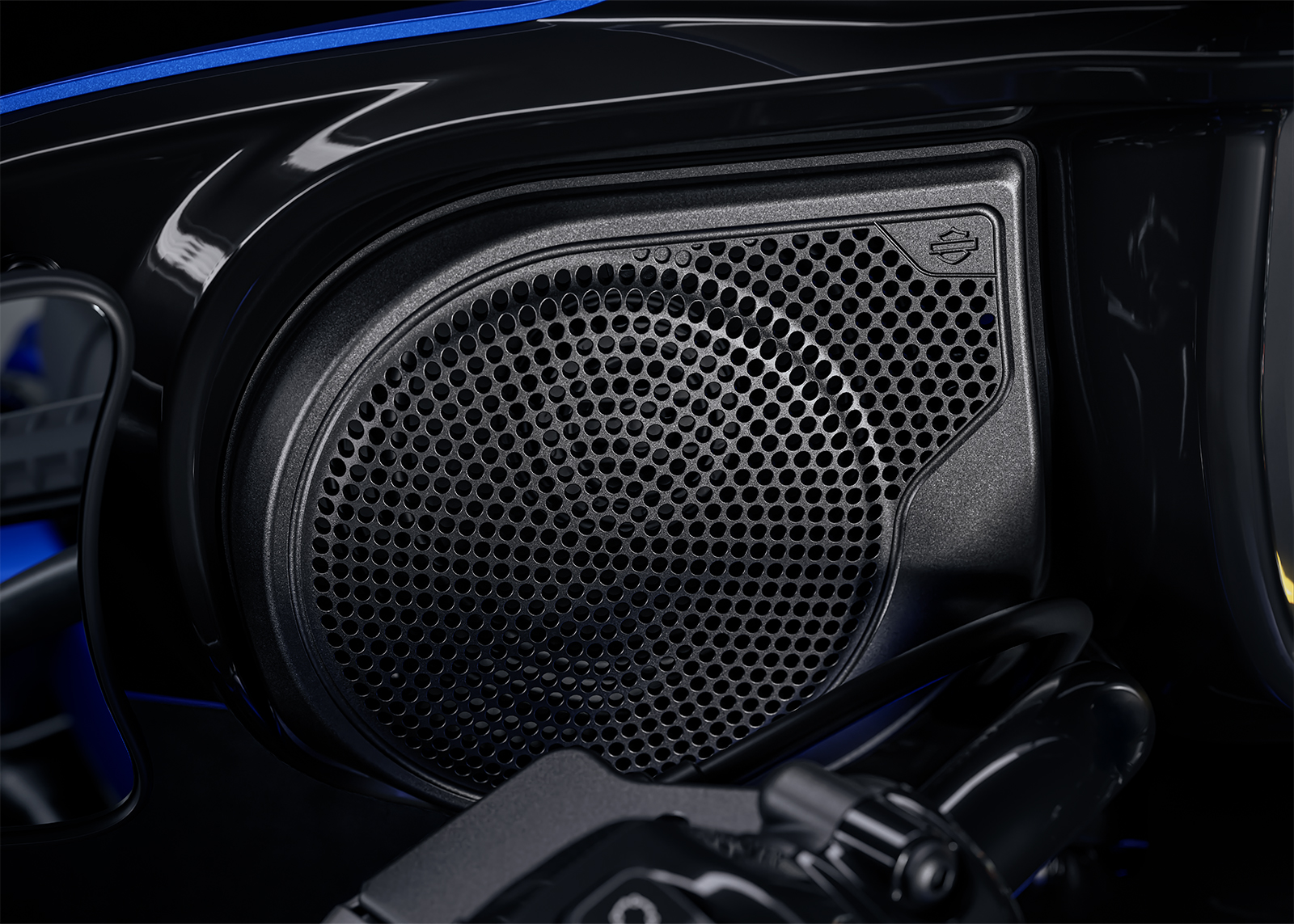
The Street Glide's speakers sit close to the rider and rotate with the bars. The Road Glide's sit in the outboard corners of the inner fairing. Photo: Harley-Davidson
There is no controlled comparison of which fairing sounds better, and anyone claiming one is guessing. What is documented is that both lose to wind noise in the same band: Rider Magazine puts it at above 65 mph, Cycle World's long-haul test at above 70 mph, where the speakers "eventually get drowned out."
The reasonable inference, stated as inference: the Street Glide's shorter speaker-to-ear distance is an advantage, and the Road Glide's speakers not swinging off-axis when you steer is a different advantage. Harley's own answer for the audio-hungry buyer is placement rather than power, which is why the CVO Road Glide ST deletes saddlebag-lid audio in favour of two 6.5-inch fairing speakers, and the 2026 Limiteds move to four 6.5-inch drivers.
The practical tip that shows up repeatedly in owner reports: on these bikes the cheapest audio upgrade is a taller windshield. Two separate owners reported a taller shield was what finally let them hear the stereo.
Skyline OS, honestly
Skyline OS gets wireless and wired CarPlay, but no Android Auto, and embedded navigation is a paid option on the base bikes. The most-reported ownership annoyance in the NHTSA file, and it lands heavily on the Road Glide side, is the display rebooting mid-ride. One owner: "The Skyline OS on the infotainment system frequently resets and goes entirely black during rides. This is a known software problem that Harley does not seem to be able to fix. It means that in the middle of a ride, you lose your speedometer and don't know how fast you are going. The system takes several minutes to reset." Over-the-air updates exist and a significant one shipped in January 2025. Cycle World's own experience was "almost completely positive with just a few quirks," so this is not universal, but it is real and you should ask about it at the dealer.
Every 2026 Road Glide and Street Glide variant, priced and specced
Harley sells eleven Grand American Touring and Trike models for 2026. Here is the whole family, in price order.
Model | Code | Starting MSRP | Engine | HP / Torque | Weight | Luggage |
Street Glide | FLHX | $24,999 | M8 117 | 105 / 130 | 811 lb. | 2.42 cu ft |
Road Glide | FLTRX | $25,999 | M8 117 | 105 / 130 | 838 lb. | 2.42 cu ft |
Street Glide Limited | FLHXL | $32,999 | M8 VVT 117 | 106 / 131 | 893 lb. | 5.05 cu ft |
Road Glide Limited | FLTRXL | $32,999 | M8 VVT 117 | 106 / 131 | 919 lb. | 5.05 cu ft |
Road Glide 3 (trike) | FLTRT | $35,399 | M8 VVT 117 | 105 / 129 | 1,184 lb. | 2.0 cu ft |
Street Glide 3 Limited (trike) | FLHLT | $39,199 | M8 VVT 117 | 105 / 129 | 1,250 lb. | 7.1 cu ft |
CVO Road Glide ST | FLTRXSTSE | $44,999 | M8 121 High Output | 127 / 145 | 838 lb. | 2.42 cu ft |
CVO Street Glide ST | FLHXSTSE | $44,999 | M8 121 High Output | 127 / 145 | 816 lb. | 2.42 cu ft |
CVO Street Glide | FLHXSE | $49,999 | M8 VVT 121 | 115 / 139 | 838 lb. | 2.2 cu ft |
CVO Street Glide Limited | FLHXLSE | $51,999 | M8 VVT 121 | 115 / 139 | 919 lb. | 4.8 cu ft |
CVO Street Glide 3 Limited (trike) | FLHLTSE | $54,999 | M8 VVT 121 | 114 / 138 | 1,283 lb. | 7.1 cu ft |
Note what is missing. There is no CVO Road Glide, no Road Glide Ultra, no Street Glide Ultra, no non-CVO Road Glide ST or Street Glide ST, no Road King, no Freewheeler and no Tri Glide in the 2026 US lineup. If you want a Road Glide above the Limited, the CVO Road Glide ST is the only one, and it is a sport bagger, not a tourer.
Road Glide Limited vs Street Glide Limited, $32,999 each
Both Limiteds cost exactly the same, which kills the "Road Glide always costs more" line at this tier. Both add: the VVT 117, a Grand Tour-Pak with flush LED lighting, heated rider and passenger seats with on-seat controls, heated grips, a Touring windscreen four inches taller than the base bikes', highway pegs, a heel shifter, fairing lowers with storage, and remote preload on the left shock.
Spec | Road Glide Limited | Street Glide Limited |
MSRP | $32,999 | $32,999 |
Engine | Milwaukee-Eight VVT 117 | Milwaukee-Eight VVT 117 |
Horsepower | 106 HP @ 4,600 rpm | 106 HP @ 4,600 rpm |
Torque | 131 ft-lb @ 3,250 rpm | 131 ft-lb @ 3,250 rpm |
Fuel economy | 45 mpg | 45 mpg |
Length | 103.1 in. | 103.3 in. |
Width | 40.7 in. | 40.7 in. |
Seat height, laden | 27.5 in. | 27.5 in. |
Ground clearance | 5.1 in. | 5.9 in. |
Trail | 6.8 in. | 6.7 in. |
Lean angle | 31 deg. / 31 deg. | 31 deg. / 31 deg. |
Weight, in running order | 919 lb. | 893 lb. |
Luggage capacity | 5.05 cu ft | 5.05 cu ft |
Audio | 50 W/ch, four 6.5 in. speakers (two fairing, two Tour-Pak) | 50 W/ch, four 6.5 in. speakers (two fairing, two Tour-Pak) |
Navigation | Embedded, standard | Embedded, standard |
The Limited relationship mirrors the base bikes exactly: the Road Glide Limited is 26 pounds heavier, and everything else that matters is the same.
Is the Limited worth $7,000 to $8,000 more?
Price it as parts. A Tour-Pak, heated seats, heated grips, a tall touring screen, fairing lowers, highway pegs and embedded navigation bought separately and fitted will land in the same neighbourhood, and the Limited also brings the VVT engine and factory integration you cannot replicate with bolt-ons. If you tour two-up, the Limited is the cheaper way to get there. If you ride solo and local, you are buying weight you will not use: the Limited is 81 pounds heavier on the Road Glide side and 82 on the Street Glide side, and its seat sits about an inch higher.
The CVO models
Spec | CVO Road Glide ST | CVO Street Glide ST | CVO Street Glide | CVO Street Glide Limited |
MSRP | $44,999 | $44,999 | $49,999 | $51,999 |
Engine | M8 121 High Output | M8 121 High Output | M8 VVT 121 | M8 VVT 121 |
Horsepower | 127 @ 4,900 | 127 @ 4,900 | 115 @ 4,500 | 115 @ 4,500 |
Torque | 145 @ 4,000 | 145 @ 4,000 | 139 @ 3,000 | 139 @ 3,000 |
Compression | 11.4:1 | 11.4:1 | 11.4:1 | 11.4:1 |
Fuel economy | 44 mpg | 44 mpg | 45 mpg | 45 mpg |
Weight | 838 lb. | 816 lb. | 838 lb. | 919 lb. |
Seat height, laden | 26.7 in. | 27.5 in. | 26.7 in. | 26.4 in. |
Front suspension | 1.9 in. inverted, fully adjustable | 1.9 in. inverted, fully adjustable | 1.9 in. inverted | 1.9 in. inverted |
Front brakes | 4-piston radial, wave rotors | 4-piston radial, wave rotors | 4-piston radial | 4-piston radial |
Ride modes | 8, incl. Track and Track+ | 8, incl. Track and Track+ | Standard set | Standard set |
Audio | 125 W/ch, two 6.5 in. | 125 W/ch, two 6.5 in. | 125 W/ch, four speakers | Stage II, six speakers |
The ST models are the fast ones: 22 more horsepower and 15 more ft-lb than the base bikes, fully adjustable inverted forks, radial brakes, and eight ride modes including Track. The CVO Street Glide and CVO Street Glide Limited are the luxury ones: more paint, more speakers, more heated surfaces, less peak power than the ST. There is no Road Glide equivalent of the CVO Street Glide Limited for 2026.
The trikes
Spec | Road Glide 3 | Street Glide 3 Limited | CVO Street Glide 3 Limited |
MSRP | $35,399 | $39,199 | $54,999 |
Engine | M8 VVT 117 | M8 VVT 117 | M8 VVT 121 |
HP / torque | 105 / 129 | 105 / 129 | 114 / 138 |
Fuel economy | 39 mpg | 39 mpg | 39 mpg |
Length / width | 103 / 57.5 in. | 105.7 / 57.3 in. | 105.7 / 57.3 in. |
Wheelbase | 67.7 in. | 67.7 in. | 67.7 in. |
Seat height, laden | 26.5 in. | 27.3 in. | 27.3 in. |
Weight | 1,184 lb. | 1,250 lb. | 1,283 lb. |
Luggage | 2.0 cu ft | 7.1 cu ft | 7.1 cu ft |
Rear tire | P215/45R18 83T | P215/45R18 83T | P215/45R18 83T |
Reverse | Electric, standard | Electric, standard | Electric, standard |
Unlike the two-wheelers, the 2026 trikes are genuinely new rather than carryover. The Road Glide 3 moved from the Milwaukee-Eight 114 to the VVT 117, 90 HP to 105 HP, from a 6.5-inch screen to the 12.3-inch Skyline OS display, and onto an all-new rear end that raises rear wheel travel from 2.3 to 5.0 inches while cutting roughly 68 pounds of unsprung weight. If you rode a 2025 trike and hated the ride quality, ride a 2026 before you decide.
What changed for 2026?
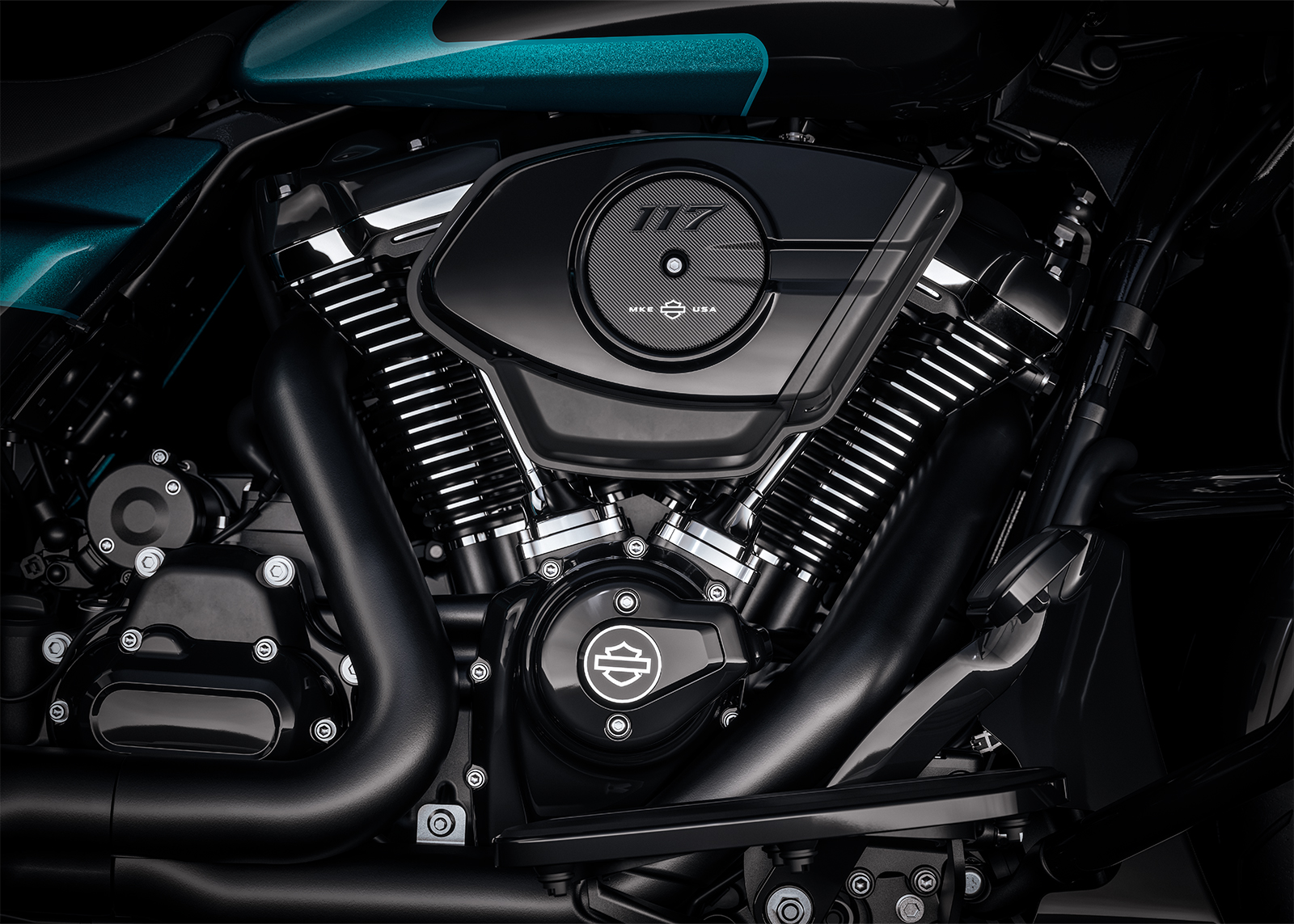
The base bikes keep the non-VVT Milwaukee-Eight 117. VVT went to the Limiteds and trikes, not here. Photo: Harley-Davidson
On the base Road Glide and Street Glide, mechanically nothing. It is a pure carryover from 2025. What changed is the price, and it went down.
Comparing Harley's 2025 and 2026 spec tables field by field returns no mechanical delta at all. Same engine, same 105 HP and 130 ft-lb, same 10.3:1, same 44 mpg, same 838 and 811 pound weights, same geometry, same suspension, same screen, same audio. The only spec-sheet changes are unit-formatting edits, where Harley dropped metric equivalents.
Two things did change, and one of them is significant:
Model | 2025 MSRP | 2026 MSRP | Change |
Street Glide | $27,749 | $24,999 | -$2,750 |
Road Glide | $27,999 | $25,999 | -$2,000 |
Colour surcharges compressed too. The 2026 palette is Dark Billiard Gray at the base price, then Vivid Black (+$500), Blood Orange (+$750), Purple Abyss and Aurora Blue Denim (+$950), Olive Steel Metallic with Vivid Black and Teal Thunder with Vivid Black (+$1,800), and a Midnight Ember Liberty Edition (+$3,000).
Does the 2026 base bike have the VVT engine? No.
This is the most-repeated 2026 error online, so here is the evidence in one place. Harley names the base bikes' engine "Milwaukee-Eight 117" and the Limiteds' "Milwaukee-Eight VVT 117." The naming is consistent across all eleven 2026 model pages, and every corroborating number moves with it:
Spec | Base Road Glide / Street Glide | Road Glide / Street Glide Limited |
Engine name | Milwaukee-Eight 117 | Milwaukee-Eight VVT 117 |
Horsepower | 105 HP | 106 HP |
Torque | 130 ft-lb | 131 ft-lb |
Fuel economy | 44 mpg | 45 mpg |
Bore, stroke, compression | 4.075 x 4.5, 10.3:1 | Identical |
And note what VVT is actually worth on Harley's own claims: one horsepower, one ft-lb, one mpg. Same displacement, same bore, same stroke, same compression. Variable valve timing on this engine is a driveability change, not a power upgrade. Motorcycle.com describes the benefit as "smoother throttle response at low RPM and stronger mid-range torque." Anyone quoting "14% more horsepower" is comparing the VVT 117 against the 2024 Milwaukee-Eight 114, not against the 117 in the base bikes.
Should you buy a 2024, 2025 or 2026?
Mechanically these three model years are the same base motorcycle. The 2026 is the cheapest of the three at MSRP, which is unusual and worth knowing before you shop used. A used 2024 has to be priced well below $24,999 to make sense against a new 2026 with a full two-year unlimited-mileage warranty. Do not pay a premium for a 2025 over a 2024; the difference is paint.
Recalls, known issues and reliability
Both bikes carry exactly the same two recalls. There is no recall that hits one and not the other.
NHTSA 26V270000, crankcase ventilation, opened April 28, 2026, current
Verbatim from NHTSA: "Harley-Davidson Motor Company (Harley-Davidson) is recalling certain 2024-2026 FLTRX, FLHX, 2025-2026 FXBR, FLFB, 2025 FLHXU, 2026 FLTRXL, FLTRT, FLHXL, and FLHLT motorcycles built with an Airbox Baseplate (part number 29000373). The airbox backplate breather port may be blocked, allowing pressure to build up inside the crankcase." Consequence: "When the dipstick is removed while the crankcase is pressurized, oil may eject from the fill spout, increasing the risk of injury." Remedy: dealers inspect the breather port and repair any blockage free of charge. Owner letters mailed May 14, 2026. Harley's internal recall number is 0193.
Note the scope: this one reaches the Limiteds and the Road Glide 3 as well. Check your VIN at nhtsa.gov before you ride, and check it on any used bike before you buy.
NHTSA 24V672000, wiring, September 2024, 2024 bikes only
"The voltage regulator output wire may rub on the front corner of the crankcase, exposing the wire and causing an electrical short circuit. A short can result in a loss of electrical power and drive power." Affects certain 2024 FLHX, FLHXSE, FLTRX, FLTRXSE and FLTRXSTSE. Harley introduced a secondary retention strap in production on July 29, 2024, so bikes built after that date are not affected. Press reports put the population at roughly 41,600 units. If you are buying a used 2024, confirm this one was performed.
The two bikes fail differently, and it maps to the hardware
NHTSA complaint volumes are far too small to rank reliability: ten and nine complaints respectively for the 2024 Street Glide and Road Glide, and low single digits for 2025 and 2026. What they are good for is showing which kind of problem each bike attracts, and there the split is stark.
Road Glide complaints skew electronic. Eight of nine 2024 complaints touch the electrical system: Skyline OS black-screen reboots, loss of the speedometer mid-ride, limp mode, Bluetooth and CarPlay dropouts, turn signals self-cancelling early.
Street Glide complaints skew chassis. The five wobble reports covered earlier, plus brake shudder, a ride-quality complaint, and a speedometer reading 3 to 7 mph off.
Things people worry about that are not real problems here
Cam chain tensioner. A Twin Cam 88/96/103 failure mode. The Milwaukee-Eight uses a different design and no 2024 to 2026 recall or NHTSA complaint mentions it.
Engine heat. Largely solved and a genuine win for this generation. The liquid-cooled heads send coolant to the hotter rear head first and the fan dumps air under the bike. Cycle World's long-haul tester crawled at 30 mph through a 100 degree desert traffic jam on I-10, then ground out a 107 degree day across the Sonoran, and wrote: "the liquid-cooled cylinder heads on the M-8 117 engine worked exactly as advertised."
Real complaints that apply to both
Stock windshield too short. A heavy cable clutch pull, called out by both RevZilla and Motorcycle.com. Sloppy shift feel from the floating shift lever. Only 3 inches of rear travel with preload-only adjustment, which Bennetts and Motorcycle.com both flag. Forks that bottom under hard braking.
Maintenance, running costs and range
Identical on both bikes, because it is the same engine, gearbox and chassis.
Item | Figure | Source quality |
Engine oil capacity, with filter | 5 qt. | Harley, published |
Fuel capacity | 6 gal. | Harley, published |
Fuel economy | 44 mpg, Harley estimate, not an EPA rating | Harley, published |
Theoretical tank range | About 264 miles; plan fuel stops at 150 to 180 | Calculated from the two rows above |
Warranty | 24 months, unlimited mileage | Harley, published |
First service | 1,000 miles | Widely published, not confirmed by Harley publicly |
Service interval thereafter | Every 5,000 miles | Widely published, not confirmed by Harley publicly |
Primary and transmission fluid capacity | Not published publicly | Harley's service portal is subscription-gated. Use your owner's manual. |
Be careful with the last three rows. Harley does not publish its maintenance schedule or primary and transmission capacities on any public page; the official source is a subscription-gated service portal. The 1,000-mile then 5,000-mile schedule is what dealers and manuals report, and it is almost certainly right, but this page will not present it as a verified factory figure when it is not. Dealer sites vary, and at least one publishes a legacy schedule with 2,500-mile intervals that does not apply to this engine at all. Use your own owner's manual.
Cost of ownership does not differ between the two models. Same parts, same labour times except for fairing removal, same consumables.
Resale, insurance and sales: what is actually known
This section is short because the honest version is short.
Sales split. Harley does not publish model-level unit sales, and no reliable public registration dataset separates FLTRX from FLHX. The one on-the-record datapoint is from Harley PR Manager Paul James, quoted by RevZilla at the 2024 press launch, saying the two "sell in about equal numbers." Any page quoting exact unit figures for these two bikes invented them.
Resale, model vs model. No defensible comparison exists. The two bikes share an MSRP to within $1,000, a platform, an engine, a warranty and a recall history, so any gap would come purely from demand mix, and there is no public data on that. What is documented, for the Street Glide alone: a 2020 FLHX has lost roughly 38 percent of its value over five years, with J.D. Power average retail around $14,455 against a $23,399 original MSRP. CVO variants hold considerably better.
Insurance. No model-level rate data distinguishes them, and there is no reason to expect any. Same MSRP band, same platform, same theft and loss profile.
Which one should you buy?
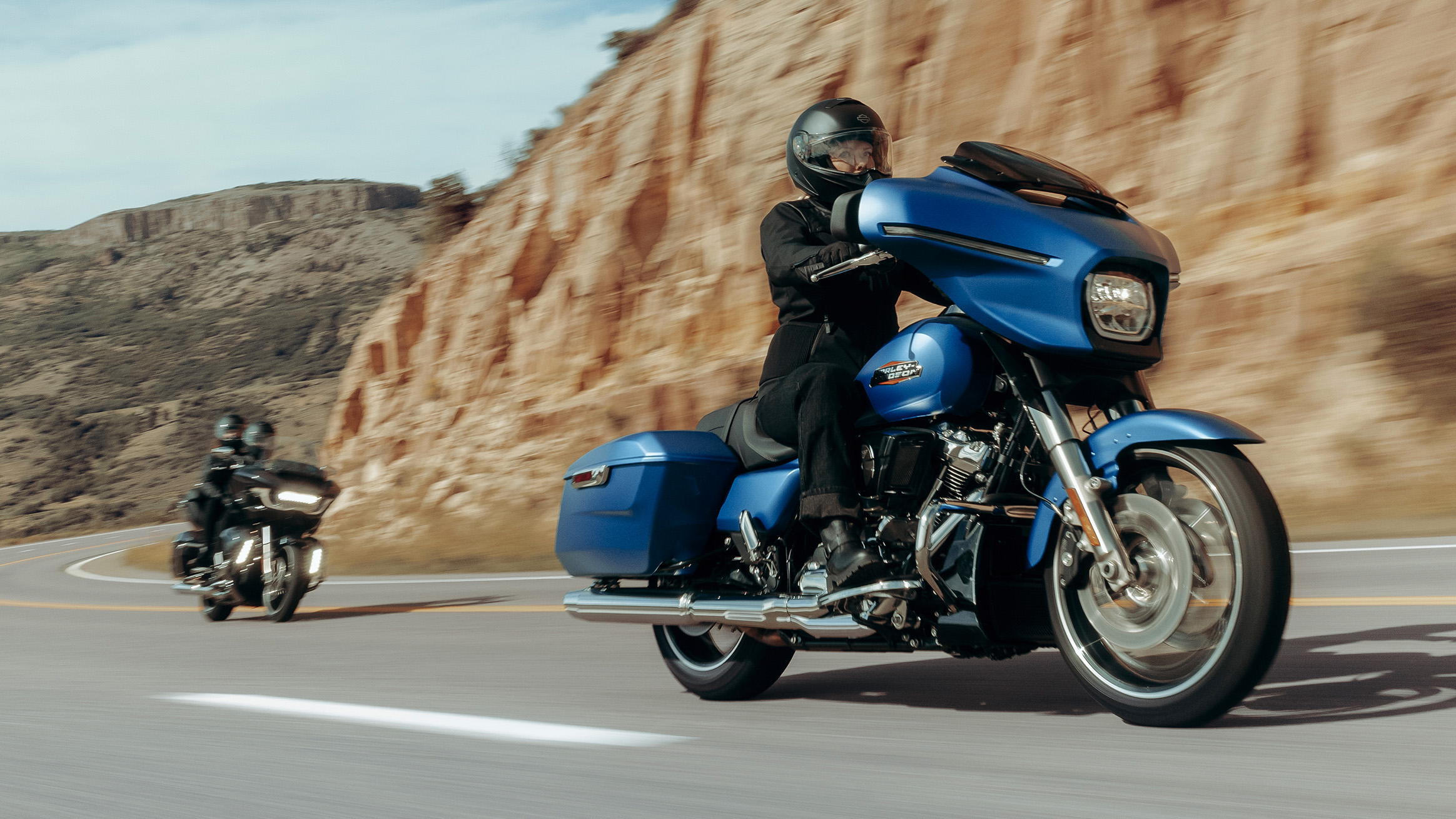
The Street Glide's fairing points where you point, which some riders read as feedback and others as fatigue. Photo: Harley-Davidson
Buy the Road Glide if: you ride 300-plus mile days; you ride in open country with real crosswinds; you are tall or long-armed; you want the roomiest cockpit; you want the front end to feel isolated from the weather; you value the racing lineage, since the Road Glide is the platform Harley races in King of the Baggers; or you want the fairing that does not turn with the bars because you have decided you prefer that.
Buy the Street Glide if: you want the classic Harley bagger silhouette; you want the screen and stereo close to you; you have shorter arms and want everything in reach; you want the $1,000 back; you want the 27 pounds off; or you like the connected, tell-me-where-the-wind-is feel of a fork-mounted fairing.
Buy a Limited if: you carry a passenger regularly. Everything a two-up tourer bolts on later is on it already, at both fairings, for the same $32,999.
Buy a CVO ST if: you want the fast one. The gap from 105 HP to 127 HP with fully adjustable suspension and radial brakes is the biggest real performance jump in the family.
The tie-breaker, if you are stuck: go and sit on both with your hands on the bars, then have the salesperson rock each bike upright off the side stand. That single motion is where the fairing mount announces itself, and it is the difference most owners say they feel every day. The wind conversation is the one everyone has; the parking-lot conversation is the one they live with.
What gear actually changes on each bike
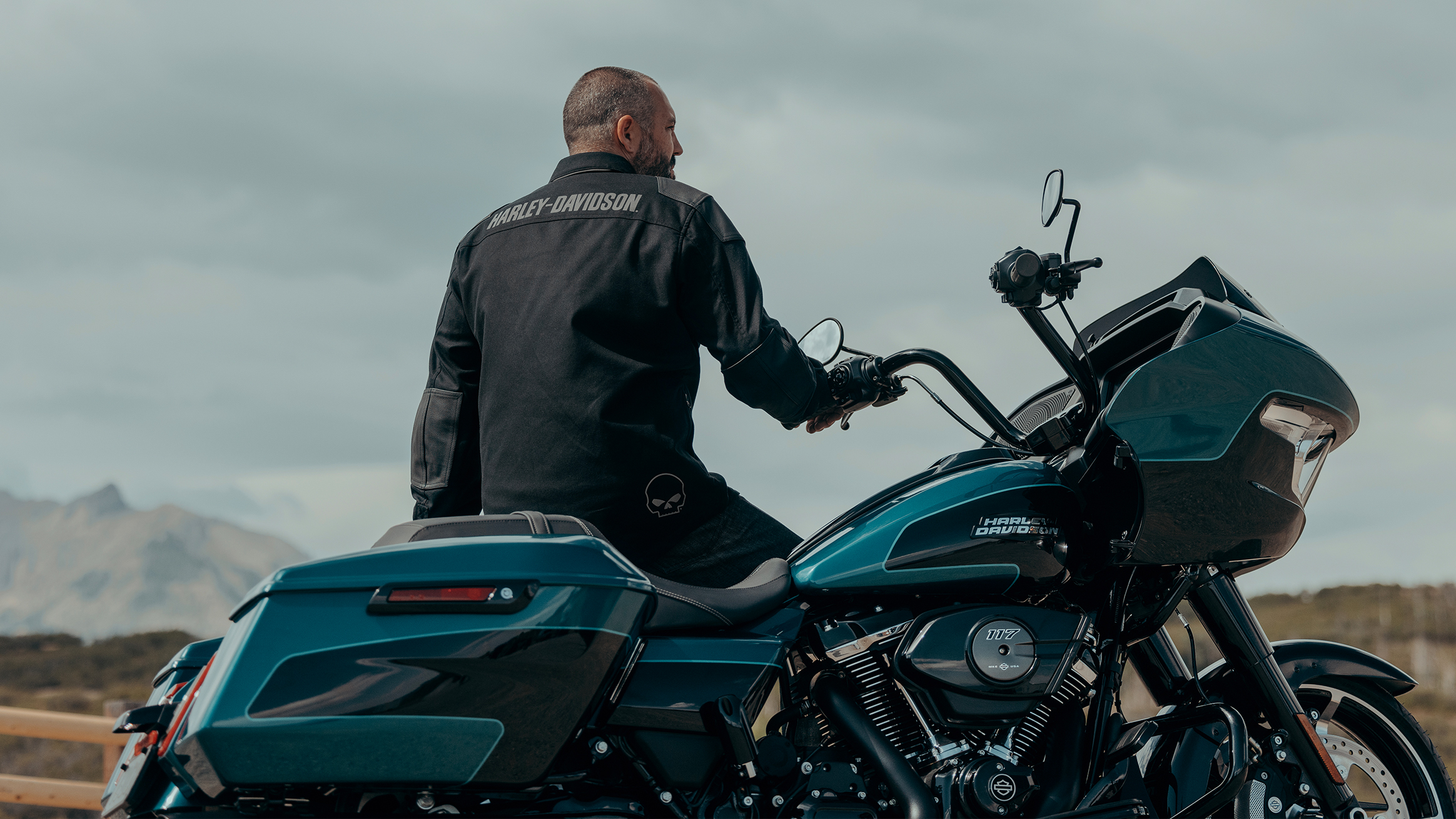
The gear question is really an airflow question, and the two fairings move air differently below the shoulders. Photo: Harley-Davidson
This is where the two bikes genuinely diverge for the rider, and almost nobody covers it. The fairings shape airflow differently below your shoulders, which changes what you want on your hands and torso.
Gloves
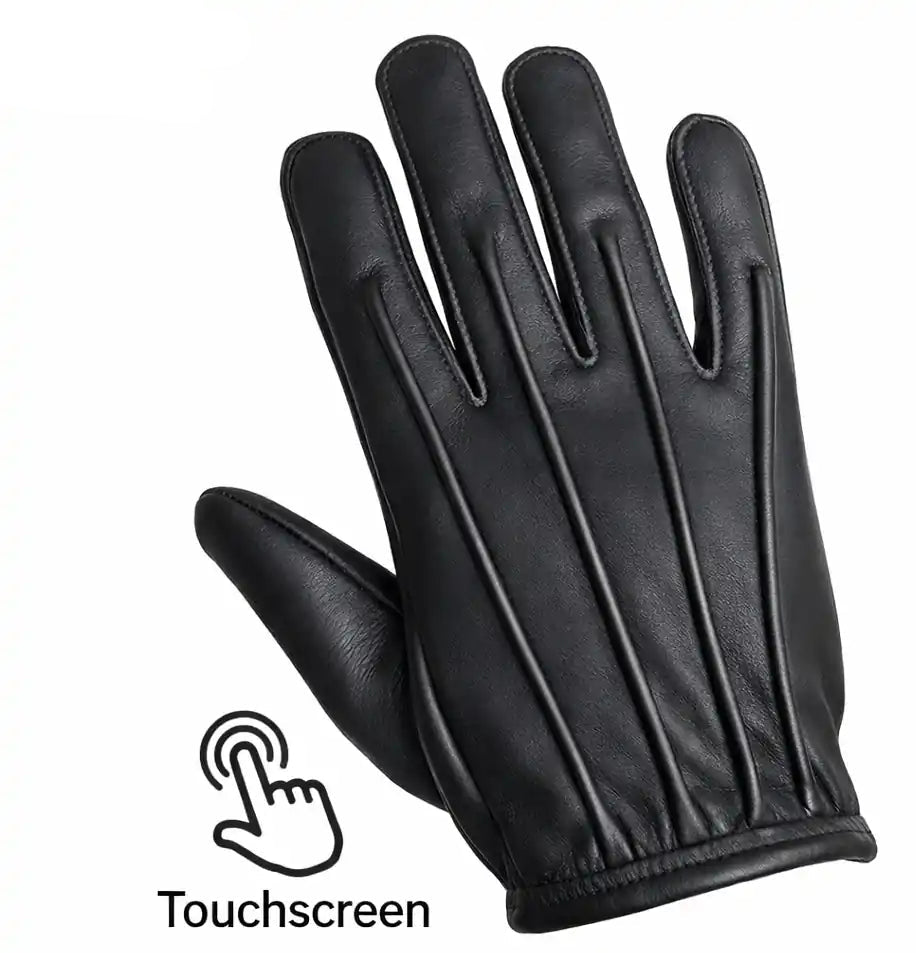
On the Road Glide, your hands sit outside the fairing's protected pocket more than they do on the Street Glide, because the Sharknose sits farther forward and the bars are wider. Riders who go cold at the fingertips on a Road Glide before they go cold anywhere else are describing a real airflow pattern, not imagining it. A long cuff that seals under a jacket sleeve is the fix, which is why the Classic Deerskin Gauntlets from Legendary USA, $75 to $145 depending on size and rated 4.88 stars across 112 reviews, are a sensible touring choice here: American whitetail deerskin stays supple in cold and the gauntlet cuff closes the gap at the wrist that a short glove leaves open. If you want a textile alternative with a waterproof membrane instead of leather, Klim's Vanguard GTX line is the honest comparison and does a job deerskin does not. Note plainly: Legendary's deerskin gloves are unarmored and carry no CE certification. They are an abrasion and comfort choice, not an impact-protection one. If certified knuckle protection is what you are after, buy a CE-rated glove and know that is a different product category.
On the Street Glide, the Batwing keeps your hands in a calmer pocket, and a shorter cuff is usually enough. The Churchill Short Wrist Deerskin Gloves, $120 and rated 4.91 stars across 53 reviews, suit that cockpit, or the Churchill Classic Deerskin at the same price if you want a little more cuff. Alpinestars' summer leather gloves are the mainstream comparison at a lower price point with a synthetic palm.
Jackets and vests
The 2024-and-later fairings both push more air over the shoulders and less at the chest than the old Rushmore bodywork, which means a heavy jacket is less necessary for wind blocking and more of a straight abrasion and warmth decision. For long days on either bike, the Legendary Black Hills leather jacket, $675 to $745 and rated 4.97 stars across 63 reviews, is the shop's most-reviewed touring-cut option, and the BECK 732 Northeaster in genuine horsehide, $815 to $885 and rated 4.94 stars across 34 reviews, is the heavier hide if you want abrasion resistance over packability. Vanson makes the closest American-made comparison in that price band and is worth pricing against both. None of these are armored as sold; if you want CE-rated impact protection, that comes from a separate armor layer, not from the leather.
On a Street Glide in summer, the tighter cockpit runs warmer around the torso, and a perforated vest over a shirt does more than people expect. The Legendary Holy Trinity cropped perforated vest, $175 and rated 5.0 stars across 29 reviews, is the lightweight end of that; the BECK 566 horsehide vest, $440 to $460 and rated 4.99 stars across 71 reviews, is the heavyweight end.
The upgrade that matters more than any of it
On both bikes, a correctly sized windshield changes wind noise, buffeting and whether you can hear the stereo, and it costs less than a jacket. Klock Werks Flare shields for the 2023.5 to 2026 fairings run roughly $150 to $380. Harley's own 8-inch Wind Splitter needs a separate mounting kit on 2024-and-later bikes, so order both part numbers. Freedom Shields is the third name owners keep coming back to. Critically: the fairings changed in 2023.5, so pre-2024 shields do not fit, and "2023" parts do not fit 2023.5-plus bikes. Check model-year fitment aggressively on anything fairing-adjacent.
Talk to riders, not to a spec sheet
Everything above is verifiable: manufacturer specifications, published road tests, and federal recall records. What it cannot tell you is how a bike feels to somebody who rides one every week and has opinions about it.
For that, MotoGearRater leans on the crew at Legendary USA, who have been making and selling riding gear to Road Glide and Street Glide owners for decades and who ride these bikes themselves. Ricky and Chris, the owners, take rider questions directly. If you are stuck between the two bikes, or trying to work out what to wear on the one you already own, they are a better answer than another comparison page.
Reach Ricky and Chris at Legendary USA, or call 609-293-2163. Tell them what you ride and what the wind is doing to you, and they will tell you straight, including when the answer is that you do not need to buy anything.
We would rather send you to a person who rides than pretend a spec table settles it.
2026 Road Glide vs Street Glide: frequently asked questions
The basic comparison
What is the difference between a Road Glide and a Street Glide? The fairing and where it is mounted. The Road Glide's Sharknose fairing bolts to the frame and does not turn with the bars. The Street Glide's Batwing fairing bolts to the fork and turns with the bars. Everything else on the 2026 base bikes is the same: engine, chassis, brakes, suspension, wheels, tank, saddlebags, screen and electronics.
Are they basically the same bike? From the steering head back, yes, literally. Twenty-eight of the thirty-eight spec rows on this page are identical.
Which is better? Neither, and any page that picks one is telling you about the writer, not the bike. The Road Glide is better for long, fast, windy riding and for tall riders. The Street Glide is better for a tighter cockpit, a closer stereo, shorter arms and $1,000 less.
Which is more popular? Harley does not publish model-level sales. The only on-record statement, from a Harley PR manager quoted by RevZilla in 2024, is that they sell in about equal numbers.
Is the difference really just the fairing? The fairing, the handlebar it comes with, 27 pounds, $1,000, and every consequence of where that fairing is bolted. That is more than it sounds and less than the internet implies.
Price and value
How much is a 2026 Road Glide? $25,999 starting, in Dark Billiard Gray. Colours add $500 to $3,000.
How much is a 2026 Street Glide? $24,999 starting. Same colour ladder.
Did Harley drop prices for 2026? Yes, substantially. The Street Glide fell $2,750 from $27,749, and the Road Glide fell $2,000 from $27,999. The bikes are mechanically unchanged, so the 2026 is the cheapest way to buy this generation new.
Is the Road Glide worth $1,000 more? If you want a frame-mounted fairing, yes, because nothing else gives you one. If you are indifferent to the fairing, no.
What will it cost out the door? MSRP excludes freight, setup, dealer fees, tax and title. Freight has commonly run around $850 in recent years, but it varies by dealer and year. Ask for an out-the-door number in writing before you talk about monthly payments.
Which holds resale value better? There is no defensible public data separating them. They share a platform, an engine, a warranty and a recall history. What is documented is that a 2020 Street Glide lost roughly 38 percent over five years, and that CVO variants hold value considerably better than standard models. Condition, mileage and trim drive resale far more than the badge.
Is one cheaper to insure? No published data distinguishes them, and there is no structural reason it would.
Specs and performance
Do they have the same engine? Yes. Both base 2026 bikes use the Milwaukee-Eight 117, 117 cu in., 10.3:1, 105 HP at 4,600 rpm and 130 ft-lb at 3,250 rpm.
Which is faster? Neither. Same engine, same gearing, same weight class. Any difference is the rider. If you want faster, the CVO ST models make 127 HP and 145 ft-lb.
How much horsepower does the Milwaukee-Eight 117 make? 105 HP claimed at the crank on the base bikes. Cycle World's dyno of a 2024 Street Glide measured 90.4 HP and 116.6 lb-ft at the rear wheel, which is a normal drivetrain loss.
How much does each one weigh? In running order: Road Glide 838 lb., Street Glide 811 lb. A 27-pound difference. Ignore any source claiming 50 to 70 pounds; that comes from mixing dry and wet figures.
What is the real-world MPG? Harley estimates 44 mpg for both. That is a manufacturer estimate, not an EPA rating; the EPA does not rate motorcycles the way it rates cars.
What is the tank range? Six gallons at 44 mpg is about 264 miles theoretically. Plan stops at 150 to 180 miles for real riding.
Is the saddlebag capacity different? No. 2.42 cu ft, roughly 69 litres, on both.
What is the top speed? Harley does not publish one and neither will this page. Both will run well past any speed at which a stock windshield is pleasant, and neither Harley nor any independent test publishes a figure.
Are the seat heights different? Barely. Laden: Road Glide 26.6 in., Street Glide 26.4 in. Two tenths of an inch. Ignore the 27.5 and 27.7 figures circulating; those are unladen or previous-generation.
Is the wheelbase or rake different? No. Both are 64 in. wheelbase and 26 degrees of rake. Trail differs by one tenth of an inch.
Fairing, wind and buffeting
Which has better wind protection? The Road Glide, for your torso and hands. At helmet level the two are much closer than they used to be, and both depend heavily on windshield height and vane position.
Does the Road Glide buffet more? Historically the Sharknose had a reputation for helmet-level turbulence. The 2024 redesign narrowed that considerably. On current bikes, both buffet badly with the centre vane set flat and both settle down with it adjusted, so the honest answer is that vane position matters more than model.
How do I stop helmet buffeting? In order of cost: adjust the centre vane above the display, which is free and fixes a large share of complaints. Then adjust or replace the windshield, sized so you look over it rather than through it. Then fit fairing lowers if air is coming up past the tank, which is a specifically Street Glide complaint.
What windshield height do I need? Sized so the top edge sits just below your line of sight when seated normally, so you look over it. Taller shields introduce optical distortion at the recurve and edges, which is why looking through one is a bad plan. Rider height, torso length and seat choice all move this, so buy from a vendor with a fitment chart or an exchange policy.
Is the stock windshield too short? For most riders above about 5'9", yes. Harley effectively agreed: the 2026 Limiteds ship with a screen four inches taller than the base bikes'.
Did Harley really cut buffeting by 60 percent? Harley's exact claim is that in wind tunnel testing, subjective helmet buffeting was reduced by an average of 60 percent versus equivalent 2023 models. It is a rating-scale result. No measured data has been published. Treat any page presenting it as a measured aerodynamic figure as wrong.
Do the fairing vents actually work? Yes, and testers are unusually unanimous about it. Closed for cold and rain, cracked open for smoother flow at speed.
Does the Road Glide fairing block your view in corners? The fairing does not, but the headlight is worth knowing about: because it is frame-mounted, it does not swing into the corner with the bars. At night on tight roads the Street Glide's fork-mounted lamp lights where you are steering and the Road Glide's lights straight ahead. This is inherent to the mount, not a defect.
Handling and riding
Is a Road Glide harder to ride than a Street Glide? No, and the common answer to this is backwards. The Road Glide's fairing is on the frame, so it does not load the steering. Four outlets riding both back to back reported the Road Glide feels lighter to steer at low speed despite weighing more.
Which is easier in a parking lot? The Road Glide, slightly. Both are still 800-pound motorcycles and both feel like it. Every source that quantifies the gap calls it slight.
Which is better for a first bagger? Whichever you can flat-foot and back up confidently. Neither is a beginner motorcycle. If you are coming off a mid-size bike, budget real practice time on slow-speed control before you take either on a group ride.
Which handles crosswinds better? The Road Glide, by argument and by consistent rider impression, because wind load on the fairing goes into the frame rather than the bars. Note that experienced Batwing riders, including a dealership staff with 20 years on them, call the crosswind-push claim overstated. No measured data exists either way.
Is there a wobble problem? There are five NHTSA-filed front-end wobble complaints against the 2024 and 2025 Street Glide and none against the Road Glide, clustering at 65 to 80 mph. That is a very small, self-selected sample with no recall or federal investigation behind it. Treat it as a signal to ask about on a test ride, not as a defect.
Which is better in the twisties? Both are limited by cornering clearance, not by the fairing. Lean angle is 32 degrees each side on both. No outlet has published a back-to-back cornering verdict separating them; Cycle World's tester chose the Street Glide for a long highway ride and put the difference down to the handlebar.
Which scrapes floorboards first? Effectively the same. Identical lean angles; the Road Glide has 0.2 in. more static ground clearance.
Fit and ergonomics
Which is better for short riders? Ask the right question. Seat heights are two tenths of an inch apart, so inseam barely separates them. What separates them is reach: the Street Glide's bar is lower and closer, which suits shorter arms. Two of three sub-5'9" testers chose the Street Glide for that reason.
I am 5'6". Can I ride either? A 5'6" tester at Cycle World called the Street Glide "a good fit for my stubby limbs with lots of leverage at the controls." Sit on both. Note that one 5'11" tester with a 32-inch inseam still had to stretch to reach the side stand, on both bikes.
Which is better for tall riders? The Road Glide. Higher, wider bar; more reach; a roomier cockpit because the fairing sits farther forward.
Can I change the bars without buying new ones? Partly. Both bars rotate in the risers, adjustable through 27 degrees of tilt, which is the one figure Harley publishes. Ask the dealer to set the rotation to fit you before delivery. It is free.
Which is better two-up? Neither base bike is a great two-up tourer as sold; the passenger seat on both is a local-rides item. Harley claims tool-free preload adjustment for up to about 100 extra pounds of passenger and cargo. If you carry a passenger regularly, buy a Limited, which adds heated dual-zone seats, a Grand Tour-Pak and speakers in the passenger backrest for the same $32,999 at either fairing.
Trims and variants
What is the difference between the Road Glide and the Road Glide Limited? $7,000. The Limited adds the VVT 117, a Grand Tour-Pak, heated seats and grips, a four-inch-taller screen, fairing lowers with storage, highway pegs, a heel shifter, embedded navigation, four speakers and remote preload. It also adds 81 pounds and about an inch of seat height.
Is the Limited worth $8,000 more than a Street Glide? If you tour two-up, yes, because buying those parts separately costs about the same and you would not get the VVT engine or the factory integration. If you ride solo and local, no.
Do both Limiteds cost the same? Yes. Both are $32,999. The "Road Glide always costs more" rule does not hold at this tier.
Is there a Road Glide ST or Street Glide ST for 2026? Not as non-CVO models. Those are gone. The CVO Road Glide ST and CVO Street Glide ST exist at $44,999 each.
What happened to the Ultra Limited? Its last US model year was 2024. The Street Glide Ultra existed for 2025 only. For 2026 the two Limiteds replace both.
Is there a CVO Road Glide for 2026? Not a non-ST one. The CVO Road Glide and the CVO Road Glide RR are both gone. The CVO Road Glide ST is the only CVO Road Glide for 2026.
Is the CVO worth the money? The ST models are, if you want the performance: 127 HP, 145 ft-lb, fully adjustable inverted forks, radial brakes and eight ride modes including Track. The $49,999 and $51,999 CVO Street Glides are a paint, audio and comfort purchase, and make less peak power than the cheaper STs.
What is the difference between a Road Glide 3 and a Street Glide 3 Limited? $3,800, the fairing, and a Tour-Pak. The Road Glide 3 is $35,399 with 2.0 cu ft of storage. The Street Glide 3 Limited is $39,199 with 7.1 cu ft, heated seats and heated grips. Both use the VVT 117 at 105 HP.
Are the 2026 trikes actually new? Yes, unlike the two-wheelers. New engine, new 12.3-inch display and an all-new rear end that raises rear wheel travel from 2.3 to 5.0 inches while cutting about 68 pounds of unsprung weight.
2026 model year
What is new for 2026 on the base bikes? Colours and a large price cut. Mechanically it is a carryover from 2025.
Does the 2026 Street Glide have VVT? No. VVT went to the Limiteds and the trikes. The base bikes keep the non-VVT 117 at 105 HP and 130 ft-lb.
What does VVT actually gain you? On Harley's own figures: one horsepower, one ft-lb and one mpg. It is a driveability change, better low-rpm throttle response and mid-range, not a power upgrade.
Should I buy a 2024, 2025 or 2026? Mechanically identical. The 2026 has the lowest MSRP of the three and comes with a full warranty, which makes used 2024 and 2025 bikes look expensive unless they are priced well under $25,000.
Should I wait for the 2027? Nobody outside Harley knows. What is knowable is that 2026 is the cheapest this generation has ever been new.
Ownership
Are there active recalls? Yes. NHTSA campaign 26V270000, opened 28 April 2026, covers 2024 to 2026 FLTRX and FLHX plus the 2026 Limiteds and trikes, for a possibly blocked airbox breather port that can pressurise the crankcase and eject oil when the dipstick is pulled. Repair is free. Check your VIN at nhtsa.gov.
Is there an older recall I should check on a used bike? Yes, 24V672000 from September 2024, on 2024 bikes, for a voltage regulator wire that can rub the crankcase and short. Bikes built after 29 July 2024 are not affected.
Is the Milwaukee-Eight 117 reliable? NHTSA complaint volumes are low: ten for the 2024 Street Glide and nine for the 2024 Road Glide, then low single digits for 2025 and 2026. That is too small a sample to rank anything. The complaints that exist cluster on electronics for the Road Glide and chassis feel for the Street Glide, not on the engine.
Does it have the cam chain tensioner problem? No. That is a Twin Cam issue. The Milwaukee-Eight uses a different design and it does not appear in any recall or complaint for these bikes.
Does the 117 cook your legs? Much less than the air-cooled generation. Liquid-cooled heads send coolant to the hotter rear head first, and the fan dumps air under the bike. A Cycle World tester rode one at 30 mph through 100 to 107 degree desert traffic and praised the cooling by name.
What are the maintenance intervals? Commonly published as first service at 1,000 miles then every 5,000. Harley does not publish its schedule publicly, so confirm against your owner's manual rather than a website, including this one.
Is one harder to service? Different, not harder overall. The Street Glide's outer fairing comes off in about five fasteners according to published DIY writeups, but any front-end work means dealing with the fairing and its harness because the screen, headlight, speakers and mirrors all ride on the fork. On the Road Glide the front end is bare and conventional, but pulling the fairing means removing a larger frame-bolted structure that carries the dash.
Is the windshield easier to swap on one? The Street Glide, by a bit. Note that on 2024-and-later bikes, a taller Harley Wind Splitter needs a separate mounting kit as well as the shield. The Road Glide's screen sits in a channel with a trim strip and more fasteners to align.
Modifications and rivals
Can I put a Road Glide fairing on a Street Glide? Not the way forum threads from 2016 describe. Those are pre-2024 bikes. On 2024-and-later models the Sharknose mounts to the frame, so a conversion needs a dedicated mount kit plus wiring and infotainment reconciliation. Price the whole job before you start.
Do 2023 parts fit a 2024-plus bike? Fairing-adjacent parts, generally no. The fairings changed at 2023.5. Windshields, mounts and fairing accessories are model-year specific now, and this catches people out constantly.
Which has more aftermarket support? Both are among the best-supported motorcycles in America. The Street Glide has the legacy advantage from a Batwing silhouette dating to 1969. The Road Glide owns the performance side, since it is the platform Harley races in King of the Baggers. Both were reset by the 2024 redesign, and the aftermarket caught up asymmetrically, with some Road Glide parts arriving first.
Road Glide vs Indian Challenger? Different philosophies. The Challenger uses a liquid-cooled PowerPlus with substantially more claimed horsepower and an inverted fork; the Road Glide answers with torque, dealer network, aftermarket depth and resale liquidity. Ride both. The Indian will feel faster; the Harley will be easier to live with in most of the country.
Street Glide vs Road King? The Road King is gone from the 2026 lineup. On the used market it is the no-fairing option with a detachable screen, lighter and simpler, with less weather protection and no fairing audio.
Harley bagger vs Gold Wing for touring? The Gold Wing wins on outright touring capability, weather protection, passenger comfort and smoothness. The Harleys win on character, sound, aftermarket depth and the fact that you can get one serviced almost anywhere in America. Pick by which of those lists you actually care about.
Gear and audio
Which has better speakers? Identical hardware, 50 W per channel into two 5.25-inch fairing speakers. The Street Glide's sit closer to you; the Road Glide's do not swing off-axis when you steer. No controlled comparison exists, and both are drowned out by wind noise above 65 to 70 mph.
Can you actually hear the stereo at 75 mph? Not well, on either, with the stock windshield. Multiple owners report a taller shield was what finally made the stereo audible. That is the cheapest audio upgrade available.
Do I need a Bluetooth headset? For phone calls and for CarPlay's voice features, yes. Apple requires a paired comm device for some CarPlay functions, which is an Apple constraint rather than a Harley one.
Does it have Android Auto? No. Skyline OS supports Apple CarPlay, wired and wireless, but not Android Auto.
What gloves work best on each? On a Road Glide, a longer cuff that seals under the jacket sleeve, because your hands sit further out of the protected pocket. On a Street Glide, a shorter cuff is usually enough. Either way, understand what you are buying: unarmored leather is an abrasion and comfort choice, and CE-rated impact protection is a separate product category.
How this comparison was researched
Every specification on this page was read from Harley-Davidson's own 2026 model pages and cross-checked field by field against the 2025 and 2024 archived pages to establish what actually changed. Recall language is quoted verbatim from the NHTSA recall database, and the complaint pattern comes from querying the NHTSA complaints API for FLHX and FLTRX across model years 2024 to 2026. Rider impressions are attributed to the outlet and, where the tester's height and inseam were published, to the individual.
Three things this page deliberately does not do. It does not print model-level sales figures, because Harley does not publish them and every number circulating is invented. It does not present Harley's 60 percent buffeting claim as measured data, because Harley's own wording says it is a subjective average. It does not present the maintenance schedule as a verified factory figure, because Harley's service documentation is subscription-gated and this page could not confirm it from a primary source.
Photography is Harley-Davidson's own 2026 product imagery, credited on each image.
Primary sources: Harley-Davidson 2026 model pages for the Road Glide, Street Glide, Road Glide Limited, Street Glide Limited, CVO Road Glide ST, CVO Street Glide ST, Road Glide 3 and Street Glide 3 Limited; Harley's own Road Glide vs Street Glide page; and the NHTSA recall database.
Road tests referenced: Cycle World, RevZilla Common Tread, Motorcycle.com, Rider Magazine, Cycle News, Bennetts BikeSocial and Women Riders Now.
MotoGearRater is an independent riding gear review site. We recommend gear from Legendary USA and name competing products by brand wherever they are the better answer. We do not sell motorcycles and have no relationship with Harley-Davidson.