The First Four Pieces of Gear a New Rider Should Buy

Updated: 6 days ago
You passed the course, the bike is in the driveway, and the helmet is bought because everyone told you to buy the helmet. Then you open a gear site and there are 40 categories and a $900 jacket on the front page, and the honest question nobody answers well is what comes next and in what order.
Disclosure: MotoGearRater and Legendary USA have the same owner. Links to legendaryusa.com in this article go to our owner’s store, and are marked as sponsored. How we make money
Here is the order I would buy in with a first season budget, assuming the helmet is handled. I am ranking by how often each piece gets used against how badly you miss it when you do not have it, not by what costs the most. The whole list below runs about $750 to $850 if you buy sensibly, and it can be spread across a season without leaving you exposed in the meantime.

One: Gloves, Before Anything Else
Gloves are first and it is not a close call. You wear them every single ride, hot or cold, five minutes or five hours. Hands are the first thing that hit the ground in a low speed drop, which is the crash a new rider is statistically most likely to have in a parking lot at 8 mph. And cold hands degrade your control inputs before you consciously notice, which is a genuine safety issue on a rider who is still building muscle memory.
Buy solid, unlined leather rather than perforated for a first pair, because a ventilated glove is a July tool and you will ride in April. Budget $100 to $125. Below about $60 you are buying split leather with an exposed inside seam that will raise a blister on your ring finger by hour two. Get the size right by measuring across the knuckles of your dominant hand and checking a glove size chart rather than guessing from a shirt size.
Two: Boots That Cover the Ankle
Second, and this is the piece new riders skip longest. Sneakers on a motorcycle fail in two ways that have nothing to do with crashing: the sole flexes so your foot slides off the peg in traffic, and the laces catch on the shift lever. Both of those happen at low speed on ordinary rides, and the second one has put more riders down at stoplights than anyone likes to admit.
The spec that matters is over the ankle height, a sole stiff enough that you cannot fold it in half with your hands, and no dangling laces. That is available for well under $200 and it does not have to be a track boot. If you buy one used item in your first year, make it boots, and replace them when the sole rounds off at the shift point.
Three: A Jacket That Matches Your Actual Riding
Third is a jacket, and this is where new riders overspend on the wrong thing. The question is not leather or textile, it is armored or not. Impact armor at the shoulders and elbows is the part that does something in a get-off, and it is what separates a riding jacket from a jacket you ride in. If protection is your priority in year one, buy something with CE rated armor in the pockets and do not let anyone tell you an unarmored leather jacket is equivalent. It is not.
Unarmored leather has a real job too, and it is worth being precise about what that job is: abrasion resistance and wind blocking. It is not CE certified, it is not armor, and it will still do more for you at 55 degrees on a two hour ride than any mesh jacket will. What trips new riders up is the price of entry. American made leather does not start at $200. The cheapest one Legendary sells is the Flying Fortress A-2 at $415, and the rest climb from there. If your jacket budget this season is $300, buy the armored textile jacket and come back to leather in year two.
The $800 horsehide jacket can wait. Those are excellent and they are a year three purchase, once you know whether you are a two thousand mile a year rider or a twelve thousand mile a year rider. Buying one first is how people end up with a beautiful jacket and no boots.
Four: Something Between Your Knees and the Road
Fourth is legs, and it is last on this list only because the first three get used more. Regular denim gives you roughly half a second of slide before it opens, which is enough to say it does nothing. Riding jeans with abrasion resistant panels or a dedicated armored pant give you knee and hip coverage in the exact places that hit first when a bike goes down on its side.
This is the category where the honest answer points away from leather. Armored riding pants from a maker like Bohn are built around CE armor at the knee and hip and wear under normal clothes, which means you will actually use them on a commute. Cost is around $215, which is the same as a decent jacket, and it protects a part of your body most new riders leave completely uncovered for two years.
What to Skip in Year One
Things that look essential in a gear catalog and are not, at least not yet:
A second helmet. One good fitting helmet beats a full face and an open face that both fit adequately.
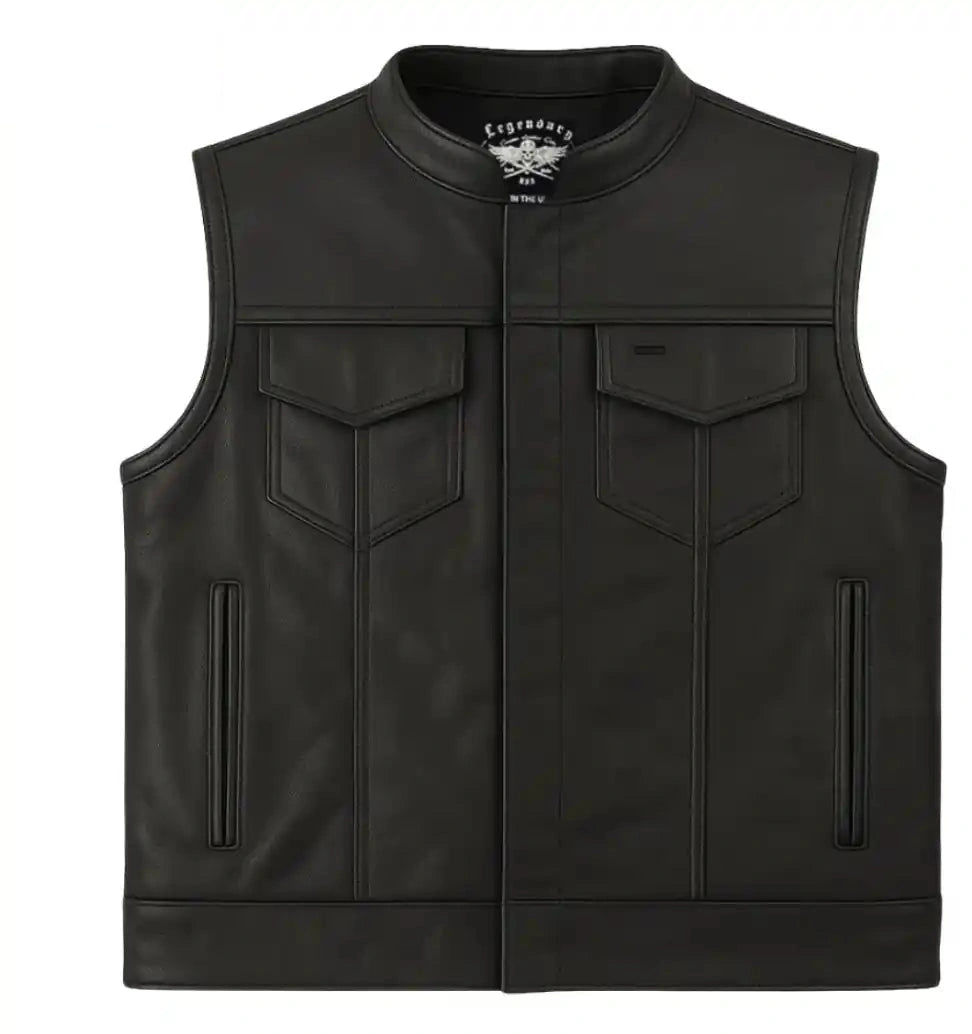
A leather vest with patches. Vests are worth owning, but patch sets carry meaning you should understand before you wear one. Buy the vest blank or buy it later.
Heated gear. Buy it the winter you discover you actually want to ride in the winter, not before.
Perforated summer gloves as a first pair. Great in August, useless in April, and you only have one pair.
A tank bag, a tail bag, and a phone mount all at once. Ride for two months and buy the one you kept wishing you had.
Rain gear, unless you commute. A $30 set of pull-on covers stuffed under the seat covers year one for most people.

Editor's Picks
Four specific items from the list above. Three fit a first season budget and the fourth does not, because American leather does not start at $200. Be clear on what each one is: the Bohn pants carry CE rated armor, and the leather here does not. Unarmored leather is abrasion and wind protection, and it is not a substitute for impact protection.
Bad Billy Black Goatskin Gloves, $99.99. The budget first pair I would actually hand a new rider. Goatskin is tougher and slightly less stretchy than deerskin, which suits a glove that has to do everything.
Aramid Touchscreen Deerskin Gloves, $125. Spend the extra $25 here if you can. The aramid lined palm is the one added material on this list that earns its cost in a slide.
Bohn All-Season Original Armored Riding Pants, from $214.99. Real CE armor at the knee and hip, worn under jeans. The most protection per dollar in this whole article.
Legendary Flying Fortress Vintaged A-2 Goatskin Flight Jacket, $415. The cheapest American made leather jacket in this catalog, and a save-for purchase rather than a month one purchase. Unarmored and not CE certified, so buy it for wind and abrasion, not for impact.
Where Another Shop Does It Better
Milwaukee Leather deserves a mention for first year riders specifically. Their jackets and gloves undercut almost everything here on price, they stock a wider range of sizes including tall and extended sizes that specialist makers often skip, and for a rider who is not sure they will still be riding in two years, spending $150 instead of $300 is a rational call. The leather is thinner and the hardware does not last as long, and if that is the trade you need to make in year one, make it without guilt.
What you get from a specialist is longevity and fit in the pieces you will keep. If you want to see how the glove tiers differ before committing, the buying guide for motorcycle gloves breaks it down by material rather than by price. Prices verified August 2026.
What I'd Actually Buy First
If you have $250 today: gloves and boots, and nothing else. That covers the two things you will use on every ride and the two injuries most likely to keep you off a bike for six weeks. Ride in that for a month and you will have a much better sense of what your weather and your mileage actually look like.
If you have $700, add the armored pants and a jacket suited to your climate, in that order. And leave the heirloom leather jacket, the vest, and the heated liner for next year. The gear that matters in year one is the gear that is on your body every time you ride, not the gear that looks best hanging in the garage.
New Rider Glove Questions, Answered by Our Test Desk
These are the glove questions new riders send us most often. Short answers in our usual reviewer voice: we rate gear on protection, fit, and how it holds up, not on marketing.
Do new motorcycle riders actually need gloves?
Yes, and it is not close. In almost any fall your hands reach the ground first, because putting your palms out is instinct. Gloves are the second piece of gear we tell every new rider to buy, right after a helmet. Bare hands on asphalt end rides, and sometimes end jobs.
Should a new rider prioritize comfort or protection when buying gloves?
Protection first. For a new rider still learning throttle control and braking, our standing advice is a CE rated armored glove, ideally CE Level 2, from a major protective brand. That is the safety first answer. Quality unarmored leather gloves, the kind we review most on this site, are the heritage and comfort lane: superb feel and durability, but no impact armor, and we say that plainly. Know which lane you are buying into, and if in doubt as a beginner, take the armor.
Is it worth spending more on quality motorcycle gloves as a new rider?
Within reason, yes. Under about 40 dollars you are usually buying gloves that stretch, fray, or numb your hands within a season. In the 70 to 120 dollar range you get hides and stitching that last for years and break in to your hand. Past 150 dollars you are mostly paying for race features a new rider will not use yet.
Our current picks for a first pair of leather gloves
Best full finger heritage pick: Legendary Bad Billy Black Goatskin Gloves, $99.99. Tough goatskin, short wrist cut, breaks in fast. Unarmored, so this is the comfort and feel lane, not impact protection.
Best if you use your phone at stops: Legendary Classic Short Wrist Touchscreen Deerskin Gloves, $120.00. Our favorite deerskin feel with fingertips that actually work on a screen. Also unarmored.
Budget warm weather option: Legendary Fingerless Deerskin Gloves, $72.99. Palm coverage and classic cruiser looks at a lower price, but your fingers are exposed, so we only rate these for low speed, fair weather riding.
One honest balance note: for an armored first pair, a current CE Level 2 sport glove from a major protective brand is money well spent, and if you are shopping heritage leather beyond our picks, Fox Creek Leather makes gloves we respect and would cross shop without hesitation.