


Flight Jackets on a Motorcycle: What Works and What Doesn't

Updated: 5 days ago
An A-2 is cut to end at your natural waist. Sit on a bike with your arms out on the bars and your natural waist moves roughly two inches up and back, and the jacket goes with it. At 65 mph the gap between that hem and your belt line turns into a scoop. I have ridden a horsehide A-2 through four Octobers and the failure is always identical: chest and arms perfectly warm, small of the back freezing, and by mile forty I am riding with my elbows pinned in to hold the hem down.
Disclosure: MotoGearRater and Legendary USA have the same owner. Links to legendaryusa.com in this article go to our owner’s store, and are marked as sponsored. How we make money
Flight jackets do work on a motorcycle. They were designed for open cockpits and unheated bomber compartments, and the hide in a decent reproduction is heavier than what goes into most modern textile riding gear. But they were cut for a man sitting upright with a harness across his chest, not for someone folded over a set of bars. Knowing which parts of that pattern fight you is the difference between a jacket you keep for fifteen years and one that goes in the closet after two rides.
The Hem Is the Whole Problem
Every military flight jacket in the A-2 and G-1 family ends in a knit waistband two to three inches deep. That band was there to seal against a flight suit and to keep the jacket from bunching under a parachute harness. On a bike it has one job and one failure mode. If the knit still has tension it grabs your waist below the belt line and the jacket stays sealed. If the elastic has gone soft, and on a vintage piece or a heavily worn repro it will, every mile of highway air goes straight up your back.
Test it the way you will use it. Zip it, lean forward with your hands about shoulder width apart at chest height, and watch the hem. If the waistband lifts clear of your belt, that is what happens at speed, and no amount of layering fixes it. It helps to wear a shirt that stays tucked underneath, so the jacket seals against something rather than two loose hems riding up together.
What the A-2 Cut Does and Does Not Give You
The A-2 has a shirt-style collar with snap-down points, two flapped patch pockets, epaulets, and a zipper with no storm flap. Read that list as a rider and three things follow.
First, the collar does almost nothing above 50 mph. It is a lay-flat collar, not a wind stop, and it will beat against the bottom of your helmet unless you snap the points down. Second, the patch pockets sit too high and forward to warm your hands. Third, that unflapped zipper is a straight seam of cold air down the centerline. On a 45 degree morning I feel it as a distinct cold line on my sternum.
What the A-2 does give you is the best sleeve geometry of any classic cut. The armhole is high and the sleeve is set with real room at the bicep, so reaching forward does not drag the body of the jacket up with it. It was cut for men reaching overhead switch panels. Hide weight matters too: goatskin at 1.0 to 1.2mm breaks in fast and stays supple in cold, lambskin is softer on day one and thinner in year ten, horsehide is stiffest for the first 500 miles and the one still standing at year fifteen.
The G-1 Collar Is a Real Trade
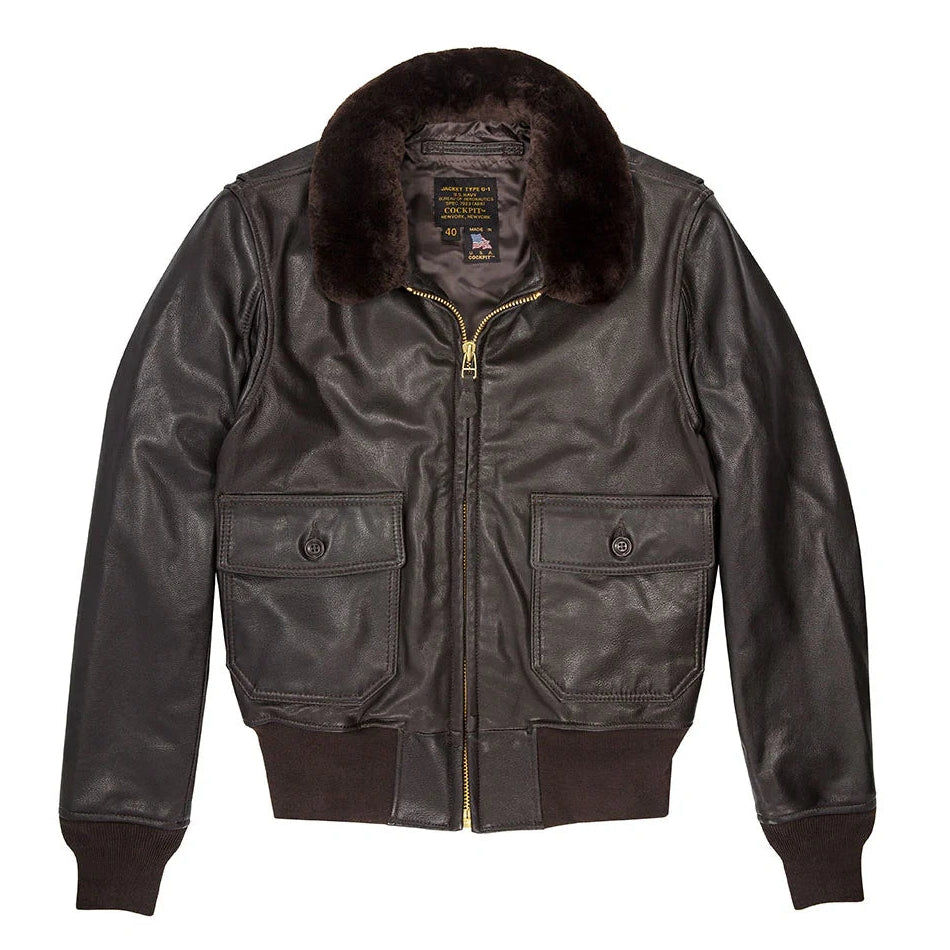
The Navy G-1 swaps the shirt collar for a mouton fur collar and adds a bi-swing back. Those two changes pull in opposite directions for a rider.
The bi-swing back is a genuine gift. Those two vertical pleats across the shoulder blades let you reach for the bars without the jacket binding, which is the most common complaint about wearing a fitted leather jacket on a bike. If you ride anything with a forward lean, the G-1 body is more comfortable than an A-2 body in the same chest size.
The mouton collar is the complication. Standing still on a 35 degree morning it is the warmest collar made. At 70 mph it becomes a sail, catching air and buffeting against your helmet at about minute six. It also soaks water and takes a full day to dry. My rule: the G-1 is the better jacket under about 55 mph, and the A-2 is the better jacket for a slab run.
What a B-3 Is Actually For
The B-3 sheepskin bomber is the jacket people romanticize most and ride in least, so it is worth being blunt. It is a sheepskin shell with the wool left on the inside, built for gunners standing at an open waist window where the air was 40 below and nobody was moving much.
Two of those facts hurt on a bike. The bulk is enormous and it sits at the shoulder and upper arm, so reaching for bars on anything with a forward lean is genuinely restricted. And the wool loft compresses to nothing wherever your back meets a seat back. On the credit side, at 20 degrees on a slow country road it is the warmest thing you can put on your torso without plugging into the bike.
So the honest read on the B-3, including the Cockpit USA version at from $1,450, is that it is a spectacular cold-weather coat that happens to be wearable on a motorcycle at moderate speed, not a riding jacket that happens to be warm. Buy it because you want it. For sustained highway cold, a layered horsehide jacket over a wind-blocking base layer beats it.
Sizing One for a Riding Position
Flight jackets are sized to a chest measurement taken standing up with your arms down. That is not how you ride. Here is the fitting-room checklist I use, in order.
Zip it fully, then lean forward into a riding posture. If the back binds across the shoulder blades, go up a size or move to a bi-swing back cut.
Check the hem against your belt. It should sit at or below the top of your jeans in that leaned position, not above it.
Reach both arms straight forward. The cuff should not retreat more than an inch up your wrist. If it does, the sleeve is short and gloves will not bridge the gap at speed.
Wear the layer you actually ride in. Sizing over a t-shirt and then adding a flannel in November is how people end up with a jacket they cannot zip.

Editor's Picks
Cockpit USA is a separate brand that Legendary USA carries as a dealer, and it is the maker worth knowing here because it builds to the original military patterns rather than a fashion interpretation of them. One thing to say plainly first: these are unarmored leather with no CE certification. They are abrasion and wind protection, not armor. The full Cockpit USA lineup at Legendary runs wider than the three below.
Cockpit USA Horsehide A-2 Flight Jacket, from $755. The one I would ride the most miles in, because horsehide takes the wind and the years better than anything else in the lineup and the A-2 sleeve does not fight the bars.
Cockpit USA USN G-1 Mil-Spec Goatskin Flight Jacket, from $685. Pick this if your riding is town speed and back roads. The bi-swing back is worth real money and the mouton collar earns its keep below 55 mph.
Cockpit USA 21st Century A-2, Black, from $610. The sensible entry point. Goatskin breaks in inside a couple of weekends and the black finish reads less costume than brown if you are not going for the period look.
Where a Flight Jacket Loses
Aero Leather does historically accurate reproduction better than anyone, with pattern research and hide sourcing that goes deeper than the commercial makers, and for a museum-correct 1943 A-2 they are the ones to call. They also take months. And if what you want is protection rather than heritage, a modern armored jacket from Alpinestars will do things no flight jacket can do.
If the actual goal is a purpose-built American riding jacket rather than a flight jacket, that is a different aisle. The BECK 732 Northeaster horsehide jacket is built on 1.3mm front-quarter horsehide by a maker that has been at it since 1928, with a hem length and a collar drawn for a motorcycle from the start. Prices verified August 2026.
What I'd Actually Buy
If you ride mostly highway and you want one flight jacket for the next fifteen years, buy the horsehide A-2 in a size where the waistband seats below your belt when you lean, and plan on a season of break-in before you judge it. If your riding is short hops and cold mornings at town speed, the G-1 is the more comfortable jacket and the collar stops being a liability. Keep the B-3 on the list only if you already own a real winter riding solution.
Whichever way you go, add a tin of leather conditioner to the same order and use it at the end of the first wet season, not the third. Flight jacket leather is thinnest at the shoulders where the sun hits it, and that is where a neglected jacket cracks first.


