


How to Break In a Stiff Leather Motorcycle Vest
- Kim Alberto

- Jul 29
- 6 min read
Updated: Aug 10
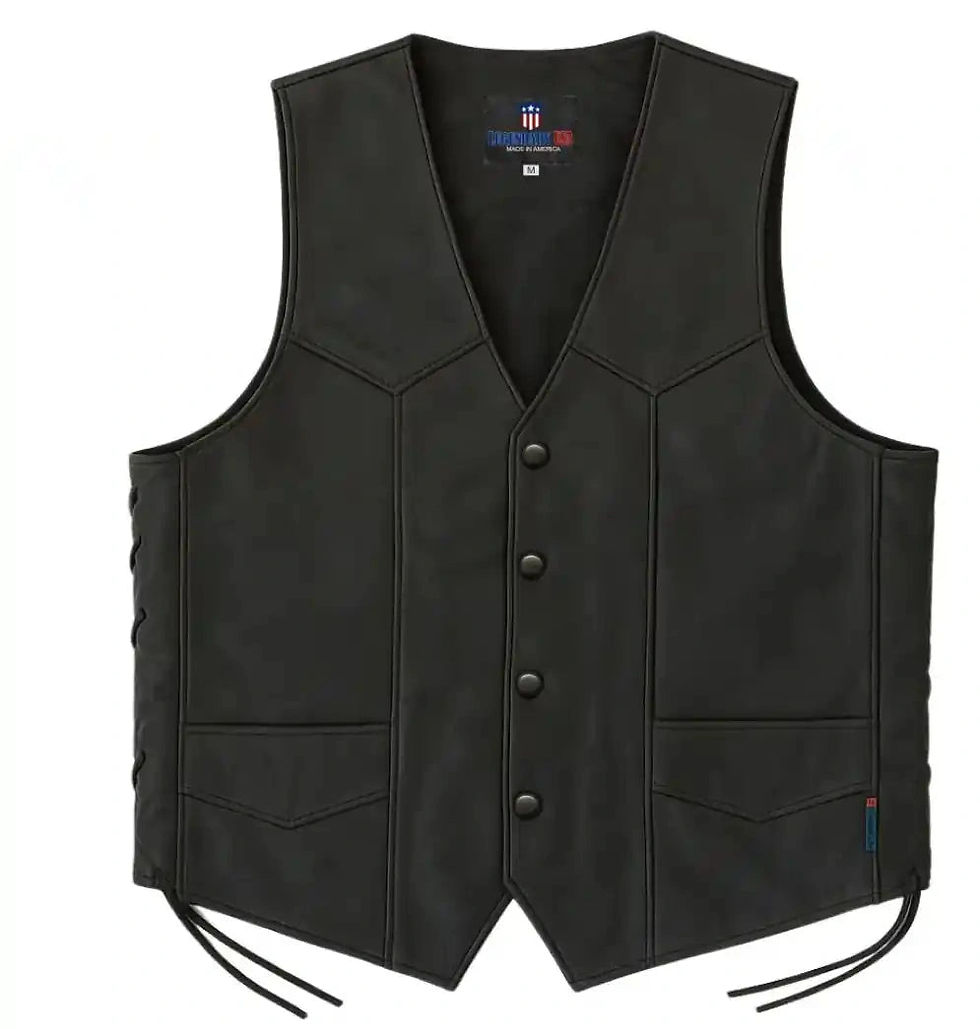
A new leather club vest does not drape. It stands. Mine sat off my chest by a good half inch at the placket, the armholes dug into the back of my shoulders every time I reached for the bars, and the back panel creaked when I turned my head to clear a lane. That is normal behavior for 1.2mm to 1.4mm cowhide. It is not a defect and it is not a sizing error. The hide was tanned, dyed, and cut flat, and it has never once been asked to bend in a specific place.
The real question is how long it takes and what actually helps. Break-in is measured in wearing hours, not in tricks, and most of the tricks people repeat in forum threads cost you either the finish or the fit. I have broken in six vests over fifteen years and wrecked one with a well meaning shortcut.
What Break-In Actually Is
Leather does not stretch evenly like a knit sweater. The collagen fiber bundles compress and realign only where you repeatedly flex them, under warmth and pressure. A vest does not get bigger during break-in. It gets shaped. If it was too tight in the chest on day one, it will still be too tight in month six, just with softer armholes. Fit problems do not resolve themselves, which is why the vest size chart matters more than anything you do afterward.
A vest breaks in at five places: both armholes, the shoulder yoke, the back panel just above your belt line, and the front placket where snaps or lacing pull. Everywhere else stays about as stiff as the day it arrived. That is fine. You do not bend there.
The Real Timeline in Wearing Hours
I started counting hours because the advice online is either "a couple of rides" or "a couple of years" and neither helps anybody. Tracked across three vests, the pattern held closely enough to write down.
Convert that to your calendar. Two hours every Saturday is roughly 100 hours across a riding season, so a weekend rider is looking at one summer. A commuter with a 40 minute round trip clears 100 hours in six to eight weeks. Weight shifts it too: a 1.2mm cowhide vest around $125 to $180 lands at the fast end, while a dense horsehide vest takes 140 to 160 hours before it stops arguing with you. Thinner softens quickly and wears out sooner. Heavier costs you a season and then lasts twenty years.
0 to 10 hours: still standing off your torso. Snaps take two hands. The collar will not lie down. Nothing has changed and you will be convinced you ordered the wrong size.
10 to 25 hours: the armholes give first. You stop noticing them when you reach forward. This is the biggest single comfort jump and it arrives sooner than most people expect.
25 to 60 hours: the back panel starts following your shoulders instead of fighting them. The placket stops standing proud when the vest is fastened.
60 to 100 hours: broken in. The leather takes a set to your posture, creases stay where you put them, and the vest holds your shape when it is hanging on a chair.
What Actually Speeds It Up
None of this is dramatic. Together these habits cut the timeline noticeably, and none of them put the hide at risk.
Wear it in 70 to 85 degree weather. Body heat is the softening agent. A vest worn in October at 45 degrees barely moves. The same vest in August traffic softens twice as fast.
Wear it over one layer, not three. A t-shirt puts your body heat right against the lining. A hoodie plus a flannel insulates the leather from the only heat source that matters.
Fasten it every single time. An unsnapped vest flaps and creases at random. A fastened vest takes a set around your actual torso, which is the entire point.
Work the armholes by hand while you watch television. Roll the leather over itself, thumb against forefinger, along the seam and the shoulder curve. Ten minutes twice a week. This is the one manual technique that does anything.
Hang it on a wide wooden hanger, never a wire one. Wire leaves two permanent shoulder dents that never come out and look exactly like what they are.
The Conditioning Mistakes
I ruined a vest by conditioning it in week one. A new vest already carries tanning oils. Piling a heavy conditioner on top does not soften the fibers, it fills the surface, and you end up with a vest that is heavier, slicker, two shades darker than the product photo, and no faster to break in. The darkening does not reverse.
The schedule that has worked for me: nothing at all for the first three months unless the vest got soaked. After that, a thin coat of Obenauf's Heavy Duty LP, from $15.99, twice a year in spring and fall. Amount matters more than brand. A fingertip's worth covers an entire back panel. If the leather still looks wet ten minutes after application, you used too much, and the excess just sits there collecting road grit.
Skip the household improvisations. Mink oil is heavier than most vest leather wants and softens structural seams over time. Olive oil goes rancid inside the fibers and you will smell it within a year. Saddle soap is a cleaner, not a conditioner. If a vest is genuinely dirty, clean it first with a product made for the job from the leather care shelf, let it dry completely, then condition.
Why You Should Not Soak It
The soak and wear trick migrated over from raw denim and work boots, and it does not translate. Water swells the fiber bundles, and as it evaporates it carries tanning oils toward the surface and out of the hide. What comes back is a vest with hard patches, visible tide lines across the panels, and roughly one to two percent of shrink through the chest. On a size 44 that is close to a half inch, and you feel it immediately.
I did it once, to a vest I liked, on the advice of a guy at a rally. It dried a half size smaller in the chest with a papery feel across the shoulders that never went away. I handed it to a smaller friend a year later.
Rain is different, and it will happen. When weather soaks a vest, hang it on a broad hanger at room temperature, away from any heater vent, radiator, or hair dryer. Anything above 100 degrees cooks the fibers and makes the stiffness permanent. Give it 24 to 48 hours to dry through, seam allowances included, then apply one light conditioner coat. Handled that way a storm is a nonissue. Handled with heat, one storm can end a vest.

Editor's Picks
Break-in effort scales with hide weight, so choose based on how patient you honestly are. These four sit across that range. All of them are unarmored leather. They are wind and abrasion protection and a place to carry patches, not crash gear, and none of them carry a CE rating. The wider range sits on the USA made vest page.
Legendary Dixon Men's Leather Motorcycle Vest, $125. The fastest break-in on this list, and the one I hand to riders who want a vest that feels normal by the third weekend.
Legendary Men's Leather Club Motorcycle Vest, $179.99. Side lacing gives you real adjustment while the hide is still stiff, which is the difference between riding through that phase and hanging the vest in a closet.
Legendary Reckless Outlaw Aged Leather Vest, $239. Arrives pre-distressed, so the first 25 hours feel like somebody already did them for you. Worth the premium if you hate the stiff phase.
BECK 588 Horsehide Motorcycle Vest, from $365. The longest break-in here by a wide margin and the last vest most riders buy. BECK is a separate American maker that Legendary carries as a dealer.
Where Fox Creek Has the Edge
Fox Creek Leather earns an honest mention here. Their vests are American made and they publish hide weights and flat measurements plainly enough that you can predict the break-in curve before you order, which genuinely helps when stiffness is your worry. If thickness per dollar and measurement transparency are your criteria, buy from them. Prices verified August 2026.
What I'd Actually Do
Buy the vest that fits correctly on day one, wear it in warm weather over a single layer, snap it every time, and leave the conditioner in the cabinet until fall. That is the whole method. The riders who end up disappointed are the ones who tried to compress a two month process into a weekend using water, heat, or a jar of grease.
If you are deciding right now and you expect to keep this vest for a decade, take the heavier hide and accept the longer break-in. If you want to actually enjoy it this season, the Dixon at $125 gets you comfortable in about three weeks of normal riding and leaves enough in the budget for a decent pair of gloves.


