


Leather vs Denim Motorcycle Vest: Which One Actually Holds Up

Updated: Sep 28
The vest question usually comes up in July, when the jacket has been in the closet for a month and you want something on your back that is not a t-shirt. At that point most riders are choosing between a leather vest at roughly $180 to $300 and a denim vest at $65. That is a big enough gap that it deserves a straight answer instead of a shrug about personal preference.
Disclosure: MotoGearRater and Legendary USA have the same owner. Links to legendaryusa.com in this article go to our owner’s store, and are marked as sponsored. How we make money
I have run both for years, including a denim vest that lived on the back of a chair through three summers and a leather club vest that is now on its second set of snaps. They fail in completely different ways, on completely different timelines, and the right answer depends less on budget than most people assume.

What Actually Wears Out First
On a denim vest, the first thing to go is almost never the fabric panel. It is the seam at the armhole and the stitching around the collar. Denim is woven, so it flexes at every shoulder movement, and the thread takes that load rather than the cloth. Expect visible thread fray at the armhole in the second or third season if you ride in it regularly. The fix is cheap, a tailor will restitch it for less than the vest cost, but you will be doing it more than once.
On a leather vest, the leather panel outlasts everything attached to it. What fails is hardware. Snaps loosen where the post seats into the leather, zipper pulls shear, and lacing dries out and snaps at the knot. Good vests use a reinforced backing washer behind each snap. Cheap ones set the snap straight into a single layer of hide, and that snap will start to spin within a season.
This is the practical difference. Denim degrades gradually across the whole garment. Leather stays intact and then loses a specific part. One is a slow decline, the other is a repair you schedule.
Denim's Real Advantages, and Where They Stop
Denim breathes in a way leather never will. On a 95 degree day in stop and go traffic, a denim vest is the difference between uncomfortable and miserable. It also washes. You can put a denim vest in cold water on a gentle cycle, hang it, and have it back tomorrow. Try that with leather and you will own a stiff, shrunken piece of art.
It is also honest about what it is. A denim riding vest at $65 is not pretending to be protective gear, and nobody buys one thinking it is. That clarity is worth something, because a lot of gear marketing blurs that line badly.
Where denim stops is wind and patch load. At highway speed a denim vest flaps. It pulls at the shoulder seams and it does nothing to block wind coming through a mesh jacket underneath. And once you load the back panel with a large patch set, denim stretches under the weight in a way that never fully recovers. The panel goes slightly convex and the patch sits proud of the fabric.
Leather's Case: Weight, Wind, and Patch Load
A leather vest earns its money in three specific places. It blocks wind on the torso, which matters more in the 55 to 70 degree range than most riders expect. It holds a patch set flat and square for years. And it takes abuse from a backrest, a passenger, and a hundred parking lot lean-ins without showing it.
The things worth checking before you buy any leather vest:
Hide weight. Anything under 1.0mm is fashion leather. For a vest that will carry patches, you want closer to 1.2mm and up.
Snap backing. Press behind each snap. If you feel a metal washer or a second layer of hide, good. If it is one thin layer, that snap will spin.
Lining. A full lining costs more and makes the vest sit better over a shirt, but it also traps heat. Unlined is cooler and shows honest construction.
Side adjustment. Lacing or side straps let the vest track your weight. A vest with neither will fit correctly for exactly one body composition.
Armhole cut. Sit on a bike in it. If the armhole binds when you reach for the bars, it will bind for the life of the vest.
The Patch Question Nobody Warns You About
If there is any chance you will run a full patch set, buy leather and buy it once. Sewing through denim is easy, which is exactly the problem: the thread carries the load and the fabric behind it slowly gives. Sewing through leather takes a proper machine or a shop, but once it is on, it does not move for a decade.
The related mistake is buying a vest that fits perfectly over a t-shirt in the shop. You will wear it over a hoodie in October. Size for the thickest thing you will layer under it, then use the side lacing to bring it in for summer. A pair of vest extenders at $24.99 solves the opposite problem, and they are far cheaper than replacing a vest that stopped closing.
Editor's Picks
These are the four I keep coming back to when riders ask me directly. They are unarmored leather and denim, not protective gear, and none of them are CE certified. What they do is block wind, carry patches, and last.
Legendary Men's Leather Club Motorcycle Vest, $179.99. The default answer for a first leather vest. Side lacing, clean panel for patches, and the price point where hardware quality stops being a gamble.
Legendary Dixon Men's Leather Motorcycle Vest, $125. The cheapest leather in the lineup I would actually recommend. Lighter hide than the club vest, so it suits riders who want leather for wind rather than for patch load.
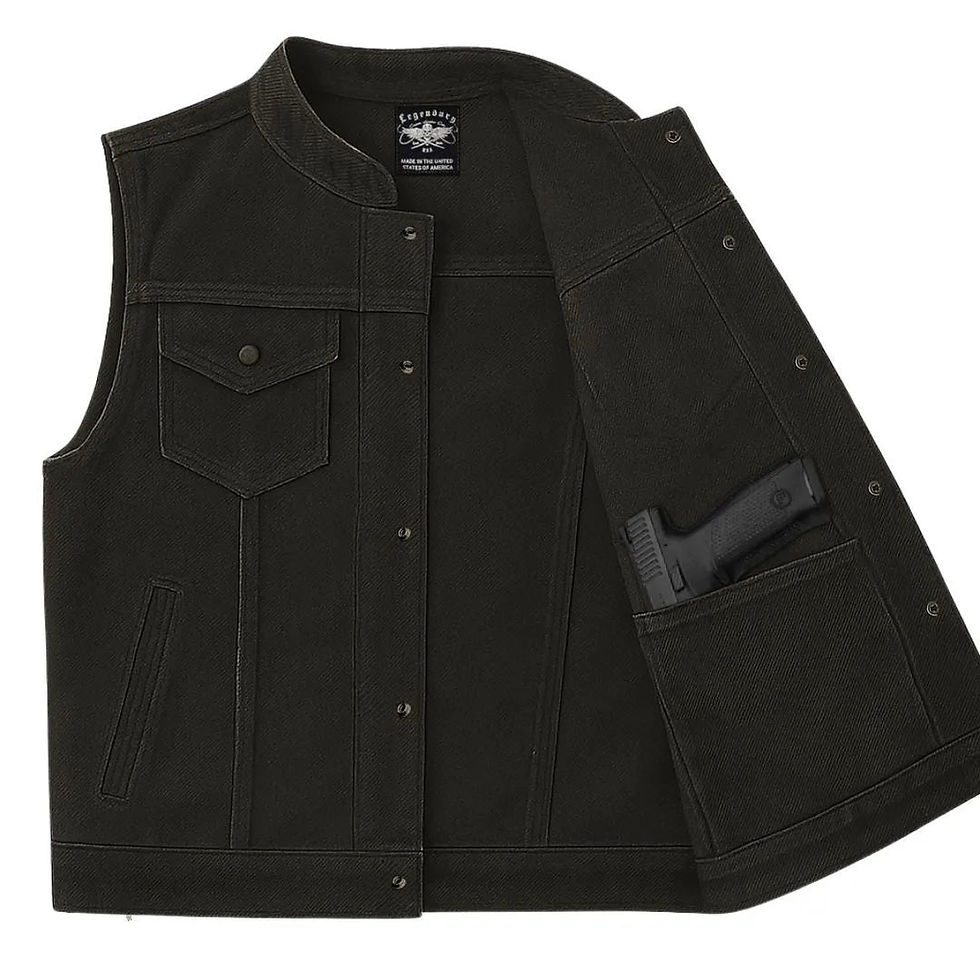
Legendary Revolution Men's Black Denim Vest, $65. Buy this if you ride in real heat and you are not carrying a patch set. It washes, it breathes, and at this price you are not precious about it.
BECK 566 Horsehide Motorcycle Vest, from $440. The buy-it-once option. BECK is a separate American maker that Legendary carries, working in front-quarter horsehide, and the difference in how the hardware is set is obvious the moment you handle one.
Where the Competition Is Better
Fox Creek Leather deserves an honest mention here. Their vests are American made, their hide weights are published clearly, and their prices sit slightly under comparable Legendary cuts. If your priority is maximum hide thickness per dollar and you do not care about styling variety, Fox Creek is a legitimately good call and I would not argue with anyone who went that way.
Where Legendary pulls ahead is breadth. There are enough cuts, weights, and closures in the made in USA vest range that you can actually match a vest to how you ride rather than settling for the one style a smaller shop offers. Prices verified August 2026.
The Bottom Line
If you are carrying patches, riding above 55 mph regularly, or you want one vest for the next ten years, buy leather. The extra $115 over a denim vest buys you hardware that can be replaced and a panel that will not stretch, and that is the whole ballgame.
If you ride short distances in hot weather, wear it over a t-shirt, and have no patch plans, denim is not a compromise. It is the correct tool, and spending three times more on leather will make you wear it less. The worst outcome is an expensive vest that stays home in July. Buy the one you will actually put on.


