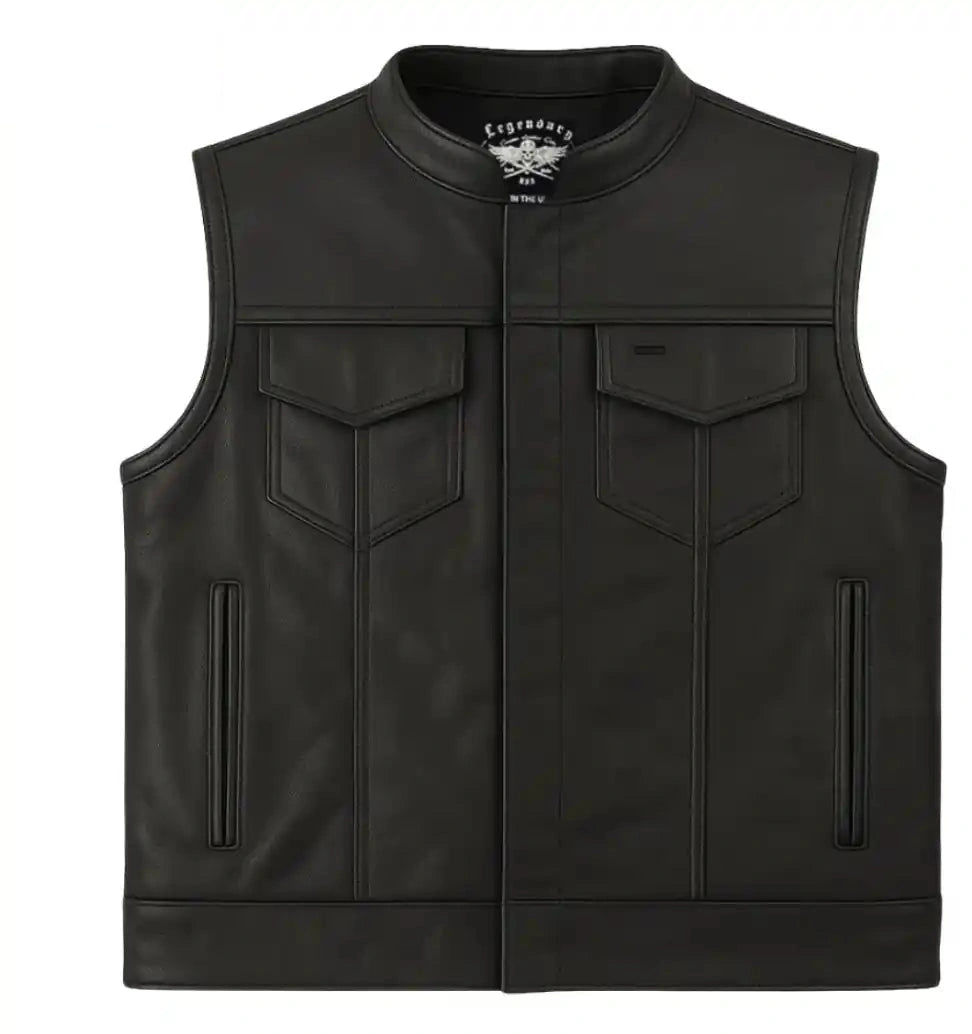
5 Common Failures in Pakistan-Made Leather Vests for Motorcycle Riders

Updated: Sep 2
Walk into any motorcycle swap meet or browse Amazon for a leather vest under $80 and you'll be looking at Pakistani imports almost exclusively. They look fine on a hanger. The leather has a consistent color, the stitching appears even, and the hardware has a clean finish. Three months of regular riding later, the story is different.
These aren't random quality issues. The failures follow a predictable pattern — and they're the direct result of specific material and manufacturing shortcuts that are baked into the economics of high-volume, low-cost production. Here are the five most common failures, why each one happens, and what you actually need to look for.

Failure 1: Split Leather That Peels After 6 Months
The most fundamental problem is the material itself. The majority of budget motorcycle vests — regardless of what the label says — are made from split leather. Split leather is the bottom layer of the hide after the top grain has been separated off. It has no natural surface structure, so manufacturers sand it, coat it, and emboss it to look like top-grain or full-grain leather.
Why it fails: That surface coating — usually a polyurethane or nitrocellulose layer — isn't bonded to a living material. It's a film on top of a fibrous substrate. Under heat cycling, UV exposure, and the flex stress of regular wear, the coating starts to crack and peel. It typically starts at the shoulders and collar — the areas under the most movement stress — and progresses quickly once it begins.
What American-made construction does differently: Full-grain leather retains the original grain layer and the dense fiber structure directly beneath it. It doesn't have a surface coating to fail. When it ages, it develops a patina. It never peels. Legendary USA's American-made motorcycle vests use full-grain cowhide for exactly this reason — it's the only leather that holds up long-term under the mechanical stress of motorcycle use.
For a deeper look at the material and manufacturing differences, see our article on why American-made motorcycle gear costs more.
Failure 2: Hardware That Rusts and Fails
The zipper pulls, snaps, D-rings, and lace hardware on budget imported vests are typically the cheapest available — stamped zinc alloy or low-grade steel with a thin chrome or nickel plating. It looks fine at the point of sale.
Why it fails: Thin plating on soft base metal doesn't survive temperature swings, road salt, sweat, and moisture exposure. The plating pits and flakes within a season. Under the plating, the base metal rusts. Zinc alloy snaps lose their tension and start popping open under movement. D-rings bend out of shape. Zipper teeth deform, and the slider starts to skip.
What American-made construction does differently: Quality domestic manufacturers source solid brass or heavy-grade steel hardware. Solid brass doesn't rust. It develops a warm patina over time. YKK or equivalent heavy-duty zippers are rated for tens of thousands of cycles and are designed to function in outdoor conditions. The cost difference in hardware between a budget import and a well-built American vest might be $15-20 at wholesale — a small fraction of the retail price difference, but it's one of the first places high-volume producers cut.
Explore the best motorcycle vests from Legendary USA — American-made leather riding vests built for cruiser riders and long-haul touring.
Failure 3: Stitching That Separates at Stress Points
The stitching on budget vests fails at predictable locations: the side seams under the arms, the shoulder seams, the pocket corners, and the snap backing. These are all high-stress areas — places where the fabric is pulled in multiple directions under load.
Why it fails: High-volume manufacturers use lighter thread (lower tensile weight) to reduce cost and increase machine speed. Stitch density — stitches per inch — is lower than it should be. Stress points that should be bar-tacked or double-stitched are single-stitched to save time. The thread itself may be lower-grade polyester that weakens faster under UV exposure and heat.
What American-made construction does differently: Proper motorcycle vest construction uses heavier nylon or polyester thread, higher stitch density at load-bearing seams, and bar-tacking at every stress point — the same technique used in workwear and military gear. The side seams on a quality vest should hold tension you can pull hard against without any give at the stitch line. If you can pull a seam apart with moderate hand pressure, the stitching isn't built for riding.
Failure 4: Lining That Tears at the Seams
Interior linings on budget vests fail in a specific way: they tear at the attachment seams — particularly at the hem and the armhole openings. You'll notice it first as bunching, then as visible separation between the lining and the leather edge.
Why it fails: Budget lining is attached with minimum seam allowance and minimum stitch density to keep labor time down. The lining material itself is often a lightweight polyester taffeta that tears easily at stressed points. Some vests use a bonded lining — glued rather than stitched — which delaminates from the inside of the leather shell when the adhesive degrades under heat and moisture.
What American-made construction does differently: Properly attached lining uses adequate seam allowance — at least 5/8 inch — with consistent stitching all the way to the terminal points. Quality linings use satin-weave polyester or other materials with enough strength to handle the pull stress at hem and armhole. The lining should feel like an integrated part of the vest, not an afterthought attached to meet a spec.
Failure 5: Sizing That Doesn't Match US Standards
This one is less about catastrophic failure and more about a product that never really fits right in the first place. Pakistani manufacturers size for export markets broadly — often using European size conventions or their own internal sizing with chest measurements that run narrow by American standards.
Why it happens: Production is often sized to minimize material waste across the widest possible market. The result is vests that fit slim through the chest and are cut short in the back — neither of which works for the average American Harley rider.
What American-made construction does differently: Domestic manufacturers can cut patterns for their actual customer base. Legendary USA's American-made motorcycle vests are cut for American proportions and the cruiser riding position — longer in the back, with more room through the shoulders and chest. That's not a minor detail. A vest that fits right on the bike is one you'll actually wear.
For comparison between how the top American brands approach fit and construction, see our Legendary USA vs Fox Creek Leather breakdown.

The Pattern Is Always the Same
None of these failures are surprising once you understand the economics. A vest built to sell for $60-80 retail leaves very little room for quality materials, quality hardware, or quality labor. The manufacturers making these vests aren't cutting corners carelessly — they're making deliberate tradeoffs to hit a price point.
The question is whether that tradeoff works for you. If you wear a vest occasionally and don't plan to keep it more than a couple of years, the math might pencil out. If you ride regularly and want a vest that's still performing at year eight or ten, you're shopping in a different tier. The best motorcycle gear made in the USA covers the domestic options worth knowing.
Frequently Asked Questions
How can I tell if a vest is split leather before I buy it?
Look at the edge where the leather is cut — a raw edge on full-grain leather shows fibrous structure throughout. Split leather often shows a fibrous backing with a coated top layer that's visibly different. The surface of split leather tends to look too uniform and may have a slight sheen that looks more like coated material than natural hide.
Is all Pakistani leather the same quality?
No — Pakistan has leather manufacturers across a wide quality range. Higher-end Pakistani manufacturers produce decent leather goods. The problem is that the budget motorcycle vest market is almost entirely served by the low end of that range, where every cost-saving measure is applied.
Can a failing vest be repaired?
Peeling split leather cannot be meaningfully repaired — once the surface coating starts to fail, it continues. Failing stitching can be re-sewn if the leather is still structurally sound. Hardware can be replaced. Lining can be re-attached or replaced. Whether repair is worthwhile depends on the condition of the leather itself.
Why do these vests still get good reviews online?
Most reviews are written shortly after purchase — when the vest looks fine and hasn't been through a season of use. Failure modes that take 6-18 months to appear won't show up in early reviews. Negative reviews often accumulate over time, but the product listing may have been replaced by then.
What's the minimum I should spend to avoid these problems?
There's no clean price threshold, but vests priced under $150 are almost always using split leather and budget hardware. Quality American-made vests typically start around $200-250 and go up from there. The cost-per-year math usually favors spending more upfront.
Shop the full selection of best motorcycle vests at Legendary USA, handcrafted in the USA with premium horsehide and cowhide leather.