What a Gun Pocket Actually Means on a Motorcycle Vest

Updated: Sep 28
Put anything with real weight into a cheap vest pocket and you will learn the problem in about four miles. The pocket sags, the vest panel pulls out of line, the whole left side of the garment hangs lower than the right, and whatever is in there swings every time you countersteer. That is not a small annoyance. It is the difference between a pocket that is a feature and a pocket that is a piece of marketing copy.
Disclosure: MotoGearRater and Legendary USA have the same owner. Links to legendaryusa.com in this article go to our owner’s store, and are marked as sponsored. How we make money
The term gun pocket gets printed on a lot of vest listings and it covers a wide range of actual construction, from a properly tethered and lined compartment to a slit in the lining with a snap on it. This post is about what the construction actually is, what to look for, and one honest paragraph about the legal side that a gear review has no business skipping.
What Is Actually Built Into a Real One
On a properly built vest, the gun pocket is not a pocket sewn onto the lining. It is a structural element with three parts: the pocket bag itself, an anchor, and a lining material chosen for wear rather than cost.
The anchor is the piece most riders never think about. On the Peacekeeper vest the pockets are tethered so the load transfers into the vest structure instead of hanging off a seam. Legendary calls their version Pistola pockets and the same tethering shows up across the vests that carry the feature. Without that tether, the weight goes straight to the stitch line at the bottom of the pocket, which is exactly where you would expect a garment to fail first.
The lining matters almost as much. Cordura in the pocket instead of the same polyester used for the vest body is a real decision. A steel object rubbing against a thin lining every mile will wear through it in a season or two. Cordura will not. On the vests I have handled with this construction, the pocket is deep enough to take a full-size frame with an integrated magazine pouch alongside it, so the second item is not knocking around loose against the first.
Hide weight under all of this is 1.2mm, listed as 3.0 ounce, on the mid-tier vests. That is enough panel stiffness to hold shape around a loaded pocket. Vests built in thinner fashion leather, anything under about 1.0mm, will bow visibly around the pocket no matter how well the pocket itself is made.
Two Pockets Is Not the Same as Ambidextrous
Most quality vests in this category give you two interior pockets, one on each side. That is the arrangement to want, and it is not the same thing as a single pocket that a left handed rider can somehow use.
A mirrored pair means the opening angle, the pocket depth, and the snap placement are correct for either hand. A single-side vest, or a vest with two pockets that are not actually mirrored, forces a cross-body reach that is slow and awkward while seated on a bike with a jacket over it. Check the photos on the interior. If the two pockets do not look like reflections of each other, they were not built as a pair.
The practical test in a store is simple. Sit down, put the vest on, close it, and reach for each pocket with the matching hand while your other hand stays on an imaginary bar. If either side requires you to twist your torso, that side is decorative.
Retention: What a Snap Does and Does Not Do
Retention is the honest weak point of this whole category and it deserves plain language. A snap holds a pocket flap closed. It does not index the object inside the pocket, it does not cover a trigger guard, and it does not stop movement within the pocket bag. That is a real functional gap compared to a purpose-built holster, which is molded to a specific frame and holds it in one orientation.
What good construction gives you instead is a deep bag, a tether that stops swing, and a lining that does not let contents slide freely. Those three things together make the pocket stable in normal riding. They do not make it a retention device, and I have never seen a vest maker claim otherwise in the actual spec text, even when the marketing photos imply more.
The practical answer used by riders who carry is to use a proper holster inside the pocket, so the pocket handles concealment and weight distribution and the holster handles orientation and trigger coverage. That combination is the only version of this that makes mechanical sense.
The Legal Part, Stated Plainly
I am a gear reviewer, not a lawyer, and nothing here is legal advice. What I can tell you is the factual part, which is that carry law in the United States is set state by state and sometimes locally, and it varies enormously. Permit requirements, reciprocity between states, rules about carrying in a vehicle versus on your person, and the definition of concealed all change when you cross a line you cannot see from the saddle.
Riding makes this worse than it is for a driver, because a good day is 300 miles and 300 miles can be three states. A vest pocket is a garment feature. It carries no legal status of any kind, and buying a vest with one does not authorize anything. If you carry, the research is on you: check the current law in every state on your route, understand your own permit and where it is honored, and talk to an attorney in your state if you are unsure. That is the whole of what I will say about it, and anyone selling you gear who says more than that should worry you.
What to Check Before You Buy
Everything on this list is visible in product photos or findable in a spec section. If a listing will not tell you these things, that itself is information.
Is the pocket tethered or anchored, or does it hang from its own seam? Tethered is the whole ballgame for sag.
What is the pocket lined with? Cordura or a similar abrasion fabric beats standard lining by a wide margin.
Are there two, and are they mirrored? Two mirrored pockets, one per side, is the arrangement that works for either hand.
Is there a magazine or secondary pouch inside the pocket, or will two items share one bag?
Hide weight. 1.2mm or heavier holds shape around a loaded pocket. Thinner leather bows.
Does the vest have side lacing or adjustment? A loaded pocket changes how the vest sits, and you will want to bring the sides in.
Size for layers. Measure over the thickest thing you will wear under it, using the published vest size chart rather than your shirt size.

Editor's Picks
These are picked on pocket construction specifically, not on styling. All of them are unarmored leather or textile, not CE-certified, and not protective gear in the impact sense.
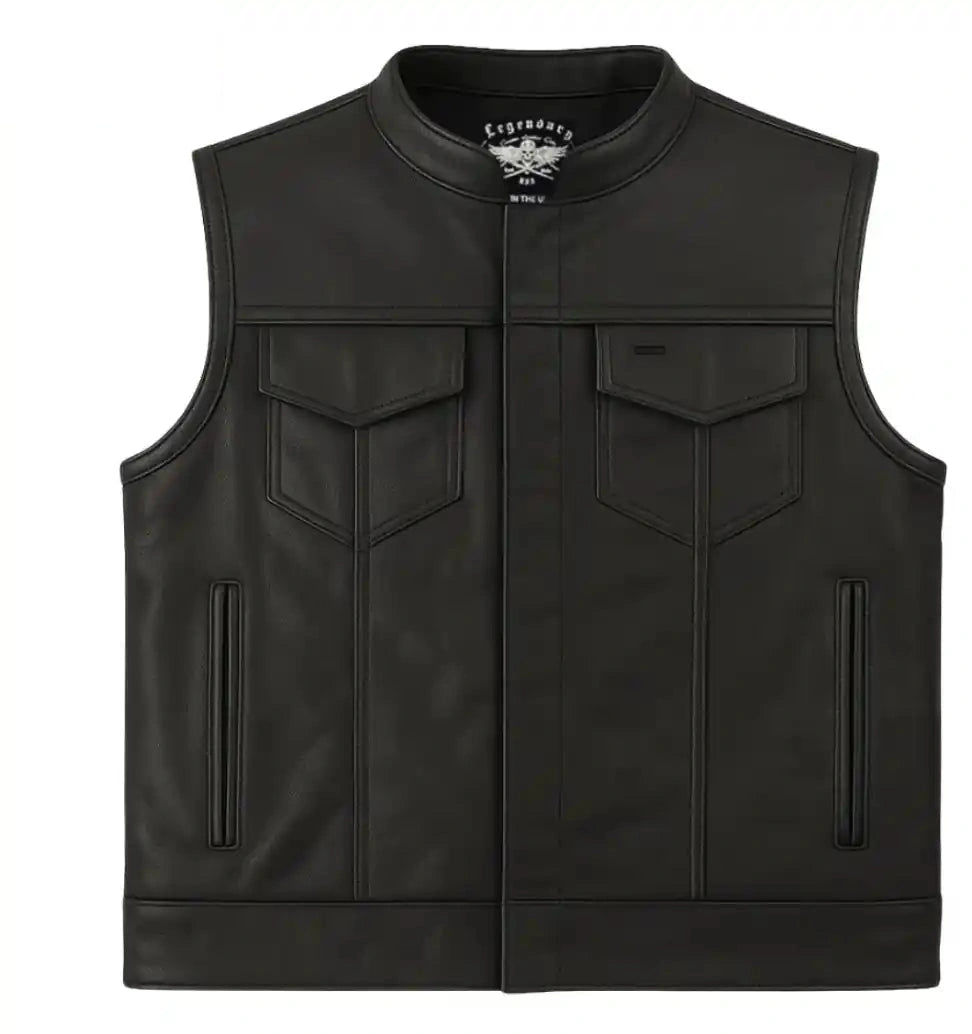
Legendary Peacekeeper Vintage Leather Gun-Pocket Vest, $184.99. The value pick. Two tethered, Cordura-lined interior pockets with snap closure and an integrated magazine pouch, in 1.2mm cowhide. This is the cheapest vest I have seen with the tethering done properly.
Legendary Outlaw Men's Leather Motorcycle Vest, $239. Same Pistola pocket approach with the tether run to the underarm, and pocket volume sized around a full-size frame plus a magazine and a phone. Buy this if the Peacekeeper's pockets feel tight for what you carry.
Legendary Gunslinger Men's Leather Vest, from $220. Multi-variant, so check the size and finish you want. It sits between the other two on price and is the one to look at if you want the pocket feature without the Outlaw's heavier styling.
Men's Concealed Carry Soft Shell Vest, from $119.99. Not leather, and that is the point. Rothco's textile version is lighter, cooler in August, and washable, at the cost of the panel stiffness that keeps a leather vest looking square.
Honest comparison: Fox Creek Leather publishes hide weights clearly and their American made vests often undercut comparable cuts on price, so if maximum hide per dollar is your priority they deserve a look before you decide. Prices verified August 2026.
The Bottom Line
A gun pocket is a construction feature, and the two details that separate a real one from a printed claim are the tether and the lining. Everything else on a spec sheet is secondary. If the listing does not mention either one, assume the pocket is a slit in the lining and price the vest accordingly.
For most riders, the Peacekeeper at $184.99 is the sensible landing spot: the construction is right, the hide weight is right, and the money you save over the heavier vests is better spent on a proper holster to go inside the pocket. If you want to compare cuts across the range first, the vest buying guide and the USA made vest collection are the places to start. Then go read your state's actual law, because the vest cannot do that part for you.