Why Experienced Riders Choose Natural Leather Over Synthetic

Updated: Sep 28
Disclosure: MotoGearRater and Legendary USA have the same owner. Links to legendaryusa.com in this article go to our owner’s store, and are marked as sponsored. How we make money
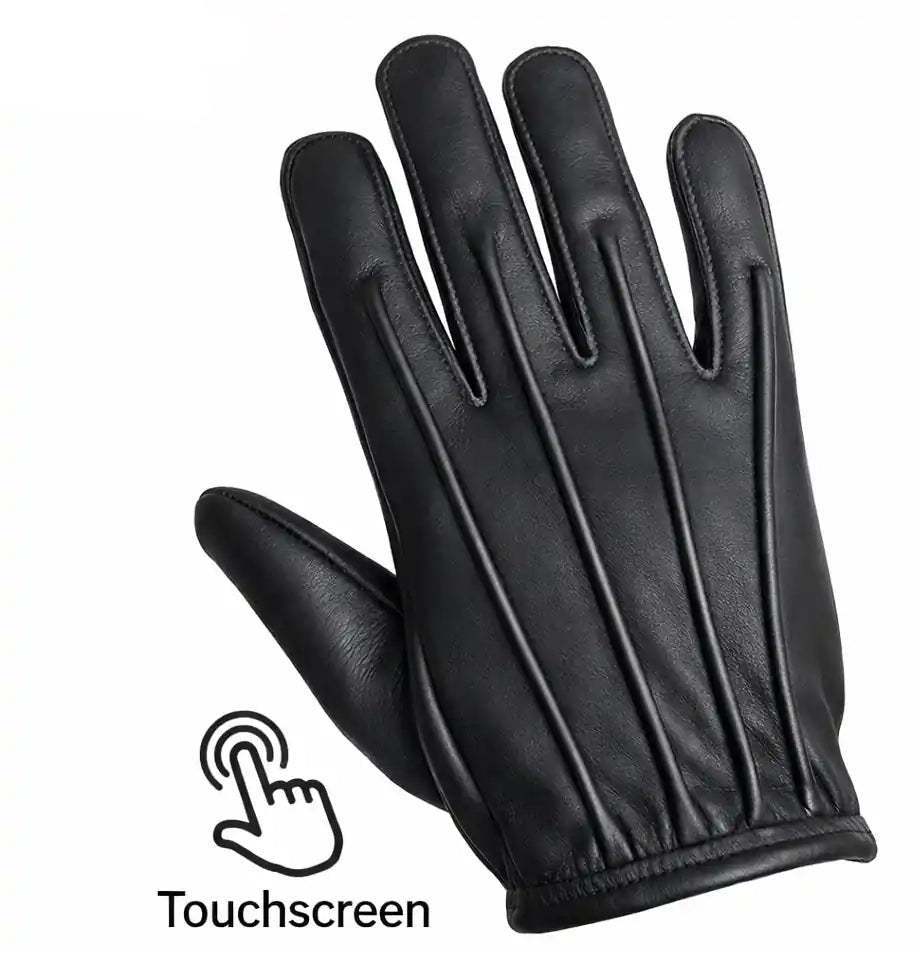
Experienced riders keep choosing natural leather because it does one thing synthetic still cannot do: it stretches to the shape of your hand and then stays that shape, and the glove that shows it most clearly is the Aramid Touchscreen Deerskin Gloves at $125. A synthetic glove is manufactured to a shape and holds it. Leather is a material that keeps moving, and after fifty or sixty hours it stops being a glove you put on and starts being something closer to a second skin over your knuckles.
The honest complication is that this is a comfort and feel argument, not a protection argument, and anyone telling you otherwise is guessing. The most protective gloves sold today are mixed construction: leather in the palm, synthetic in the panels, hard parts on the knuckles, tested as a finished glove. If you want certified protection, that is where it lives, and it is not in this catalog. What follows is the case for leather on the terms where leather actually wins.

How We Scored These
Every glove here was judged on three things: how it feels on the controls in the first hour, how it feels after a season, and whether the construction is doing anything a cheaper glove does not. Break-in time counted against a glove. Stretch that turns into sloppiness counted against it harder.
The numbers are editorial judgments from riding and handling this gear. They are not measurements. No laboratory was involved, we do not run abrasion or seam burst tests, and a score here tells you what we think of a glove, not what will happen to your hand at 45 miles an hour. None of the Legendary or Churchill gloves below carries a CE rating. Prices verified August 2026.
1. Aramid Touchscreen Deerskin Gloves, Best Argument for Natural Leather
This is leather doing what leather does with one modern material added where it helps. The aramid lined palm sits under the deerskin at the heel of the hand, which is the first place that touches pavement and the first place a plain glove wears through from grip pressure alone. You get deerskin on the outside for feel and fit, and a cut resistant fiber underneath at the one spot where it earns its keep. At $125 it is five dollars over the plain version, which is the easiest five dollars in the catalog to justify. Buy this if the leather versus synthetic question is really a question about not giving up either one.
Price: $125
Score: 8.8 out of 10
Best for: riders who want leather feel with something extra in the palm
2. ILL DOZER Outseam Gloves, Best Construction in Plain Leather
Outseam construction turns the seams outward so the stitching and seam allowance sit on the outside of the glove instead of pressing into your fingers. The ILL DOZER gloves are built that way at $140, and the difference shows up on hour four of a ride, when a conventional inseam glove has left a line across the inside of your fingers and this one has not. The perforation keeps summer temperatures manageable. This is the glove for the rider who has already decided on leather and now wants the version where somebody thought about where the seams go.
Price: $140
Score: 8.6 out of 10
Best for: long days, hot weather, anyone bothered by interior seams
3. Classic Deerskin Gauntlets, Where Synthetic Falls Behind Fastest
Cold is where the material difference stops being a preference. Most synthetic shells get stiffer as the temperature drops, and a stiff glove means you are squeezing harder to hold a grip that used to take no effort. Leather does the opposite once it is warm from your hand. The Classic Deerskin Gauntlets at $145 add the other half of the answer, which is a cuff long enough to go over a jacket sleeve and stop the wind that is actually making your fingers cold. These are unlined, so they are not a deep winter glove on their own, and a thin liner underneath extends them a good deal further than most riders expect.
Price: $145
Score: 8.5 out of 10
Best for: cold mornings, wind up the sleeve, long distance riding
4. Held Riding Gloves, The Honest Case Against Everything Above
We do not sell Held and we are not linking to them, but leaving them out of this post would make it dishonest. Held builds gloves that are CE certified to the European glove standard, which means an independent lab tested the finished glove for abrasion, cut, tear, and seam strength and published the result. Their better gloves also use natural leather, often kangaroo, combined with synthetic panels and hard knuckle protection. That combination is more protective than any unarmored leather glove, ours included, and it costs more. If your question is which glove protects your hand best, this is the answer and the rest of this page is about something else.
Price: varies by model, we do not sell it
Score: 9.0 out of 10 for tested protection
Best for: riders who want certification, not opinion
5. Churchill Classic Deerskin Gloves, The Quiet Traditional Choice
Churchill is a separate brand that Legendary USA carries as a dealer, not a house label, and the Churchill Classic Deerskin Gloves at $120 are as plain as this category gets. No touchscreen fingertip, no venting, no styling. A longer cuff, soft deerskin, and stitching that stays where it was put. Riders who have been through four or five pairs of gloves tend to end up here, because at some point the features stop mattering and the only questions left are whether it fits and whether it will still fit in three years. Look at the full Churchill glove range if that description sounds like you.
Price: $120
Score: 8.3 out of 10
Best for: traditionalists, cool weather, riders who hate gimmicks
How Thin Is Too Thin, and What Else to Check
Thickness is the number riders ask about and it is the wrong number to fixate on, because a glove is tested as a finished object and not as a swatch of hide. Here is what actually matters when you are standing there with the glove in your hand.
Glove leather generally lives somewhere around 0.6mm to 1.0mm. Thicker than that and you lose the lever feel that makes a glove worth wearing. Much under 0.5mm and you are holding a dress glove, whatever the label says.
There is no published minimum thickness that makes leather safe. The European glove standard, EN 13594, tests abrasion, cut, tear and seam strength on the finished glove, and a well built thin glove can outperform a badly built thick one.
Check the seams before the hide. A glove that bursts at the seam has failed regardless of how good the leather was.
Press the palm against the heel of your hand. That is the contact point in almost every fall, and it is where you want either extra leather or an aramid layer.
Try to make a fist. If you cannot close your hand comfortably in the shop, you will not be able to at 60 miles an hour either.
If the glove will be your only protection and you want proof rather than a claim, buy something CE certified. Our glove buying guide lays out where unarmored leather does and does not make sense.
Common Questions
Why do experienced riders prefer natural leather over synthetic for gloves?
Because leather conforms to the individual hand and synthetic does not. Over a season, leather stretches at the knuckles and across the palm until the glove matches you specifically, which means less grip pressure, less fatigue, and better feel on the levers. Leather also handles a soaking and a drying cycle without going brittle if it is looked after. Synthetic shells hold their factory shape from the first ride to the last, which some riders prefer, and modern mixed material gloves are more protective than plain leather.
What is the thinnest leather that is still safe for motorcycle gloves?
There is no thickness number that certifies a glove as safe, and any figure quoted as one is invented. Most riding glove leather runs roughly 0.6mm to 1.0mm, and below about half a millimeter you are into fashion glove territory where the material will tear before it slides. Testing standards like EN 13594 look at the finished glove and its seams, not at hide thickness, which is exactly why a thin, well constructed glove can beat a thick, cheaply sewn one.
Is a leather glove enough on its own?
It is much better than a bare hand and much less than certified protection. Unarmored leather gives you a layer between skin and pavement plus some resistance to sliding, and that is a real benefit we are happy to argue for. It does nothing for impact, and none of the leather gloves on this page has been tested against a standard.
What I Would Actually Buy
For the rider who wants the leather argument settled in one purchase, the Aramid Touchscreen Deerskin Gloves at $125 are the pick, because they give you the feel and fit that keeps riders coming back to hide, with a cut resistant palm layer at the spot that hits the ground first. The runner up is the ILL DOZER at $140, which is the better built glove of the two and the one to choose if seams inside your fingers have ever annoyed you.
If protection is the whole reason you are reading this, buy a certified glove from a maker that publishes its test results, and wear it. We would rather say that plainly than sell you a story about leather that leather cannot back up.