The Complete Guide to Motorcycle Glove Safety

Updated: Sep 28
Hands hit the ground first in most motorcycle crashes. It's a natural instinct — you reach out to break your fall. Without gloves, the asphalt wins every time. With the wrong gloves, the result isn't much better.
Disclosure: MotoGearRater and Legendary USA have the same owner. Links to legendaryusa.com in this article go to our owner’s store, and are marked as sponsored. How we make money
This guide covers what actually matters in motorcycle glove safety: protection zones, materials, CE ratings, and how to tell whether a glove will protect you when it needs to.

Why Motorcycle Gloves Are Not Optional
Yes, motorcycle gloves are necessary. Your hands contain 27 bones each. Carpal and metacarpal fractures, road rash on the palms and fingers, abrasion injuries to tendons — hand injuries from unprotected crashes are severe, slow to heal, and can permanently affect dexterity.
More than any other body part, your hands are what allow you to do fine work, play instruments, type, grip tools. Losing that function — even partially — has life-altering implications. Properly designed motorcycle gloves prevent the majority of hand injuries in low- to mid-speed crashes.
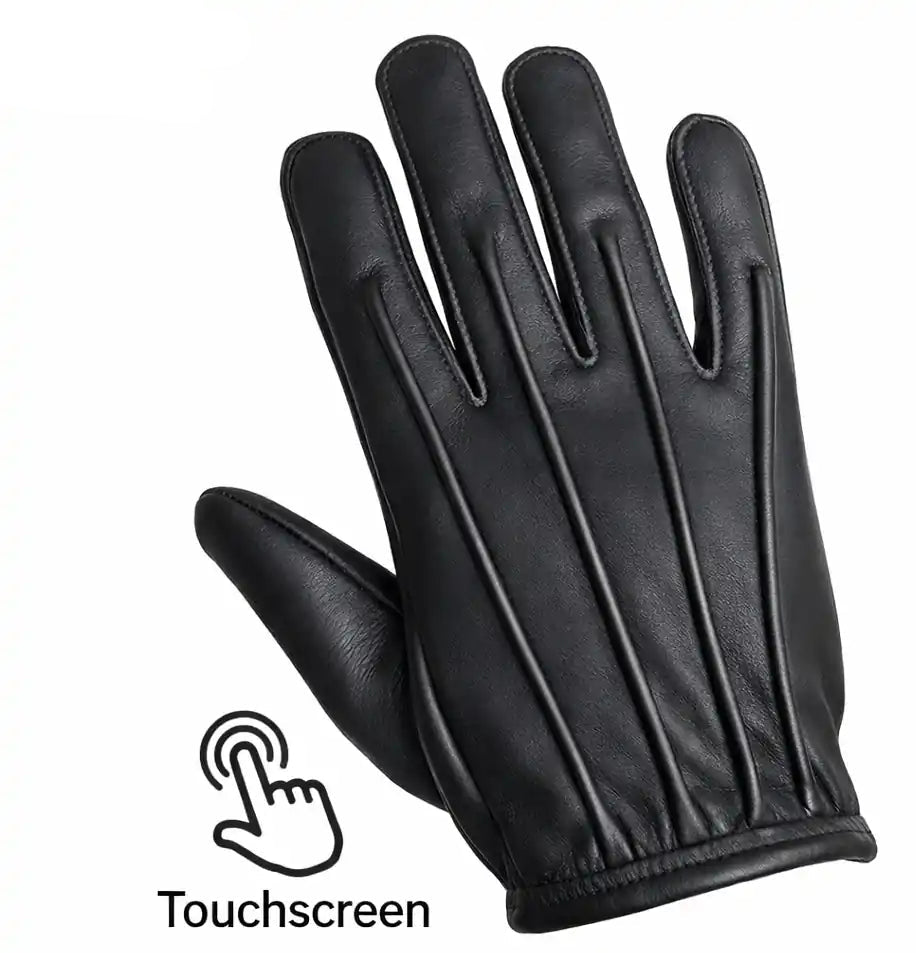
The practical version of this: the glove you actually wear on every ride beats the armored glove you leave at home. A comfortable everyday pair such as the Legendary Bad Billy Black Goatskin Gloves at $65 (129 reviews, 4.93 average) puts cut-resistant, American-made goatskin between your palms and the asphalt, which is the difference between road rash and a skin graft at commuting speeds. They are unarmored and carry no CE rating, so what they give you is abrasion resistance and leather quality, not certified impact protection. For faster or longer riding, step up to a CE Level 2 glove from Dainese, Alpinestars or Held.
The Five Critical Protection Zones in a Motorcycle Glove
1. Palm Protection
Your palm hits the ground first in most fall scenarios. Good palm protection includes a reinforced leather palm (multiple layers or a separate reinforcement panel) and ideally a palm slider — a hard or semi-rigid panel that distributes load and allows the hand to slide rather than grab.
2. Knuckle Protection
Hard-case knuckle protectors — either hard plastic or CE-rated TPU — absorb impact energy when your knuckles contact the ground or another surface. Soft padding is insufficient; the protector needs to be rigid enough to deflect rather than compress into the knuckle.
Are knuckle protectors necessary? For street riding they are the single most worthwhile hard feature, and if you want them in a traditional leather glove the Legendary Uppercut Knuckle Defense Gloves at $120 (73 reviews, 4.92 average) build leather-covered carbon fiber knuckle defenders into ventilated deerskin. That is a genuine rigid defender rather than foam, but it is a construction feature and not a certification: the Uppercut is not CE rated and Legendary does not test it to EN 13594. If you need a knuckle protector with a measured impact-transmission figure behind it, buy a CE Level 2 glove from Dainese, Alpinestars or Held.
Explore the best motorcycle gloves from Legendary USA — American-made deerskin and cowhide riding gloves built for serious riders.
3. Finger Protection
Individual finger protection often gets overlooked. Look for reinforced finger construction — either leather volume or rigid channels along the sides and top of each finger. The little finger (pinky) is statistically the most commonly broken finger in motorcycle crashes.
4. Wrist Support and Retention
A glove that comes off in a crash offers no protection. The wrist closure must be secure — velcro, zipper, or strap — and the cuff should overlap your jacket sleeve to prevent the glove from sliding off during a slide.
The closure that passes this test most reliably is simply a long cuff. The Legendary Classic Deerskin Gauntlets at $75 (112 reviews, 4.88 average) overlap the jacket sleeve and cannot be stripped off the hand partway through a slide, which is the whole point of retention. They are traditional unarmored American deerskin with no CE rating, so the cuff is the safety feature here, not certified impact protection. If you want a locking wrist strap alongside CE Level 2 armor, Held and Alpinestars both build one.
5. Cuff Length
Short cuffs are a compromise. A longer cuff provides better wrist and lower arm coverage and significantly reduces the chance of the glove separating from your jacket during impact.
CE Safety Ratings Explained
The European CE standard for motorcycle gloves is EN 13594. Level 1 — Basic protective performance. Passes abrasion, cut, and impact tests at a threshold adequate for most road riding. Level 2 — Enhanced protective performance. More stringent testing. Better protection for higher-speed incidents. When a glove claims CE certification, check which level it achieves. Level 1 is the minimum; Level 2 provides meaningfully better protection and is worth seeking for highway use.
Leather vs Textile vs Synthetic: What Protects Best?
Full-grain leather at 1.2mm+ provides excellent abrasion resistance. Deerskin at proper thickness performs well for abrasion with the additional benefit of better grip retention. Modern technical textiles — Cordura and Kevlar-reinforced constructions — can achieve CE ratings and provide good abrasion resistance at lighter weights than leather. Hard armor (TPU and carbon fiber) is the standard for knuckle and wrist protectors.

What 'Motorcycle Gloves' That Don't Protect Look Like
There's a category of product marketed as motorcycle gloves that provides minimal real protection: thin fashion leather with no palm reinforcement, short velcro cuffs that won't stay on in a crash, soft foam 'protection' over knuckles, decorative hardware over structural stitching, split leather or bonded leather labeled as 'genuine leather.' The tell: if a glove costs $30-50 and doesn't specify the leather grade, protection standard, or knuckle protector material — it's probably not protective.
Matching Gloves to Riding Type
Highway/Touring: Full-finger leather with CE-rated knuckle protection, wrist closure, cuff coverage. Comfort for hours of use is as important as protection credentials. Urban/Commuting: CE-rated gloves with hard knuckle protection. Touch-screen compatible fingers. Cruiser/Harley: Quality leather — deerskin or cowhide — with palm reinforcement and reliable closure. Track/Aggressive Sport: Level 2 CE-rated gloves with hard palm sliders, reinforced finger construction, secure wrist closure.
How to Test a Glove's Protection Before Buying
Palm test: Push firmly on the palm with your opposite thumb. Quality reinforcement resists deformation. Knuckle test: Press the knuckle protectors against a hard surface and push. Rigid protectors don't move; soft padding compresses into your knuckle. Closure test: Put the glove on, close the cuff, then try to pull the glove off quickly. A well-designed cuff stays on. Seam inspection: Pull gently at stitched seams. Quality construction at 8+ stitches per inch resists separation.
Glove Maintenance and When to Replace
Replace gloves when: leather is visibly thinning or cracking, seams are separated or loose, armor has been impacted or is UV-degraded, the closure no longer holds securely. For leather gloves: condition regularly (2-4 times per year), clean after wet rides, store away from direct sunlight. Well-maintained quality leather gloves can last 5-10+ years.
Frequently Asked Questions
Are motorcycle gloves legally required?
Laws vary by jurisdiction. In most US states, gloves are not legally required for motorcycle riding. Whether they're legally required doesn't change the physics of what happens to unprotected hands on asphalt.
What CE level is sufficient for highway riding?
Level 1 is the minimum acceptable standard; Level 2 provides better protection and is recommended for regular highway use. For track use or aggressive riding, Level 2 with hard palm sliders is the appropriate target.
How important is fit for glove protection?
Fit is critical. An oversized glove bunches on the palm and can shift in a crash, moving protection away from impact zones. A properly fitted glove keeps protective elements in the right place.
Shop the full selection of best motorcycle gloves at Legendary USA, handcrafted in the USA with premium leather for every riding style.