The 2026 Harley Softail Lineup vs the 2026 Indian Chief Lineup

Updated: Sep 28
Quick answer: Both ranges open at exactly $14,999, with the Harley Street Bob and the Indian Chief. From there Harley gives you eight Softails up to $23,999 and Indian gives you a Chief family whose specs we could verify for three models up to $21,999. Harley's weakest Softail tune makes 120 ft-lbs, which is also the strongest figure Indian publishes for any Chief. Harley also goes lower on the seat, down to 25.2 in laden, is lighter at both ends of the range, and carries 5 gallons where every Chief carries 4. Shop the Softail range unless you specifically want the Sport Chief's 32 degrees of lean or the Chief's $14,999 with a 26 in seat.
Disclosure: MotoGearRater and Legendary USA have the same owner. Links to legendaryusa.com in this article go to our owner’s store, and are marked as sponsored. How we make money
MotoGearRater measures nothing itself. We read the published figures, compare like with like and leave the blanks blank. What we do rate is what a rider wears, and our reference point for American made leather is Legendary USA, which the gear section below is measured against. On two ranges that mostly do without fairings, that is a practical question rather than a decorative one.
All prices are base MSRP and exclude freight, destination, taxes and dealer charges.
What is actually in each range
Harley Softail, eight models. Street Bob $14,999, Super Glide $15,999, Deadwood $17,999, Low Rider S $18,999, Heritage Classic $19,999, Fat Boy $22,599, Breakout $22,999, Low Rider ST $23,999. Deadwood and Super Glide are new names on the MY2026 list.
Indian Chief. Indian's 2026 Chief family page lists Chief, Chief Bobber, Chief Vintage, Sport Chief and Super Chief. We have verified specs for three, the Chief at $14,999, the Sport Chief at $19,999 and the Super Chief at $21,999, and we will not print numbers for the other two, which we have not read. Flag on the Super Chief: Indian dates its specs page 2024, and no 2026 page for that model exists on the site.
Only one of these two companies publishes a horsepower figure. Harley prints one on every Softail model page, 98 for the Street Bob, Super Glide, Deadwood and Heritage Classic, 103 for the Fat Boy and Breakout, and 114 for the Low Rider S and Low Rider ST. Indian publishes horsepower for its Scout and PowerPlus families and not for any Thunderstroke, and every Chief is a Thunderstroke. So the horsepower column exists on the Harley side of this comparison and is blank on the Indian side, which leaves torque and weight as the only ground the two ranges can be set against each other on directly, and any horsepower number you see attached to a Chief came from somewhere other than Indian.
Engines: one displacement against two
Harley has simplified hard. Every MY2026 Softail carries a 117 cubic inch Milwaukee-Eight in one of three states of tune. Classic makes 120 ft-lbs at 2,500 rpm and is in the Street Bob, Super Glide, Deadwood and Heritage Classic. Custom makes 126 ft-lbs at 3,000 rpm and is in the Fat Boy and Breakout. The Low Rider S and Low Rider ST get 128 ft-lbs at 4,000 rpm. All Harley figures are its own J1349 method.
Indian runs two engines in the Chief. The air cooled Thunderstroke 111, 1,811cc, makes 108 ft-lbs at 3,200 rpm in the Chief and the Super Chief. The Thunderstroke 116, 1,890cc, makes 120 ft-lbs at 2,900 rpm in the Sport Chief. Indian does not state a testing method the way Harley does, so read the cross brand gaps as directional.
Put those together and one line settles the engine question. Harley's lowest Softail output, 120 ft-lbs, equals Indian's highest published Chief output, 120 ft-lbs. The cheapest bike in the Softail range makes as much torque as the dearest Chief we have figures for. That is not a small structural advantage and it is the single most important thing on this page.
Indian's counter is where the torque arrives, and it does not land. The Sport Chief's 120 ft-lbs peaks at 2,900 rpm and the Chief's 108 at 3,200, against Harley's Classic tune at 2,500 rpm. Harley's base tune is the earliest peak in the comparison. The Thunderstroke 111 at $14,999 is still a different engine character from a 117, and some riders will simply prefer it.

Kitting out two ranges with no fairing
Almost nothing in either line up has a fairing, and the two makers describe cooling very differently. Indian labels every Thunderstroke air cooled. Harley prints no cooling description at all on its Softail pages, and we are not going to assert one on its behalf. That produces two gear problems that pull in opposite directions. In July traffic the motor puts heat back at you and you want ventilation. At highway speed there is nothing between you and the wind and you want coverage. Anything that solves only one gets left at home half the year.
Legendary Brotherhood Men's Leather Vest, $195. The vest is the layer that answers both problems, because it covers the torso without adding a sleeve, and it goes over a shirt in August and under a jacket in October without changing what else you own. This one is cut for a rider sitting upright behind bars, which is the position on seven of the eight Softails and every Chief. Made in the USA. See the vest.
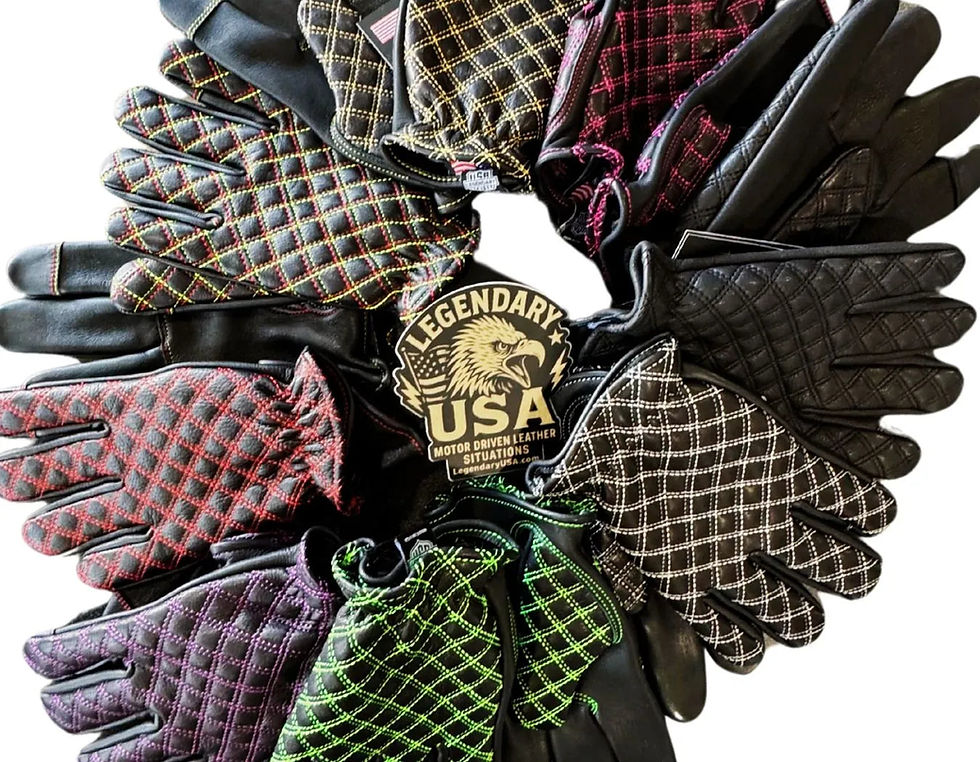
Holy Blanco Ventilated Gloves, $114. Ventilated deerskin is the specific answer to a big twin in stopped traffic, where the heat problem is real and no published figure captures it. The touchscreen panel means you are not peeling a glove off at every set of lights. Made in the USA. No armour, no certification and no impact rating, which is the accurate description rather than small print. See the gloves.
BECK 732 Northeaster Flying Togs Black Horsehide Jacket, from $815. For the other half of the year. Horsehide is the dense, heavy hide, and on a fairingless big twin the jacket is doing all of the wind management because nothing else is. BECK is Legendary's own house line rather than an outside label, which is worth saying plainly. See the jacket.

None of the three is CE rated and none of it is armoured. Fox Creek is the closest American made comparison and a fair benchmark to price this list against, and Schott NYC is the other long service life name worth putting next to the jacket above. If certified impact protection is the requirement rather than leather, Dainese and Held both build to a standard none of this claims. Harley's own MotorClothes will be in front of you in the Softail showroom and deserves pricing against the leather motorcycle jackets above rather than an assumption either way.
Weight, seat and fuel across both ranges
Weight, running order. Softails run from 646 lb for the Street Bob to 719 lb for the Heritage Classic. Chiefs run from 670 lb for the Chief to 739 lb for the Super Chief. Harley is lighter at both ends, and the Street Bob is 24 lb under the lightest Chief. Indian also prints dry and as shipped figures, which are not the ones to compare.
Seat height. Harley's Softails span 25.2 in laden on the Super Glide to 27 in on the Low Rider pair. Indian's Chiefs span 26 in to 27 in, printed as Seat Height with no laden or unladen split. Harley reaches almost an inch lower and offers more choice inside the range.
Fuel and lean. Every Softail except the Street Bob carries 5 gallons, and the Street Bob carries 3.5. Every Chief carries 4. On lean angle Indian takes the single best number, 32 degrees on the Sport Chief against 31.3 on the Low Rider pair, but the Chief and Super Chief sit at 28.5 and Harley's range runs from 25.6 on the Fat Boy to 31.3.
Which range to shop
Shop the Softail range if you want the widest choice and the better numbers in most columns. Eight models, one 117 in three tunes, more torque at every price point, lower seats, less weight, and a gallon more fuel on seven of the eight. The Street Bob at $14,999 with 120 ft-lbs and 646 lb is the clearest single value in this comparison.
Shop the Chief range if you want the Sport Chief specifically. At $19,999 it is the one Indian in this group that wins something outright, with 32 degrees of lean, dual Brembo calipers on 320mm rotors and 4 in of rear travel. The base Chief at $14,999 with a 26 in seat, 670 lb and the Thunderstroke 111 is the other real reason, and it is a different flavour of big twin rather than a worse one.
Do not shop on popularity. Neither Harley-Davidson nor Polaris publishes model level unit sales, so nobody can tell you which range is outselling the other. Judge them on the published figures, on which seat height you can flat foot, and on the dealer.
Related reading on MotoGearRater: Harley-Davidson vs Indian Motorcycle, the Harley Milwaukee-Eight engine guide, and PowerPlus vs Thunderstroke.