


Harley vs Indian in 2026: The Honest Buyer’s Verdict

Updated: Sep 28
Quick answer: Buy the Harley, unless one of four specific things is true. On the published figures Harley wins the direct matchups most buyers actually face: $19,999 against $21,999 on the classic cruiser, $24,999 against $29,749 on the batwing bagger with 130 ft-lbs against 119 at the same 811 lb. Harley also sells the only three wheeler of the two. Buy the Indian if your budget is under $15,000, if you want a fully liquid cooled engine under a fairing, if you want a range where each price step buys a different motor rather than a different set of clothes, or if the Scout is simply the bike you want.
Disclosure: MotoGearRater and Legendary USA have the same owner. Links to legendaryusa.com in this article go to our owner’s store, and are marked as sponsored. How we make money
MotoGearRater is a review publication. On gear we do hold a settled view, and our reference point across this whole series has been the American made leather and deerskin from Legendary USA. On the motorcycles we run no dynos and hold no test data, so we compare what the two companies publish and name the gaps rather than filling them in.
All prices below are base MSRP and exclude freight, destination and dealer charges.
The head to heads, settled
The classic cruiser. Heritage Classic $19,999, Milwaukee-Eight 117 Classic, 98 HP, 120 ft-lbs at 2,500 rpm, 719 lb in running order, 5 gallons. Super Chief $21,999, Thunderstroke 111, 108 ft-lbs at 3,200 rpm, 739 lb, 4 gallons. Harley is cheaper, lighter, stronger, earlier, and the only one of the two with a published horsepower figure, because Indian prints none for any Thunderstroke. Not close.
The batwing bagger. Street Glide $24,999, 105 HP, 130 ft-lbs at 3,250 rpm, 811 lb, 6 gallons. Chieftain $29,749, 119 ft-lbs at 3,000 rpm, 811 lb, 5.5 gallons. Identical running order weight, $4,750 apart, and the Harley makes 11 more ft-lbs. The Harley is also the better documented machine here, because Harley prints 105 HP and Indian prints no horsepower at all for the Thunderstroke Chieftain. Indian’s counter is cooling, and it needs stating precisely. Harley describes the touring 117 as having liquid cooled heads and a centre mounted radiator, so this is not the air against water contest it is usually made out to be. What Indian still has, and Harley does not sell at any price, is that same fairing over a fully liquid cooled engine, the PowerPlus at $27,999 with 122 hp and 128 ft-lbs.
The traditional cruiser at money. Fat Boy $22,599, 103 hp, 126 ft-lbs at 3,000 rpm, 694 lb. Scout Classic $16,699, 105 hp, 82 ft-lbs at 6,300 rpm, 555 lb. Indian wins this one on $5,900 and 139 lb, and it is the clearest single win on its side of the ledger.
The entry bike. Both companies start at exactly $9,999. Harley’s Nightster is a liquid cooled Revolution Max 975T, 72 ft-lbs at 5,750 rpm, 481 lb. Indian’s Scout Sixty Bobber is a liquid cooled 999cc twin, 85 hp, 65 ft-lbs at 6,500 rpm, 536 lb in running order. Same money, different bikes, and both makers publish a horsepower figure, 91 HP for the Nightster against 85 hp for the Scout Sixty Bobber.
Three wheels. Harley lists the Road Glide 3 at $35,399 and the Street Glide 3 Limited at $39,199. Indian does not list a three wheeler among the models on its US site. If this is your requirement, the comparison is over before it starts.
What a rider actually wears on either badge
Fifty posts into this series the gear conclusion has not moved, because the gear question does not care which badge is on the tank. Both companies build upright cruisers with wide bars and your hands out in undisturbed air, both run their upper models through a touchscreen, and both leave you exposed from the chest up unless you buy a fairing. The kit follows from that, not from the brand.
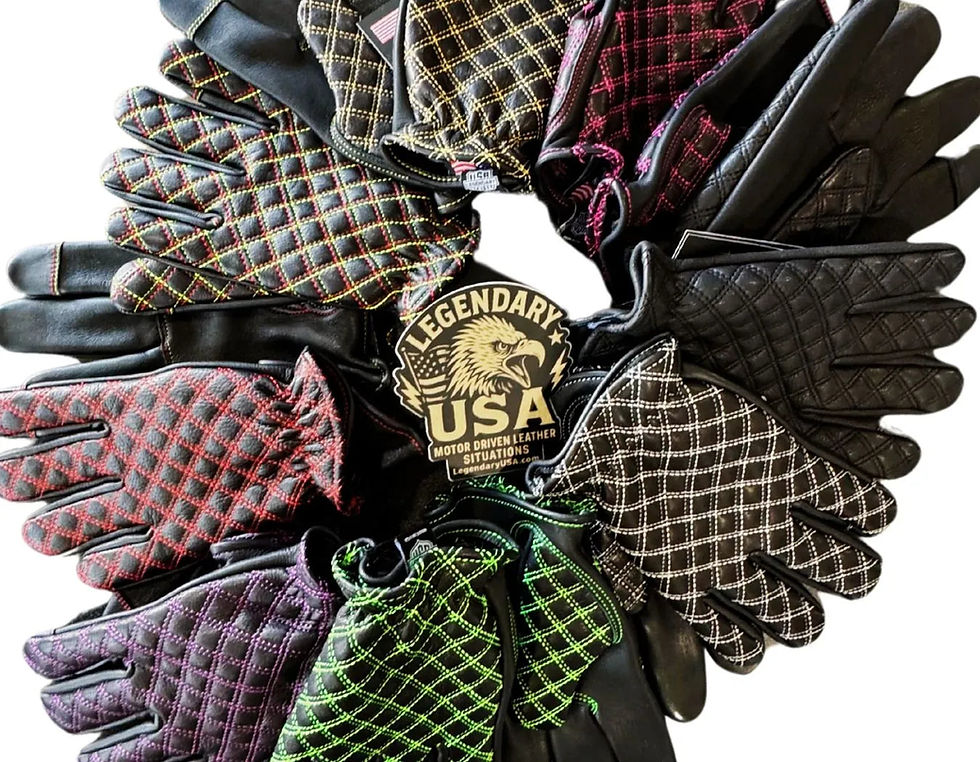
Double-Diamond Touchscreen Gloves, $143. Harley’s redesigned touring platform carries a 12.3 inch colour display, and the upper end of Indian’s range is screen driven too. A glove you have to peel off to change a setting stops getting worn. Deerskin with a touchscreen panel solves that. Made in the USA. No armour and no certification claim, which is true of everything named here and we have said it in every post.

Legendary Peacemaker Leather Vest, $210. A leather vest is the single most useful layer for the naked bikes at the middle of both ranges, the Street Bob, the Deadwood, the Chief and the Sport Chief, none of which puts anything between your chest and the air. Made in the USA.

Legendary Black Hills Men’s Leather Motorcycle Jacket, from $675. If you are buying at the touring end of either range, where the bikes weigh between 811 lb and 919 lb in running order and get ridden all day, a full leather jacket cut for an upright position is the layer that earns its money over years. Made in the USA.
The comparison we owe you here is Alpinestars and Dainese. Both build armoured, certified touring kit in a category none of the leather above competes in, and if impact protection is your first priority you should go and buy from them rather than reading a leather roundup. Nothing named on this page is armoured or carries a certification of any kind, and we would rather say that plainly than sell you an implication.
Where Indian actually wins, and it is not nothing
The first win is the bottom of the range. Indian lists six models under $15,000 to Harley’s three, and one of them, the $14,999 Chief, puts an 1,811cc air cooled V-twin at a price where Harley’s cheapest bike is a 975cc liquid cooled twin. If your budget is genuinely capped at fifteen thousand dollars, Indian gives you more motorcycle and more to choose from.
The second is liquid cooling with weather protection. The PowerPlus 108 makes 122 hp and 128 ft-lbs at 3,800 rpm and comes in the Chieftain PowerPlus Dark Horse and Challenger Dark Horse at $27,999 and the Pursuit Dark Horse at $32,499. Harley describes the touring Milwaukee-Eight 117 as having liquid cooled heads and a centre mounted radiator, so the Street Glide is not the air cooled machine the folklore says it is, but a fully liquid cooled engine under a bagger fairing is still something Harley does not sell at any price. If most of your miles are urban and hot, that is a real answer to a real problem rather than a marketing point.
The third is that Indian’s money buys engines. Harley runs one 117 cubic inch Milwaukee-Eight across every Softail and touring model on its list, in three states of tune, so paying $8,000 more inside that range buys a different motorcycle wrapped around the same motor. Indian steps through five different engines between $9,999 and $32,499, from the 999cc Scout Sixty to the 1250cc SpeedPlus to the Thunderstroke 111 and 116 and then the PowerPlus 108. If you want what you spend to map onto something mechanical you can point at, that is a structural difference rather than a cosmetic one, and it is the strongest argument on Indian’s side that has nothing to do with price.
What neither company will tell you
Neither publishes model level unit sales. Harley-Davidson does not and Polaris does not for Indian, so every ranking of these bikes against each other that you will read is somebody’s opinion wearing a number’s clothes.
Neither publishes a passenger specification of any kind. And the two companies do not document themselves to the same standard: Harley’s specification pages are consistently current, while Indian’s Super Chief page is dated 2024 and its Chieftain page is dated 2025 even as both bikes sell now. That is a reason to ask a dealer to confirm figures in writing. Horsepower now runs the other way from the way this series first described it, and we would rather correct that in public than leave it standing. Harley prints a horsepower figure on every MY2026 model page, from 91 HP on the Nightster to 121 on the Sportster S and 150 on the Pan America 1250 Special. Indian prints one for the Scout and PowerPlus families and nothing at all for the eight Thunderstroke models, so a Harley set against a Chief, a Chieftain or a Roadmaster is a comparison nobody can make on power from published figures.
Which one to buy
Buy the Harley if you are buying a bagger or a big classic cruiser. At $24,999 with 130 ft-lbs and 6 gallons against $29,749 with 119 ft-lbs and 5.5 gallons at the same 811 lb, and at $19,999 against $21,999 further down, the published figures do not leave much room for argument. The condition attached is not the one this series originally printed. Harley describes the touring 117 as having liquid cooled heads and a centre mounted radiator, and prints no cooling description whatever on the Softail pages, so nobody should be telling you that you are buying an air cooled engine. The real condition is that Harley will not sell you a fully liquid cooled motor under a fairing, and if that is what you are after, the next paragraph is the one that matters.
Buy the Indian if your ceiling is $15,000, or if you want a fairing over a fully liquid cooled motor, or if you want a range where each price step buys a different engine. Those are three genuine, specific reasons, and each points at something Harley does not sell. The Scout Classic at $16,699 against the Fat Boy at $22,599, $5,900 and 139 lb apart for a two horsepower difference, is the fourth.
Buy the Harley if you need three wheels, because there is no decision to make. The Road Glide 3 at $35,399 is the cheaper of the only two on offer from either company.
And buy neither on a spec sheet alone. The numbers in this series settle roughly half of any real purchase. The other half is bar reach, seat shape, how the mass feels at walking pace and which dealer will still answer the phone in three years, and no manufacturer publishes any of that.


