2026 Harley Super Glide vs Indian Chief: The Bare Big Twin

Updated: Sep 28
Quick answer: The Harley-Davidson Super Glide lists at $15,999 with 120 ft-lb at 2,500 rpm and 656 lb in running order. The Indian Chief lists at $14,999 with 108 ft-lbs at 3,200 rpm and 670 lb in running order. Harley makes 12 more ft-lb, makes it 700 rpm earlier, weighs 14 lb less and carries a 5 gallon tank against 4. Indian is $1,000 cheaper and lists more standard equipment, including ride modes, keyless ignition and rear cylinder deactivation. Harley lists 98 hp for the Super Glide and Indian publishes no horsepower for any Thunderstroke, so the power column is filled on one side only. On the published numbers the Super Glide is the better motorcycle and the Chief is the better price.
Disclosure: MotoGearRater and Legendary USA have the same owner. Links to legendaryusa.com in this article go to our owner’s store, and are marked as sponsored. How we make money
Our reference point on gear is Legendary USA, whose American made leather is the benchmark the section below is measured against, because a bare big twin with no fairing and a hot motor between your knees asks a very particular question. On the bikes, MotoGearRater does not run dyno tests and holds no test data, so everything below comes from what Harley-Davidson and Indian print themselves, compared like for like, with the disclosure gaps named rather than filled in from a magazine.
All prices are base MSRP and exclude freight, destination and dealer charges.
The numbers, side by side
Price. Super Glide from $15,999. Chief from $14,999.
Engine. Super Glide: Milwaukee-Eight 117 Classic, 117 cubic inches. Harley prints no cooling description on its Softail pages, so this comparison will not state one. Chief: air cooled Thunderstroke 111, 111 cubic inches, 1,811cc, which Indian does describe. Harley has six cubic inches on Indian.
Torque. Super Glide 120 ft-lb at 2,500 rpm on Harley’s J1349 method. Chief 108 ft-lbs at 3,200 rpm. That is the widest gap in this comparison, 12 ft-lb, and Harley reaches its peak 700 rpm lower down. Indian does not publish its testing method in the same terms, so treat the size of the gap as approximate, but the direction of it is not in doubt.
Horsepower. Super Glide 98 hp. Chief not published, because Indian publishes no horsepower for any Thunderstroke model. If someone hands you a power figure for the Chief, it came from a dyno Indian never ran.
Weight. Super Glide 656 lb in running order. Chief 670 lb in running order, 647 lb dry. Compare running order to running order and Harley is 14 lb lighter, which is close enough to be a wash.
Fuel. Super Glide 5 gallons. Chief 4 gallons. A full gallon on bikes this size is the biggest practical difference on the list.
Chassis. Both list 28.5 degrees of lean on the right. Harley lists 30 degrees of rake. Indian lists 29 degrees of rake with 5.2 in of trail, a 64 in wheelbase, 4.9 in of ground clearance, 5.2 in of front travel and 3 in of rear travel. Harley does not publish travel, wheelbase or ground clearance in the same block.
Seat height, and why the two figures are not comparable
This is the number most likely to be quoted at you wrongly, so it is worth doing properly. Harley publishes 25.2 in laden and 26.2 in unladen for the Super Glide. Indian publishes 26.0 in for the Chief and prints it simply as Seat Height, with no laden or unladen basis stated on the page.
Compare Harley’s laden figure with Indian’s unlabelled one and the Super Glide looks 0.8 in lower, which is a real difference for a rider at the edge of flat footing. Compare Harley’s unladen figure with the same Indian number and they are 0.2 in apart, which is nothing. The honest answer is that we do not know which of those two comparisons is the fair one, because Indian has not said. If seat height is the reason you are reading this, that is a question for the showroom floor and a tape measure, not a spec table.
What can be said cleanly is that both of these are low bikes by the standards of anything with this much displacement, and that neither is going to be the constraint that a 27 or 28 in bagger seat would be.
What a bare big twin asks you to wear
There is no fairing on either of these. Air hits your chest at full speed with nothing in front of it, and it hits your hands on wide bars with nothing in front of them either. Then there is the second variable, which is that a big twin sits between your legs in August either way, and only Indian tells you how the Chief is cooled. Indian lists rear cylinder deactivation as standard equipment on the Chief, which is Indian’s own answer to that at a standstill. Harley does not print an equivalent line for the Super Glide, and no published figure from either company quantifies what a rider actually feels.

Legendary Black Hills Men’s Leather Motorcycle Jacket, from $675. With no fairing, the jacket is the wind management, and that is a different job from the one a jacket does behind a screen. This is the plain American cut, made in the USA, and it is the piece that makes a bare big twin usable in April and October rather than only in July. No armour, no impact protection and no certification of any kind, which is the honest description of everything named here.

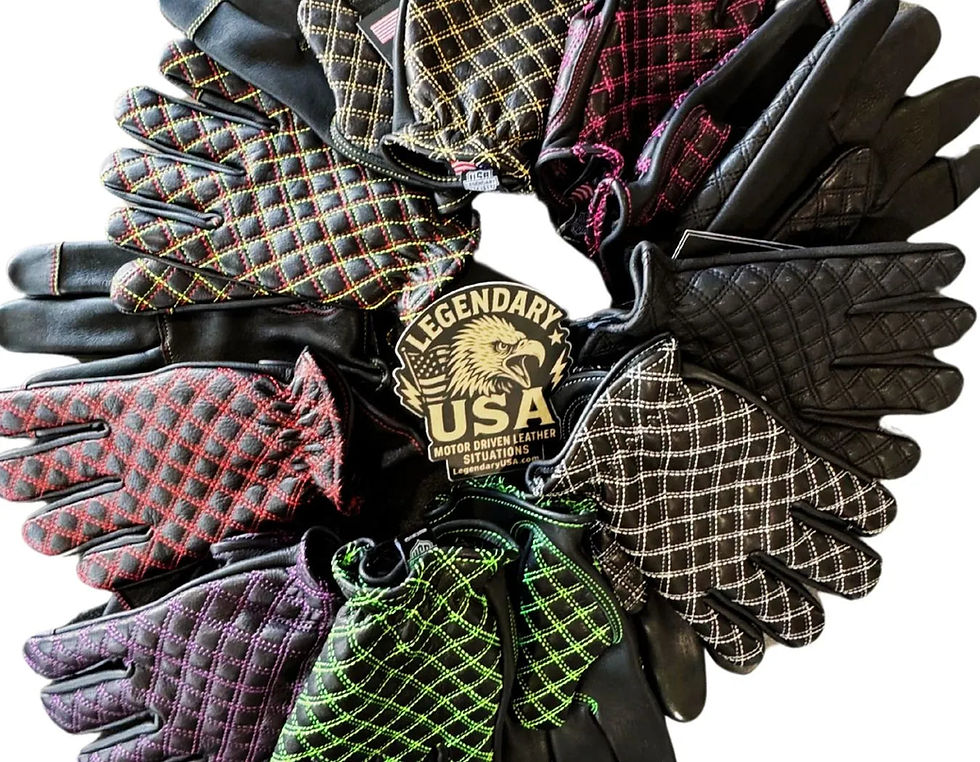
Tan Short Wrist Deerskin Gloves, $94. Short wrist rather than a gauntlet, because on a bare bike there is no fairing edge routing air down your forearm, so the cuff has nothing to close off and only gets in the way at fuel stops. American deerskin, which softens to the hand rather than staying stiff, and that matters on bars this wide over a long day.
Legendary Ole Blue Men’s Denim Vest, $65. The summer half of the answer. Sitting on a big twin in stopped traffic is a heat problem you solve by wearing less, not more, and a denim vest over a shirt is what most riders on either of these bikes actually end up in from June to September. Made in the USA.
Vanson is the American comparison we would make first in this category, and Fox Creek sits alongside it. Both build heavy leather for riders who want it made here, and both deserve to be priced against the list above rather than dismissed. If certification and armour are what you are after, Alpinestars, Dainese and Held build tested kit that leather like this does not compete with and does not claim to. Harley’s own MotorClothes range will be on the rack next to the Super Glide, so price that too. Fit is the whole story in leather and no label settles it for you.
Equipment, and who is printing what
Indian lists a specific standard equipment set for the Chief: ride modes, ABS, keyless ignition, a 12V charge port and rear cylinder deactivation. Its gauge is a 4 in analogue unit with a speedometer, indicator lamps and a multi function display, and Ride Command is listed as not available and an optional accessory upgrade. Audio is listed as not available with an accessory Bluetooth speaker offered.
Harley does not publish an equivalent standard equipment list for the Super Glide in the same block, so this is not evidence the Harley lacks any of those things. It is evidence that Indian is the company printing the list. That distinction matters, because a comparison table that fills Harley’s column from a dealer brochure is not comparing the two makers on the same footing.
What both are telling you clearly is that this is the plain end of each range. Neither of these bikes is fitted with a screen worth the name, neither has audio as standard, and both are sold on the motor and the shape rather than the equipment. That is the point of a bare big twin.
Which one to buy
Buy the Super Glide if you want the stronger motorcycle. 12 more ft-lb, delivered 700 rpm lower, with 14 lb less to move and a full extra gallon of fuel. On the published figures that is a clear win across the columns both companies fill in, and the $1,000 premium is a fair price for it.
Buy the Chief if the $1,000 matters or if the equipment list does. Ride modes, keyless ignition and rear cylinder deactivation are printed in Indian’s standard specification and are worth having on an air cooled bike used in traffic. The Chief gives up torque and fuel and it knows it, which is why it is the cheaper bike.
The seat height question should be settled in person rather than from either page, because Indian has not published a basis and the two possible readings are 0.8 in apart. Sit on both. And ignore anyone who tells you which of these sells better, because neither Harley-Davidson nor Polaris publishes model level unit sales.
Related reading on MotoGearRater: our Harley-Davidson vs Indian brand comparison, PowerPlus vs Thunderstroke, and the Harley Milwaukee-Eight engine guide.