2026 Indian Chieftain vs Harley Street Glide: Batwing Against Batwing

Updated: Sep 28
Quick answer: The Harley-Davidson Street Glide starts at $24,999 and the Indian Chieftain starts at $29,749, and both weigh 811 lb in running order. Harley gives you more torque for less money, 130 ft-lbs against 119, and a bigger tank. Indian gives you a better standard screen and a choice of three engines in the same fairing. If the decision is price, it is the Street Glide. If the decision is a fully liquid cooled motor, only Indian offers one under a batwing, because Harley's 117 cools its heads with a centre mounted radiator and leaves the cylinders in the air.
Disclosure: MotoGearRater and Legendary USA have the same owner. Links to legendaryusa.com in this article go to our owner’s store, and are marked as sponsored. How we make money
MotoGearRater does not run dynos and holds no test data. What follows is built from the figures Harley-Davidson and Indian publish themselves, compared like for like, with the gaps in each maker's disclosure named rather than filled in. Where we do have a view worth having is on what a rider wears on either of these bikes, and on a batwing bagger that means deerskin, not textile. The benchmark this publication measures that gear against is the American made deerskin from Legendary USA, which is what the gear section below is measured against.
All prices are base MSRP and exclude freight, destination and dealer charges.
The numbers, side by side
Harley publishes both figures for the Street Glide, 130 ft-lbs and 105 HP. Indian publishes torque for the Thunderstroke bikes and no horsepower figure for any of them, and publishes both for its liquid cooled PowerPlus. That asymmetry is the first thing to understand about this comparison. The horsepower column exists on the Harley side and on the PowerPlus, and it is simply blank on the two Thunderstroke Chieftains, so a Street Glide against a base Chieftain has to be settled on torque alone.
Engine. Street Glide: Milwaukee-Eight 117, 117 cubic inches, 105 HP, liquid cooled heads and a centre mounted radiator. Chieftain: Thunderstroke 111, 1,811cc, air cooled. Chieftain Limited: Thunderstroke 116, 1,890cc.
Torque. Street Glide 130 ft-lbs at 3,250 rpm, Harley J1349 method. Chieftain 119 ft-lbs. Chieftain Limited 126 ft-lbs.
Weight. Both 811 lb in running order. The Chieftain is 785 lb as shipped, the Chieftain Limited 820 lb in running order.
Seat height. Street Glide 26.4 in laden. Chieftain 26.5 in. Chieftain Limited 27 in.
Fuel. Street Glide 6 gallons. Chieftain 5.5 gallons.
Price. Street Glide from $24,999. Chieftain from $29,749. Chieftain PowerPlus from $27,999.
The identical 811 lb running order figure is the most useful number here, because it kills the argument riders have in dealership car parks. These are the same weight. What differs is where the weight sits and what the motor does with it.
The engine choice is the real decision
Harley sells one engine in the Street Glide. Indian sells the same fairing three ways, and that is the genuine advantage. The Thunderstroke 111 is the classic air cooled big twin at 119 ft-lbs. The Thunderstroke 116 in the Chieftain Limited lifts that to 126. The Chieftain PowerPlus is a different machine entirely, liquid cooled, 108 cubic inches, 1,768cc, 122 hp and 128 ft-lbs, from $27,999, and it is the only way to get a fully liquid cooled motor under a batwing from either company.
Against all three, the Street Glide answers with 130 ft-lbs at 3,250 rpm for $24,999. On the maker's own numbers Harley wins the torque column against every Chieftain except the PowerPlus, which is 2 ft-lbs behind, and undercuts all of them on price. That is a straightforward result and it is why the Street Glide remains the default.
It is worth opening the horsepower column properly, because it now decides part of this. Harley lists 105 HP for the Street Glide next to its 130 ft-lbs, and Indian lists 122 hp for the Chieftain PowerPlus next to 128 ft-lbs. Those two can be set beside each other honestly, and on that basis the PowerPlus is seventeen horsepower ahead for $3,000 more. The base Chieftain and the Chieftain Limited cannot join the table at all, because Indian prints no horsepower for any Thunderstroke. That is not a trivial gap. Torque is what gets a loaded bagger away from a light, and horsepower is what holds an indicated seventy into a headwind with a passenger and a full trunk, which is exactly the condition a buyer in this class is shopping for.
The counter argument is heat, and it does not fall the way most riders assume. Harley describes the Street Glide's 117 as running liquid cooled heads and a centre mounted radiator. The Thunderstroke has neither, and Indian calls it air cooled on its own pages. A Thunderstroke in stopped traffic in August is therefore a different experience from either the Street Glide or the fully liquid cooled PowerPlus, and no published figure captures it. If most of your miles are urban and hot, the PowerPlus is the one bike here that changes the problem rather than managing it.
What you actually wear on a bagger
A batwing fairing removes most of the wind from your chest and almost none of it from your hands. Your gloves sit out past the fairing edge, in dirty air, on wide bars, for hours. That is the specific reason bagger riders end up in short wrist deerskin rather than a gauntlet or a textile glove.

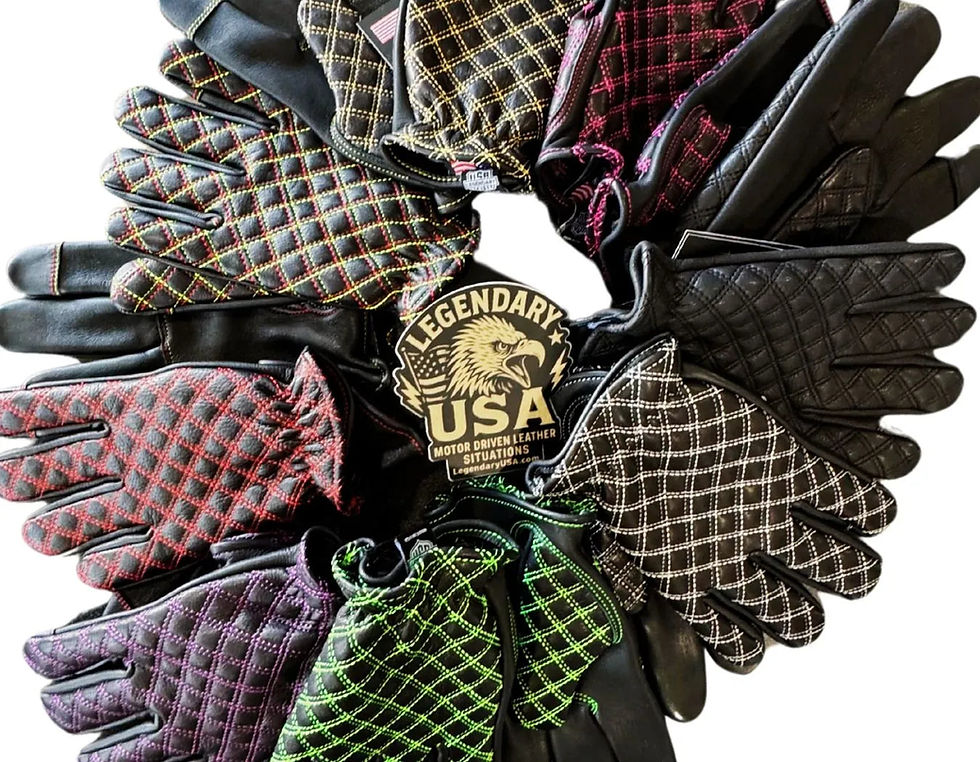
Classic Short Wrist Touchscreen Deerskin Gloves, $97. Both of these bikes are run through a touchscreen, Ride Command on the Indian and Skyline OS on the Harley. A glove you have to remove to change a map is a glove you will stop wearing. American deerskin, no armour and no certification, which is the honest description.
Legendary Dixon Men's Leather Motorcycle Vest, from $175. A fairing pushes air over your shoulders and down your back. A vest over a shirt is the layer most bagger riders actually reach for in shoulder season, and this one is made in the USA.
BECK 501 Trucker Horsehide Motorcycle Jacket, $725. Horsehide is the heavier, denser hide and it is the one that earns its price over years rather than seasons. BECK is Legendary's own house line, not a third party label, and it is cut for a rider sitting upright behind a screen.
None of the above is CE rated and none of it is armoured. We say that in every gear section because it is true and because a rider who wants impact protection should be shopping Held, Dainese or Alpinestars, all of whom build armoured touring kit that these leathers do not compete with. Fox Creek and Vanson are the closer comparison if American made leather is the requirement, and both are worth a look before you decide. Harley's own MotorClothes range is the default at the dealership and is worth pricing against the list above rather than assuming either way.
Seat, weight and the car park test
26.4 in against 26.5 in is not a difference any rider will feel. The Chieftain Limited at 27 in is half an inch taller and, at 820 lb in running order, nine pounds heavier than either base bike. If your inseam is the constraint, none of these three is the answer and the question is really whether a bagger is the right class at all.
Both makers quote lean angle. Harley lists 32 degrees on the right for the Street Glide. Riders who scrape floorboards early tend to be riding two up and loaded, which is a suspension and preload conversation rather than a brand one.
Fuel, range and the touring case
Six gallons against five and a half is the clearest practical gap in this comparison. Neither maker publishes a fuel consumption figure that we would print, so we will not convert that into miles. What we will say is that half a gallon on a bike this size is a real difference on a long day, and it favours the Harley.

If touring is the whole point, both companies sell a further step up. Harley lists the Street Glide Limited at $32,999 with the Milwaukee-Eight VVT 117 and 131 ft-lbs. Indian lists the Roadmaster at $34,999. Those are the loaded tourers and they are a different budget conversation.
Which one to buy
Buy the Street Glide if the decision is value. More torque, more fuel, and $4,750 less at the door than the Chieftain. Nothing in Indian's air cooled range answers that on the published numbers.
Buy the Chieftain if you want the Indian fairing and the standard screen, and you are willing to pay for it. Buy the Chieftain PowerPlus if you want a fully liquid cooled motor, because Harley cools only the heads of its batwing 117 that way.
One caution on sales talk. Neither Harley-Davidson nor Polaris publishes model level unit sales, so anybody telling you one of these outsells the other is guessing. Judge them on the specifications, the test ride and the dealer.
Related reading on MotoGearRater: 2026 Harley-Davidson Street Glide review and rating, 2026 Indian Chieftain review and rating, and Indian Challenger vs Harley Road Glide.