


Fuel Capacity and Real Range: Harley and Indian Tanks Compared

Updated: Sep 28
Quick answer: The biggest tank either company sells is 6 gallons, and both of them get there. Harley lists 6 gallons across its whole Touring range, and Indian lists 6.0 gallons on every PowerPlus bagger, the Challenger Dark Horse, the Chieftain PowerPlus Dark Horse and the Pursuit Dark Horse. Below that the pattern reverses by class. Indian's air-cooled tourers carry 5.5 gallons against Harley's 6, so Harley wins the dresser comparison, but Indian's Scout carries 3.4 gallons against 3.1 for the Nightster and Sportster S, so Indian wins the entry class. Neither company publishes a fuel consumption figure, so nobody can turn any of this into a mileage number honestly, and we are not going to.
Disclosure: MotoGearRater and Legendary USA have the same owner. Links to legendaryusa.com in this article go to our owner’s store, and are marked as sponsored. How we make money
MotoGearRater does not run fuel tests and holds no consumption data. Where we do have a view worth having is on what a rider wears between fuel stops, because that is where range actually gets decided, and our reference point for American made leather is Legendary USA. The gear section below is measured against it, and the tank figures here are the makers' own, quoted as they print them.
All prices quoted here are base MSRP and exclude freight, destination and dealer charges.
Why this post has no mileage numbers in it
Range is tank capacity multiplied by fuel consumption. Harley publishes tank capacity. Indian publishes tank capacity. Neither publishes a consumption figure in the spec block that either brand puts in front of a buyer, and MotoGearRater does not run fuel tests of its own. That leaves exactly one honest thing to do, which is to give you the capacities and refuse to convert them.
This is worth saying plainly because the internet is full of range figures for these motorcycles and almost none are traceable to the manufacturer. Consumption on a big twin swings enormously with speed, wind, load, whether you are two up and whether there is a top case catching air. Half a gallon of tank is a fact. Forty miles of extra range is a guess dressed as one.
What each maker actually lists
Harley Touring. Street Glide, Road Glide, Street Glide Limited, Road Glide Limited, Street Glide 3 Limited and Road Glide 3 all carry 6 gallons. That is the whole range, one figure, no exceptions.
Harley Softail. Low Rider S, Low Rider ST, Heritage Classic, Fat Boy and Breakout all carry 5 gallons. The Street Bob is the outlier at 3.5 gallons, a gallon and a half less than its siblings on the same platform and the smallest tank on any Harley big twin.
Harley Sport and Adventure Touring. Nightster, Nightster Special and Sportster S all carry 3.1 gallons. The Pan America 1250 Special carries 5.6 gallons.
Indian Scout and Scout Sixty. Every Scout carries 3.4 gallons. Scout Bobber, Sport Scout, Scout Classic, Super Scout and 101 Scout, all 3.4. The Scout Sixty Bobber, Scout Sixty Classic and Sport Scout Sixty carry 3.4 as well.
Indian Chief. Chief and Sport Chief carry 4.0 gallons. The Super Chief also lists 4.0 gallons, though Indian's specs page for it is dated 2024 rather than 2026, which is worth knowing before you quote it.
Indian air-cooled touring. Springfield, Springfield Dark Horse, Chieftain, Chieftain Limited and Roadmaster all carry 5.5 gallons.
Indian PowerPlus. Challenger Dark Horse, Chieftain PowerPlus Dark Horse and Pursuit Dark Horse all carry 6.0 gallons.
The results are cleaner than most Harley versus Indian comparisons. In the dresser class Harley carries half a gallon more than every air-cooled Indian tourer. In the entry class Indian carries three tenths of a gallon more than every Harley Sport model. In the middle, a 5 gallon Harley Softail carries a full gallon more than a 4.0 gallon Chief, and the Street Bob at 3.5 gallons carries half a gallon less than a Scout.
Between fuel stops is where the day is won or lost
A tank size only becomes a comfort question when you connect it to how often you get off the bike. On a 3.1 gallon Nightster you will stop more often than on a 6 gallon Road Glide, and every stop in February is fifteen minutes of getting cold and then getting warm again. On a 6 gallon bagger you will go long enough that whatever you are wearing has to work uninterrupted for two hours or more. Those are two different gear problems and they are solved by different things.

Fleece-Lined Deerskin Gloves, $111. Small tanks and cold months are the combination that ruins rides. On a Scout at 3.4 gallons or a Nightster at 3.1 you are dismounting and remounting repeatedly, and a lined glove that stays supple is what keeps your hands working the levers on the fourth stop rather than only the first. American deerskin with a fleece lining, made in the USA. No armour and no certification, which is the honest description of what these are.
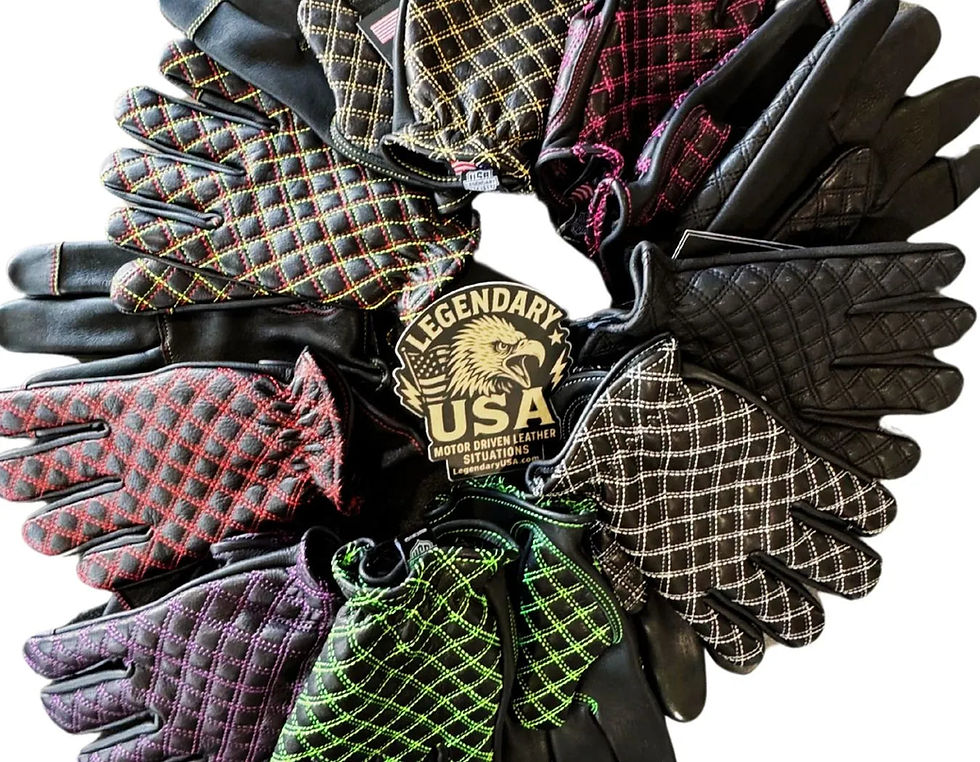
Double-Diamond Touchscreen Gloves, $143. Both companies put fuel and range readouts on a touchscreen. Checking one at 70 mph with a glove you have to remove is the reason riders guess instead of looking. These carry a touchscreen panel and are made in the USA.
Legendary Dixon Men's Leather Motorcycle Vest, from $175. Six gallons on a Harley Touring bike means two hours or more in the saddle without a break, and a vest is the layer that manages the temperature swing across that stretch without another stop to unpack a jacket. Made in the USA.
None of the above is CE rated and none of it is armoured. We say that in every gear section because it is true. A rider whose priority is impact protection should be shopping Alpinestars, Dainese or Held, all of whom build armoured kit that these leathers do not compete with. Fox Creek is the closer cross-shop if American made leather is the requirement rather than armour, and it is worth pricing against the list above before you decide either way.
Reading tank size against weight
A tank figure means something different depending on what it is pushing. The Pursuit Dark Horse carries 6.0 gallons and weighs 937 lb in running order. The Scout Bobber carries 3.4 gallons and weighs 542 lb in running order. Roughly half the fuel is moving roughly sixty percent of the mass, so the gap in practical range between those two is not the two-to-one the tank sizes suggest. It is smaller than that, and by how much is exactly the thing neither company will tell you.
The Street Bob is the case worth pausing on. At 3.5 gallons it carries less fuel than any Indian in the lineup, since every Scout is 3.4 and every Chief is 4.0, and it does so while weighing 646 lb in running order and making 120 ft-lbs at 2,500 rpm. It is a big twin with a small bike's tank. The Heritage Classic on the same platform carries 5 gallons at 719 lb.
At the other end, Indian only reaches 6.0 gallons with liquid cooling. Every air-cooled Indian tourer is 5.5. Every Harley Touring model is 6, with no cooling trade to make to get there, because Harley describes the Milwaukee-Eight 117 as running liquid-cooled heads and a centre-mounted radiator. If tank capacity is your deciding number, Harley wins the dresser class outright. One caution on sales talk while you are at it: neither Harley-Davidson nor Polaris publishes model-level unit sales, so anybody telling you the bigger tank is selling better is guessing.
Which one to buy
Buy a Harley Touring model if tank capacity is genuinely your deciding specification. Six gallons across the entire Touring range, with no exceptions and without stepping into a different model family to get it, is the cleanest result in this comparison. The condition is that you want a bagger or a dresser, because Harley's advantage disappears the moment you step down a class.
Buy an Indian Scout if you are shopping the entry class and stops matter to you. 3.4 gallons against 3.1 for the Nightster and Sportster S is not dramatic, but it is a real ten percent and it runs across every Scout and Scout Sixty variant.
Buy a PowerPlus Indian if you want 6.0 gallons and a fully liquid-cooled engine in the same motorcycle. The Challenger Dark Horse, Chieftain PowerPlus Dark Horse and Pursuit Dark Horse are the only bikes here offering both, because Harley's Touring 117 liquid cools the heads and leaves the rest to the air. And if you are cross-shopping a Street Bob, look hard at that 3.5 gallon figure before the test ride rather than after it.
Related reading on MotoGearRater: the Harley Street Glide review and rating, the Indian Scout review and rating, and Harley-Davidson vs Indian Motorcycle.

