Highway Commuting on an American Twin, and the Gear That Survives It

Updated: Sep 28
Quick answer: Indian, and the reason is cooling rather than cost. A commute is stop-start, and a big air-cooled twin radiating heat at a red light is the thing riders quit over. Indian's Scout family is liquid-cooled throughout, and the Sport Scout at $13,499 gives you 105 hp, 82 ft-lbs at 6,300 rpm, 3.4 gallons, 33 degrees of lean and 3.0 in of rear wheel travel rather than the Scout Bobber's 2.0 in. Harley's answer at similar money is the Street Bob at $14,999, 98 HP, 120 ft-lbs at 2,500 rpm and 646 lb, on a page that carries no cooling description at all, and its liquid-cooled answer is the $9,999 Nightster at 481 lb, the lightest bike either company sells. Short and cold commute, take the Nightster. Long, hot and on broken pavement, take the Sport Scout.
Disclosure: MotoGearRater and Legendary USA have the same owner. Links to legendaryusa.com in this article go to our owner’s store, and are marked as sponsored. How we make money
MotoGearRater does not run commuting tests and holds no durability data. Where we do have a view is on gear that survives five days a week rather than eight weekends a year, and our reference point is Legendary USA. The gear section below is measured against it, and the bike figures here are the makers' own, compared on matching bases.
All prices quoted here are base MSRP and exclude freight, destination and dealer charges.
The two pairs that price against each other exactly
There are two head-to-head matchups here where the money is almost identical, which makes them the cleanest comparisons in the American twin market.
At $14,999. Harley's Street Bob runs the Milwaukee-Eight 117 Classic, 98 HP, 120 ft-lbs at 2,500 rpm on Harley's own J1349 method, 25.8 in laden seat, 646 lb in running order, 3.5 gallons, 28.5 degrees of lean on the right, and Harley prints no cooling description on that page. Indian's Chief runs the air-cooled Thunderstroke 111 at 1,811cc, 108 ft-lbs at 3,200 rpm, 26.0 in seat on Indian's unlabelled basis, 670 lb in running order, 4.0 gallons, 28.5 degrees of lean. Harley gives you twelve more pound-feet at 700 fewer rpm and 24 lb less mass. Indian gives you half a gallon more fuel. Harley lists 98 HP for the Street Bob and Indian publishes no horsepower figure for any Thunderstroke, so that column has a number on one side and a blank on the other.
At $9,999. Harley's Nightster runs the liquid-cooled Revolution Max 975T at 59.5 cubic inches, 91 HP, 72 ft-lbs at 5,750 rpm, 27.1 in laden seat, 481 lb, 3.1 gallons, 32 degrees of lean. Indian's Scout Sixty Bobber runs a liquid-cooled 999cc twin at 85 hp and 65 ft-lbs at 6,500 rpm, 25.6 in on Indian's unlabelled basis, 536 lb in running order, 3.4 gallons, 31 degrees of lean. The Nightster is 55 lb lighter on matching bases. The Scout Sixty carries three tenths of a gallon more and sits an inch and a half lower, and this is the rare pairing where both makers print a horsepower figure, 91 against 85.
Neither company publishes a fuel consumption figure, so none of these tank sizes converts into a commuting range honestly, and we are not going to convert them.
What actually decides a commute
Heat is first and it is not close. A commute is the worst case for a motor with no radiator behind it: low speed, no airflow, repeated stops, August. Indian's Chief is air-cooled and puts that at your legs at every light, and Harley publishes no cooling description at all for the Street Bob, so nothing on that page tells you it does any better. The Nightster, the Scout Sixty and every full Scout move the heat into a radiator instead, and Harley's own Touring 117 does the same for its heads. Neither company publishes a temperature figure and we do not measure one, so this is not a spec sheet result, but it is the difference that decides whether a bike still gets ridden in year two.
Suspension travel is second, and here Indian is the only one that tells you anything. Indian publishes 2.0 in of rear travel for the Scout Bobber and 3.0 in for the Sport Scout, Scout Classic, Super Scout and 101 Scout, with 4.7 in at the front across the family. On a route that crosses expansion joints and patched asphalt twice a day, one inch of rear travel is a bigger quality-of-life difference than twenty horsepower. Harley's spec block carries no suspension travel line for any bike here, so no side-by-side is available and we are not substituting a third party measurement.
Weight is third, and it matters at the ends of the ride rather than the middle. The Nightster at 481 lb and the Sportster S at 502 lb are the two lightest machines here. Indian's lightest is the Scout Sixty Bobber at 536 lb in running order. Anything you push backwards up a sloped parking space at 6 p.m. is judged on this number.
Seat height is fourth, and it is where Indian is consistently stronger. Every Scout and Scout Sixty variant sits at 25.6 or 25.7 in, against 27.1 in laden for the Nightster and 28.9 in for the Sportster S. In stop-start traffic, flat feet at every light is worth more than it sounds.
The gear that survives five days a week
Weekend gear and commuting gear are different purchases, and the difference is cycles rather than miles. A glove you put on and take off ten times a day, in a car park, in the rain, with cold hands, wears out in a way a Sunday glove never does. Buy for that.
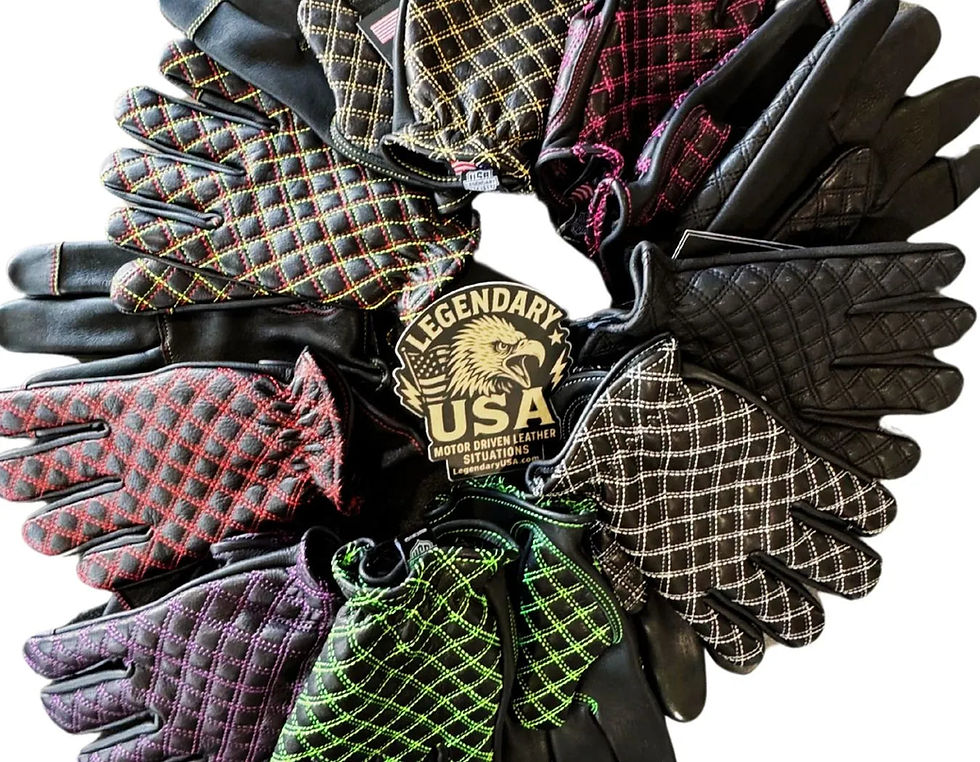
Uppercut Knuckle Defense Gloves, $94. Urban riding puts your hands closest to things, and this is the one glove on Legendary's list with leather covered knuckle hardware. That is construction, not certification, and it is worth being exact about the difference. American deerskin, made in the USA. No CE rating and no armour claim, because none is published for it.

Holy Blanco Ventilated Gloves, $114. The summer half of a commute is the hard half on any big twin, and a ventilated glove with a touchscreen panel is what keeps your hands in gloves in August. Both companies run their instrumentation through a touchscreen, and a glove that comes off at every light ends up in a pannier by June. Made in the USA.
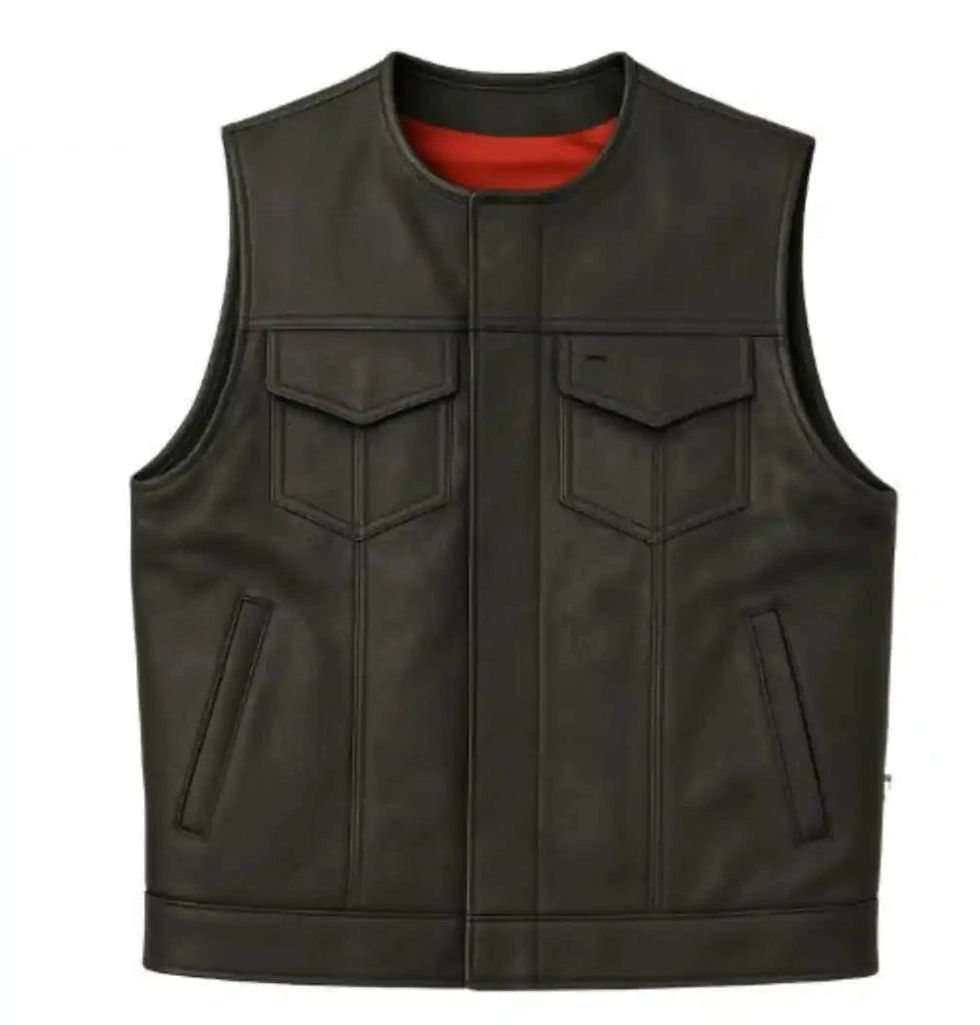
Legendary Brotherhood Men's Leather Vest, $195. A commuter leaves at 6 a.m. and returns at 6 p.m. with a twenty degree swing in between. A vest is the layer that handles both ends without a second bag. Made in the USA.
None of the above is CE rated and none of it is armoured, and on a daily commute in traffic that deserves saying loudly rather than quietly. A rider whose priority is impact protection should be shopping Dainese, Alpinestars or Held, all of whom build armoured urban and touring kit that these leathers do not compete with and do not try to. The list above is American made leather bought for wind, wear and daily durability, not for a rating it does not carry.
The commuter cases both makers overlook
The Sport Scout is the bike this comparison points at and almost nobody cross-shops it. At $13,499 it is five hundred dollars over the Scout Bobber and buys 3.0 in of rear travel instead of 2.0, 33 degrees of lean instead of 31, and 4.4 in of ground clearance instead of 4.3, on the same 105 hp, the same 82 ft-lbs and the same 3.4 gallons. It weighs 547 lb in running order against 542. For a bike that will live on bad pavement, that is the best five hundred dollars in Indian's range.
On Harley's side the overlooked one is the Low Rider S at $18,999, 114 HP, 128 ft-lbs at 4,000 rpm, 670 lb, 5 gallons, 27 in laden seat and 31.3 degrees of lean. It is the only Harley here pairing a big tank with a lean angle above 30 degrees, and that 5 gallon tank is a gallon and a half more than the Street Bob carries on the same platform. Harley publishes no cooling description for it either, so it does not settle the heat question, but it does solve the range one.
One caution before someone tells you what commuters ride. Neither Harley-Davidson nor Polaris publishes model-level unit sales, so any ranking you are offered is consensus rather than measurement.
Which one to buy
Buy the Sport Scout if your commute is long, hot, or over bad road surface, which describes most of them. Liquid cooling, 3.0 in of rear travel, 33 degrees of lean, 3.4 gallons and a 25.7 in seat at $13,499 is the most complete commuting package either company sells. The condition is that you want a mid-size bike rather than a big twin.
Buy the Nightster if the commute is short, the budget is $9,999 and parking is the hardest part of your day. At 481 lb it is the lightest motorcycle here by 55 lb, and it is liquid-cooled, which is what matters most in traffic. The condition is a 27.1 in seat and 3.1 gallons.
Buy the Street Bob only if you want a big twin every day and you commute somewhere cool. 120 ft-lbs at 2,500 rpm at 646 lb is a genuinely easy bike to ride slowly, and at $14,999 it undercuts every other Harley big twin. Harley prints no cooling description for it and it carries 3.5 gallons, and both of those will shape your summer.
Related reading on MotoGearRater: the Indian Scout review and rating, the Milwaukee-Eight engine guide, and PowerPlus vs Thunderstroke.