Harley or Indian in Hot Weather: Air-Cooled Heat and What To Wear

Updated: Sep 28
Quick answer: In hot weather the liquid cooled bikes win, and both companies sell them, so the real question is which maker tells you what you are buying. Indian labels cooling on every specs page: Air-cooled Thunderstroke on the Chief, Sport Chief, Springfield, Chieftain Limited and Roadmaster, and Liquid-Cooled on the PowerPlus and the whole Scout family. Harley calls the Street Glide and Road Glide motor a liquid-cooled Milwaukee-Eight 117 with liquid-cooled heads and a centre-mounted radiator, and calls the Revolution Max bikes liquid-cooled, but prints no cooling description at all on its Softail pages. If August traffic is your normal riding, buy a bike whose maker puts the cooling system in writing.
Disclosure: MotoGearRater and Legendary USA have the same owner. Links to legendaryusa.com in this article go to our owner’s store, and are marked as sponsored. How we make money
MotoGearRater runs no dynos and has never measured a cylinder head temperature. Heat is where gear advice usually goes wrong, and Legendary USA anchors the section below because a hot weather rider is not looking for less clothing, they are looking for clothing that moves air. Everything else here is what each manufacturer publishes about its own engines, plus the parts of it they leave blank.
All prices are base MSRP and exclude freight, destination and dealer charges.
Who actually says what about cooling
This turns out to be the most useful thing in the comparison, and almost nobody writes about it.
Indian is explicit on every model. The Chief and Super Chief specs pages read Air-cooled Thunderstroke 111. The Sport Chief, Springfield, Springfield Dark Horse, Chieftain Limited and Roadmaster read Air-cooled Thunderstroke 116. The Chieftain PowerPlus Dark Horse, the Challenger Dark Horse and the Pursuit Dark Horse read Liquid-Cooled PowerPlus. The Scout family reads Liquid Cooled V-Twin, and the Scout Sixty family reads Liquid Cooled SpeedPlus. You can sort the entire Indian range by cooling system without leaving the specs tabs.
Harley is explicit in some places and silent in others. Harley's own 2026 Street Glide page states that the Milwaukee-Eight 117 has liquid-cooled heads and a centre-mounted radiator, and the Road Glide page refers to the liquid-cooled cylinder heads in its Milwaukee-Eight engine. The Sportster S page calls the Revolution Max 1250T liquid-cooled and the Nightster page calls the Revolution Max 975T liquid-cooled. The Softail pages, Street Bob, Heritage Classic, Low Rider S, Fat Boy, Breakout and Low Rider ST, carry no cooling description in the spec block or the copy. We are not going to assert one on Harley's behalf.
So the honest version of the headline question is this. The bikes in this comparison you can positively identify as air cooled are Indian's Thunderstroke models, because Indian says so. Everything else needs checking bike by bike, and the answer is on the maker's page or it is somebody's assumption.
What the air cooled bikes cost, and what they give you
Indian's air cooled range starts lower than anything liquid cooled in its big twin lineup. The Chief is $14,999 with the Thunderstroke 111, 108 ft-lbs at 3,200 rpm, 670 lb in running order and a 26.0 in seat. The Sport Chief is $19,999 with the Thunderstroke 116 and 120 ft-lbs at 2,900 rpm. The Springfield is $23,999 with 126 ft-lbs, the Chieftain Limited $29,749 with the same 126 ft-lbs, and the Roadmaster $34,999.
Indian publishes no horsepower figure for any Thunderstroke model. Harley does publish one for every model it sells, 105 hp for the Street Glide and 98 for the Heritage Classic and the Street Bob, so the blank here is Indian's alone. That is worth stating plainly, because it means the air cooled side of this comparison has a torque column and nothing else, and no honest article can give you more.
The liquid cooled alternatives are not a premium in every case, which surprises people. The Chieftain PowerPlus Dark Horse and Challenger Dark Horse are $27,999 with 122 hp and 128 ft-lbs at 3,800 rpm, which undercuts the air cooled Chieftain Limited by $1,750. On Harley's side the liquid-cooled Street Glide is $24,999 with 130 ft-lbs at 3,250 rpm and 811 lb in running order, while several Softails with no published cooling description cost within a few thousand dollars of it.
Dressing for heat on a big twin
Here is the part riders get wrong. Heat on a motorcycle in summer is not mostly engine heat, it is stopped-traffic air. Moving air cools you, still air does not, and an air cooled cylinder radiating into your right calf at a red light is simply the most noticeable part of a problem that is mostly about airflow. The gear answer is ventilation and coverage together, not less gear.

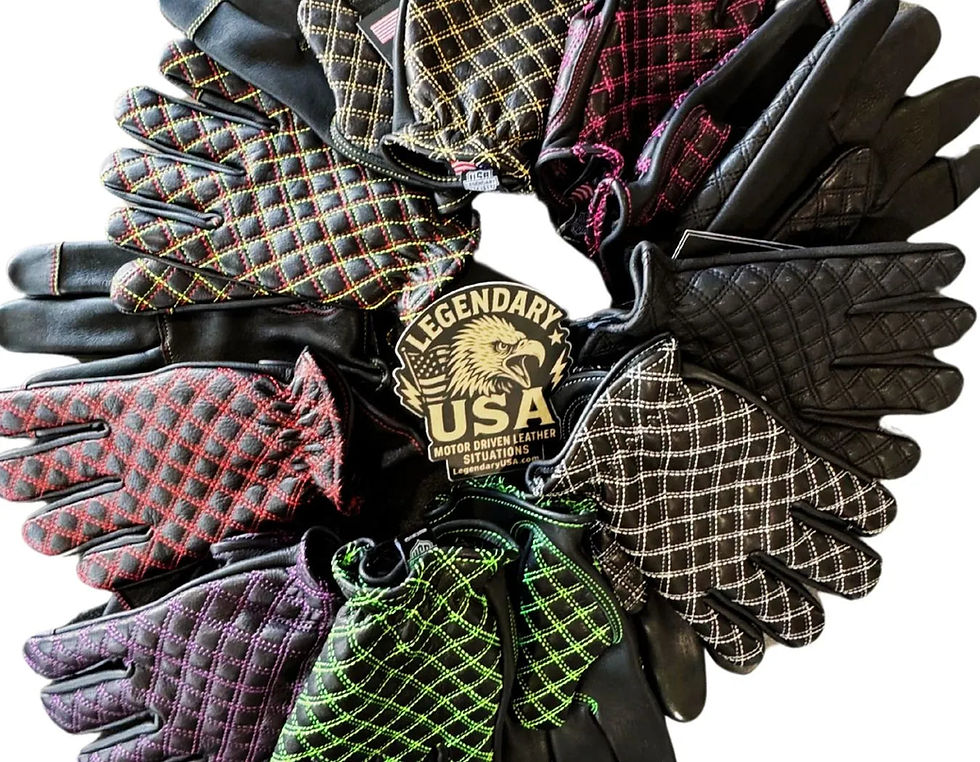
Fingerless Deerskin Gloves, $91. On a bike with no fairing your hands are in moving air the whole time, and in genuine heat a full glove is the first thing riders abandon, which means they end up with nothing. Fingerless deerskin keeps the palm covered on wide cruiser bars while leaving the fingers in the airflow. American made, and no armour or certification is claimed for it.
Holy Blanco Ventilated Gloves, $114. White, ventilated, short wrist deerskin with a touchscreen panel. The white matters more than it sounds like it should when a glove is sitting on a bar in direct sun at a fuel stop, and the touchscreen panel means you can work Ride Command or Skyline OS without stripping down at every junction.
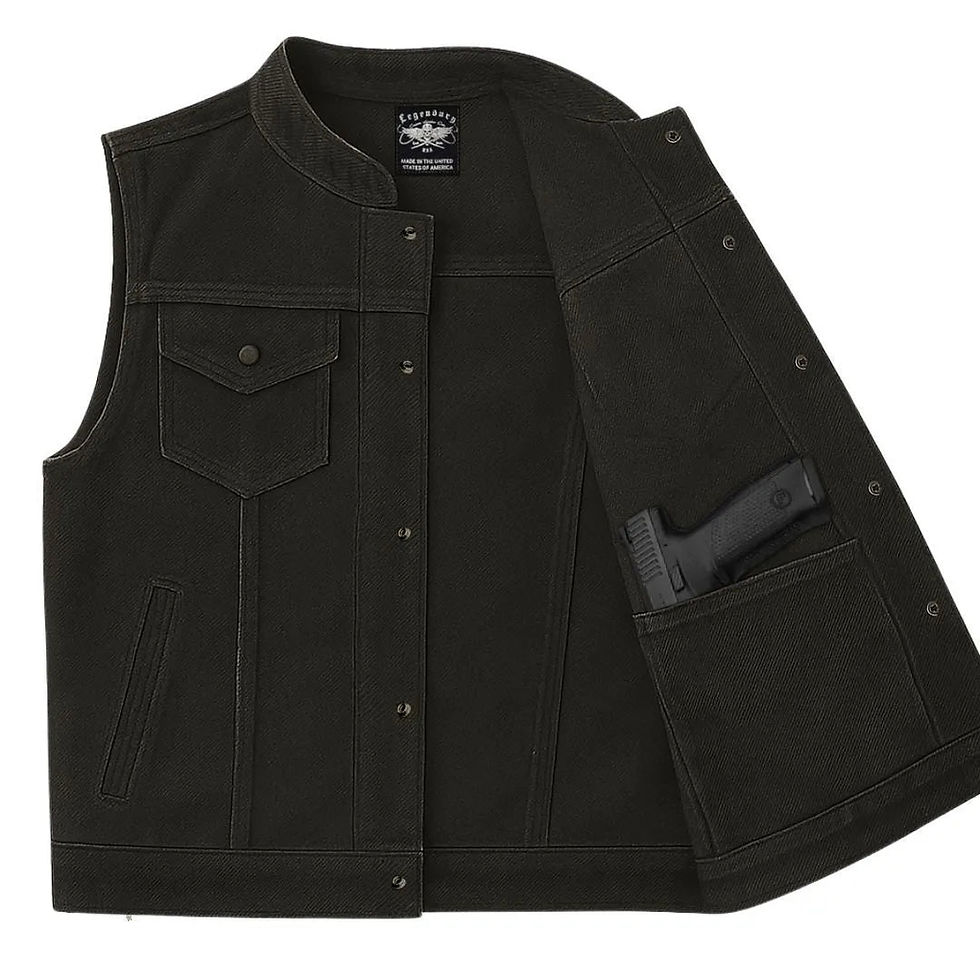
Legendary Revolution Men's Black Denim Vest, $65. The cheapest useful hot weather layer there is. On an air cooled Thunderstroke you want a shoulder and back layer that will not turn into an oven above thirty miles an hour, and denim over a shirt is what most riders in hot states already default to. Made in the USA.
None of the above is CE rated and none of it is armoured, which we state in every gear section on this site. Dainese builds ventilated summer kit with armour in it and is the obvious comparison if impact protection is the priority rather than material and fit. The list above is American leather and denim, cut for cruiser ergonomics, and it is worth pricing against a dealership counter before you assume the branded option is comparable.
The practical hot weather answer
If your riding is largely open road, cooling system is close to irrelevant. Air cooled engines have crossed deserts for a century and the airflow at fifty miles an hour does the work. The Springfield at 827 lb in running order and the Chief at 670 lb will both be entirely comfortable on a hot highway, and the Chief in particular is a lot of air cooled big twin for $14,999.
If your riding is urban, the calculation changes and it changes sharply. Stop-start traffic removes the airflow that an air cooled engine depends on and puts the rider's legs next to a cylinder that has nowhere to send its heat. This is the one riding pattern where the liquid cooled options are worth paying for, and it is why the $27,999 Challenger Dark Horse is a genuinely different proposition from a $23,999 Springfield rather than simply a more expensive one.
A caution on the received wisdom you will hear in either showroom. Neither Harley-Davidson nor Polaris publishes model level unit sales, so claims about which of these is the more popular hot weather bike are consensus at best. And neither publishes a rider comfort or engine temperature figure, so any specific claim about how much hotter one runs than another has been invented somewhere along the way.
Which one to buy
Buy an Indian PowerPlus bike if hot city riding is your normal condition. The Challenger Dark Horse and Chieftain PowerPlus Dark Horse at $27,999 give you a liquid cooled motor Indian labels as such, a published 122 hp and 128 ft-lbs, and at 855 lb and 842 lb in running order they are lighter than Harley's $32,999 Limiteds. That is the clearest hot weather buy in either range.
Buy the Harley Street Glide if you want liquid cooling with a fairing at the lowest price. $24,999 for a motor Harley describes as having liquid-cooled heads and a centre-mounted radiator, 130 ft-lbs at 3,250 rpm and 811 lb in running order is the best value of anything named in this post.
Buy the Indian Chief if the heat is not really the problem and the money is. $14,999, 108 ft-lbs and 670 lb in running order is the cheapest way into an American air cooled big twin, and on an open road in July you will not envy anyone.
Related reading on MotoGearRater: Harley-Davidson vs Indian Motorcycle, PowerPlus vs Thunderstroke, and the 2026 Indian Scout review and rating.