Harley vs Indian Two-Up: Which Brand Treats a Passenger Better

Updated: Sep 28
Quick answer: Neither Harley-Davidson nor Indian publishes a single passenger specific figure, so an honest answer is built from the numbers that do exist. Harley's Street Glide lists 811 lb in running order, 130 lb-ft at 3,250 rpm and $27,749, and Harley claims a 60 percent average reduction in helmet buffeting for the redesigned touring platform, the only published figure from either company about what the person behind you feels. Indian's two-up answer inside the current Scout range is the Super Scout at 571 lb and $16,499. For regular two-up miles it is the Harley. For occasional two-up on a budget the Super Scout does it for $11,250 less.
Disclosure: MotoGearRater and Legendary USA have the same owner. Links to legendaryusa.com in this article go to our owner’s store, and are marked as sponsored. How we make money
MotoGearRater does not run dynos and holds no test data of its own. What follows is built from what Harley-Davidson and Indian publish, compared like for like, with the gaps in each company’s disclosure named rather than filled in. Where we do have a view worth having is on what two people wear for a long day, and our reference point there is the American made leather and deerskin from Legendary USA, which is what the gear section below is measured against.
All prices in this post are base MSRP and exclude freight, destination and dealer charges.
What the makers publish about a passenger, and what they do not
Start with the honest part. Neither company publishes a passenger seat height, a passenger peg or footboard position, a seat to peg distance, a backrest dimension or a payload figure for any bike named below. There is no passenger column. Anybody who hands you one has built it themselves.
The asymmetry runs deeper on the Indian side of the sheet. Indian publishes horsepower for its Scout and PowerPlus families and none at all for any Thunderstroke model, and the Thunderstroke bikes are exactly the ones a Harley tourer gets set against. There is no clean power comparison between a Harley touring bike and an Indian Thunderstroke, and this post will not invent one.
The third trap is weight. Harley quotes weight in running order. Indian quotes dry and running order for the Scout family, and the Challenger was quoted wet at launch. Those are three different scales, and a good share of the arguments in dealership car parks are riders comparing a wet number against a dry one without knowing it.
The Harley side of the ledger
The Street Glide is the bike most Harley riders actually put a passenger on. It lists the Milwaukee-Eight 117, 1,923cc, 130 lb-ft at 3,250 rpm, 811 lb in running order, a laden seat height of 26.1 in and an unladen height of 28.1 in, at $27,749. Harley added the Street Glide Ultra above it at $30,749.
The touring platform was redesigned from the ground up for 2024, and in Harley’s own words that was the most comprehensive product development in the touring platform in well over ten years. Two changes bear directly on a passenger. Rear suspension travel went up to 3 in, and Harley claims a 60 percent average reduction in helmet buffeting. That is a manufacturer claim rather than an independent test, and we flag it as one, but it is the only published claim in this comparison about the air a passenger sits in.
One number is worth staring at. Harley lists the current Street Glide at 26.1 in laden and 28.1 in unladen, a two inch difference. The 2023 Street Glide Special was 26.1 in laden against 27.2 in unladen, a 1.1 in difference, at 827 lb and $27,999. That gap is Harley’s own measure of how far the seat settles with a rider aboard, and it roughly doubled with the redesign. Add a second person and it settles further. Neither company publishes what happens then.
Dressing two people for the same road
Two-up changes the gear problem in a way no spec sheet shows. The rider sits behind a fairing and the passenger does not. The rider’s hands are out past the fairing edge in dirty air. And the passenger cannot stand on the pegs, stretch or shift position, which is why a passenger gets cold, and stays cold, a good hour before the rider notices anything.
Legendary Black Hills Men’s Leather Motorcycle Jacket, from $675. Full leather is the layer that works for the person who cannot move to warm up. It is cut for an upright riding position rather than a tuck, and it is made in the USA. No armour and no certification claim, and we say that in every gear section because it is true of everything in it.

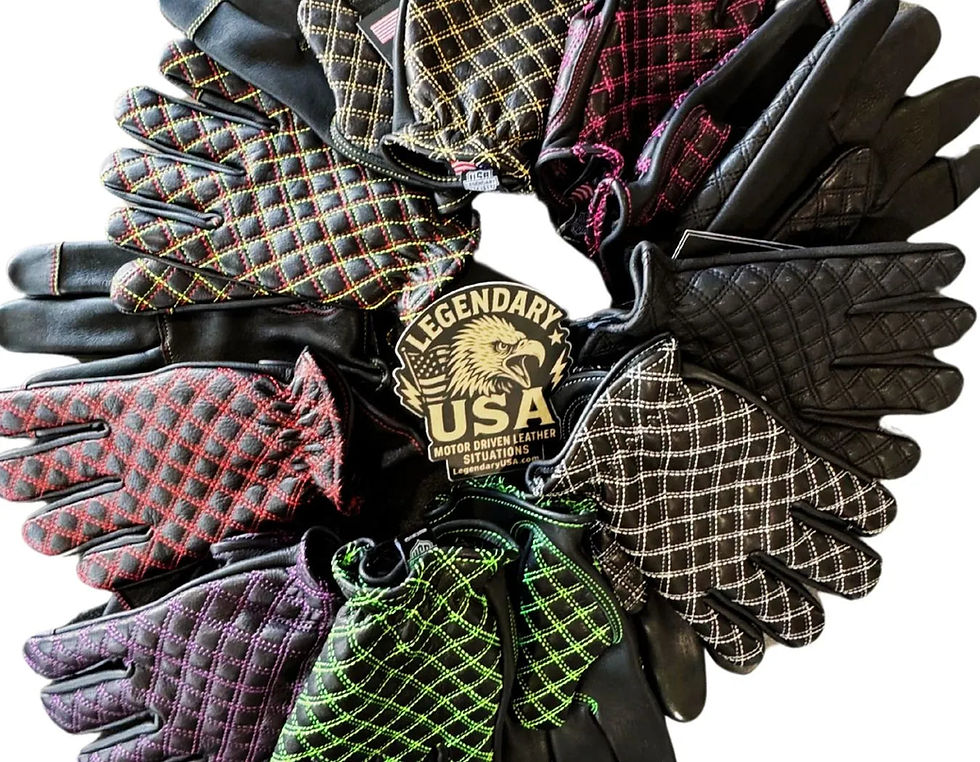
Tan Short Wrist Deerskin Gloves, $94. A batwing fairing takes the wind off your chest and almost none of it off your hands, which sit out on wide bars for hours. Short wrist deerskin is the long distance default, and deerskin stays supple rather than going board stiff after a wet day. American deerskin, no certification of any kind.
Legendary Holy Trinity Cropped Perforated Leather Vest, $175. Perforated leather is the sensible passenger layer once it warms up, because the person on the back sits in the rider’s wake in comparatively still air and heats up faster than you would expect. Cropped, perforated and made in the USA.

The honest comparison outside that list is Fox Creek Leather, which builds American made touring leather in the same heavy hide tradition and is worth pricing directly against the jacket above, particularly if you want a longer cut. Nothing named here is armoured and nothing carries a certification of any sort. A rider who specifically wants impact protection is shopping a different category of product and should say exactly that at the counter.
The Indian side of the ledger
Indian’s Scout platform is a smaller motorcycle than a Street Glide by every published measure. The SpeedPlus 1250 makes 105 hp at 6,300 rpm and 82 lb-ft at 6,300 rpm. The Scout Bobber lists 522 lb as shipped, a 25.6 in seat and $12,999. Sport Scout is $13,499 and 528 lb, Scout Classic $13,999 and 536 lb, the 101 Scout $16,999, 529 lb and 111 hp. The Super Scout tops the family at $16,499 and 571 lb, 49 lb more than the Bobber, and that weight is the only published clue to what the extra buys. Below all of it the Scout Sixty family starts at $9,999 with 85 hp and 65 lb-ft.
Indian’s larger two-up machines are recorded here at their launch figures rather than as current specifications, and the distinction matters. The Challenger arrived as Indian’s flagship with the liquid cooled PowerPlus 108, 1,770cc, 122 hp, 128 lb-ft, a 26.5 in seat, 796 lb wet and a $21,999 launch price. The all new Chief platform arrived with the Thunderstroke 111 at 108 lb-ft or the Thunderstroke 116 at 120 lb-ft, a 26 in seat, 670 lb at the base of the range and launch pricing from $14,499 to $20,999 across six variants.
Where the torque lives is the real two-up number
Peak torque is the figure everybody quotes and the rpm underneath it decides how a loaded bike behaves. The Street Glide makes its 130 lb-ft at 3,250 rpm. The SpeedPlus 1250 makes 82 lb-ft at 6,300 rpm. Those engines are not solving the same problem. With two people and luggage aboard, pulling out of a junction on a hill or overtaking on a two lane road, the low rpm number is the one you feel through the seat.
That is the strongest argument for the Harley here, and it is built from the makers’ own published figures rather than anything we measured. It is also why the Indian bikes that genuinely compete two-up are the Thunderstroke and PowerPlus machines rather than the Scout.
Which one to buy
Buy the Street Glide if you carry a passenger regularly. It is the better documented bike for the job, it is the only machine here with a manufacturer claim attached to passenger buffeting, and its 130 lb-ft arrives at 3,250 rpm, which is where a loaded motorcycle actually lives. At $27,749 it is also the expensive answer, and that is the condition attached.
Buy the Super Scout if two-up is occasional, the rider is not tall and the budget is the binding constraint. At $16,499 and 571 lb it sits $11,250 and 240 lb below the Street Glide, and a lighter motorcycle is easier to hold at a stop with a passenger already aboard. Be honest about the trade. Peak torque at 6,300 rpm asks you to ride differently.
Look at the Thunderstroke and PowerPlus bikes if you want an Indian and you want to tour two-up properly. That is where Indian’s real answer to a Street Glide sits.
One caution before you take anybody’s word on this. Harley-Davidson publishes no model level unit sales and neither does Polaris for Indian, so a claim that one brand sells more two-up bikes is guesswork. Harley does publish family level shipments, and its Grand American Touring segment shipped 69,252 units in 2025 against 85,757 in 2024. That describes a segment, not a model, and nothing at all about a passenger.
Related reading on MotoGearRater: Harley-Davidson Street Glide review and rating, Indian Chieftain review and rating, and Harley-Davidson vs Indian, the honest brand comparison.