Harley vs Indian vs Honda vs BMW: The 2020 Best Sellers Compared

Updated: 3 days ago
Four motorcycles led four different corners of the American market in 2020: Harley-Davidson's Street Glide Special, Indian's Scout, Honda's Rebel 500 and BMW's R 1250 GS. Lined up in a single table they look like rivals. They are not, and reading that table as a scoreboard is the quickest way to buy the wrong motorcycle.
Disclosure: MotoGearRater and Legendary USA have the same owner. Links to legendaryusa.com in this article go to our owner’s store, and are marked as sponsored. How we make money
Four category leaders, not four rivals

An 827 pound American bagger, a low seat midsize cruiser, a 408 pound beginner twin and a 549 pound German adventure bike are four different answers to the question of what a motorcycle is for. Almost nobody cross shops them. A rider choosing between a Street Glide Special and a Rebel 500 is not comparing motorcycles, they are deciding what kind of riding they intend to do.
Which makes the paper comparison close to meaningless. Peak torque figures taken at different engine speeds, on engines that share nothing, tell you very little. The table below earns its place for two of its columns: seat height and weight. Those decide whether you can ride the bike at all. Nearly everything else is negotiable.
One caveat before the numbers. Harley-Davidson publishes no model level unit sales, and neither does Polaris for Indian or Honda for the US. BMW Motorrad alone publishes model level figures, and it only began separating individual models in its 2025 report. Three of these four are consensus picks, not published rankings, and we will not invent a unit number.
Two notes on what is being compared. The Harley is the Street Glide Special, in this era a separate model from the base Street Glide, which used a smaller Milwaukee-Eight engine and cost considerably less. The Indian is the Scout platform rather than a single bike, and the Scout Bobber supplies the spec line as the platform's volume entry point.
The 2020 numbers, side by side
Bike | Engine | Torque | Seat height | Weight | MSRP |
Harley-Davidson Street Glide Special | Milwaukee-Eight 114, 1868cc | About 122 to 123 lb-ft at about 3,000 rpm (see note) | 26.1 in laden, 27.2 in unladen | 827 lb in running order | $27,699 |
Indian Scout Bobber | 1133cc liquid cooled 60 degree V-twin, 100 hp at 8,100 rpm | 72 lb-ft at 6,000 rpm | 25.6 in | Not published (see note) | $10,999 |
Honda Rebel 500 | 471cc liquid cooled parallel twin, DOHC | Not published | 27.2 in | 408 lb, 414 lb with ABS | $6,199, $6,499 with ABS |
BMW R 1250 GS | 1254cc ShiftCam boxer twin, 136 hp at 7,750 rpm | 105 lb-ft at 6,250 rpm | 33.5 in standard, 34.3 in optional | 549 lb | $17,895, Adventure $20,195 |
Four caveats apply. Harley's published torque for this same engine changed for the 2021 model year, from roughly 123 lb-ft at about 3,000 rpm to 118 lb-ft at 3,250 rpm: the measurement changed, not the engine, so treat the 2020 figure as soft. Published weights for this generation of Scout Bobber conflict on a wet versus dry basis and cannot be reconciled, so that cell is empty rather than flattering. Honda US publishes no torque figure for the Rebel 500 in any year, and the European figure available for later model years was not published for 2020. BMW's own materials disagree on peak torque rpm for the 1250, giving 6,250 globally and 6,500 in the US listing. We have used 6,250.
Harley-Davidson Street Glide Special: who it is actually for
This is a highway machine and it does not pretend otherwise. Fairing, hard bags, a 1868cc Milwaukee-Eight 114 and 827 pounds in running order. The weight is the thing to understand before anything else: you feel all of it at walking pace, backing out of a space, on a cambered driveway or in a slow U turn, and you feel very little of it at highway speed, where the mass is part of why the bike sits so still.
The seat is low, 26.1 inches laden, so a short inseam is usually not what stops people. What stops people is holding up 827 pounds at a stoplight and moving it around a garage. That makes this a poor first motorcycle for most riders, and a difficult one for a small rider regardless of experience.
Buy it if you ride long days on pavement, often two up or loaded, and you want wind protection and luggage as standard equipment rather than as an accessory catalogue. Budget accordingly. The $27,699 figure is the base price before freight, and base is not how most of these leave the showroom.
Indian Scout Bobber: who it is actually for
The Scout's headline number is the seat: 25.6 inches, the lowest of these four by a clear margin. For riders who have spent years being told to buy taller boots, that alone justifies a test ride.
The engine is not a conventional cruiser engine. It is a 1133cc liquid cooled 60 degree V-twin making 100 hp at 8,100 rpm and 72 lb-ft at 6,000 rpm. Those are high engine speeds for the category, and the practical effect is that the Scout does not deliver its shove just off idle. You have to use revs. Riders arriving from a large air cooled twin sometimes find that strange. Riders arriving from almost anything Japanese find it familiar.
At $10,999 it was also the cheapest way into a full size V-twin here. Bobber trim is a styling and ergonomics decision rather than a mechanical one, so sit on it and on the standard Scout before committing, because the riding position is the part people change their minds about. It suits shorter riders, shorter rides and anyone who wants cruiser character without cruiser bulk.
Honda Rebel 500: who it is actually for
408 pounds, 414 with ABS, a 27.2 inch seat and a $6,199 starting price. The Rebel 500 is the lightest and by a wide margin the cheapest bike here, and it is the obvious answer for a first season.
It is not only a beginner bike. The 471cc parallel twin has enough in reserve to hold highway speed without feeling frantic, and for 2020 Honda revised it with a new fork, LED lighting and an assist and slipper clutch that cut lever effort by about 30 percent. That last item reads like a footnote and is not. Light clutch effort is the difference between enjoying stop and go traffic and dreading it.
Its limits are honest ones. There is no wind protection and no standard luggage, so a long day on the interstate is possible rather than pleasant. Buy it as a first bike, as a return to riding after a long break, as a commuter, or as the bike that leaves enough of the budget for good gear and a rider training course.

BMW R 1250 GS: who it is actually for
The GS is the most adaptable machine here: a 1254cc ShiftCam boxer making 136 hp at 7,750 rpm and 105 lb-ft, with the range, the luggage provision and the suspension travel to treat a gravel road as a road.
Then there is the seat height, and for a great many riders it settles the question on its own. 33.5 inches as standard, 34.3 inches with the taller option. That is genuinely tall. It rules out riders who would be perfectly comfortable on the far heavier Street Glide Special, because on the Harley you sit down into the bike and on the GS you sit up on top of it. Sit on one before you read another word about it.
If you fit it, this is the bike for long distance in any weather, for two up touring with real luggage, and for riders who resent being limited by the surface. It asks for experience: 549 pounds, a tall seat and that much power is a lot to learn on. At $17,895, with the Adventure at $20,195, it also sits closer to the Harley than to the Honda.
How to actually choose
Work in this order and the decision usually makes itself.
Start with seat height and weight, because they are the only hard filters. Sit on all four. The Scout Bobber at 25.6 inches, the Street Glide Special at 26.1 laden and the Rebel 500 at 27.2 are all low. The GS at 33.5 is a different conversation entirely. Then lift each bike off its stand and walk it a few paces. If you cannot manage it in a car park, the rest of the spec sheet is decoration.
Next, the distance you actually ride, not the distance you picture yourself riding. Short trips around town: Rebel 500 or Scout Bobber. All day on pavement, often loaded or two up: Street Glide Special. All day, any weather, any surface: R 1250 GS.
Budget last, and count the whole number. Prices here run from $6,199 to $27,699. Whichever end you are at, set your figure to include gear, training, insurance and the first service, then see what is left for the motorcycle itself.
Experience cuts across all of it. For a first season the Rebel is the sane choice and the Scout is defensible. The Street Glide Special and the GS are both a lot of motorcycle to learn on.
On paper these four barely belong in the same article. On fit they separate cleanly: the Rebel for starting out, the Scout for riders who need a low seat and still want a real V-twin, the Street Glide Special for covering distance on pavement in comfort, the GS for riders who fit it and refuse to be limited by weather or surface. Decide what you are going to do with the bike, then choose the badge.
The Part the Spec Table Leaves Out
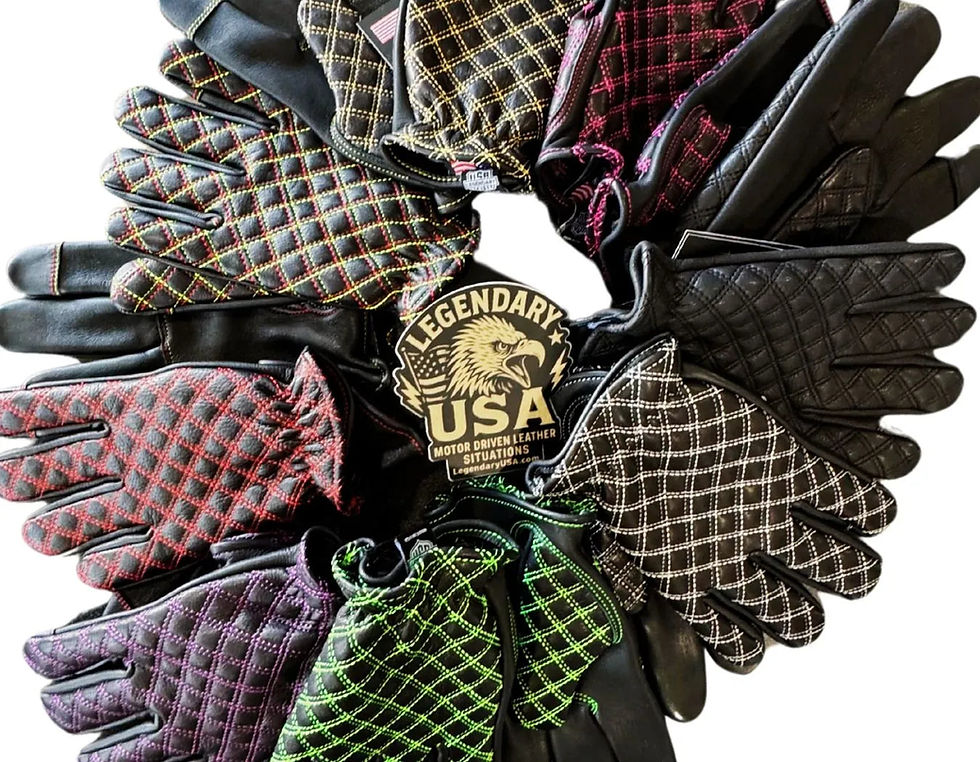
Every bike in this comparison is ridden in weather, and the gear decision usually gets made after the bike money is gone, which is the wrong order. Gloves are the cheapest meaningful layer and the one that gets used on literally every ride. Legendary USA's American-made glove range is a reasonable starting point for what a full-coverage leather glove costs.
Cover photo: "Harley-Davidson Street Glide parked at Hogs for Hospice, Leamington, Ontario, 2025-08-02 04" by Chris Woodrich, CC BY-SA 4.0, via Wikimedia Commons.