2026 Indian Scout Classic vs Harley Fat Boy: Chrome, Presence and Price

Updated: Sep 28
Quick answer: The Harley-Davidson Fat Boy lists at $22,599 and the Indian Scout Classic at $16,699, and the $5,900 between them buys 139 lb of motorcycle and 44 more ft-lbs of torque. Fat Boy: Milwaukee-Eight 117 Custom, 103 hp, 126 ft-lbs at 3,000 rpm, 694 lb in running order. Scout Classic: liquid cooled 1250cc V-twin, 105 hp, 82 ft-lbs at 6,300 rpm, 555 lb. Their laden seat heights are 25.9 in and 25.7 in, close enough that no rider will tell them apart. Want the presence, buy the Fat Boy. Want the same look in a bike you can shove around a garage, buy the Scout Classic.
Disclosure: MotoGearRater and Legendary USA have the same owner. Links to legendaryusa.com in this article go to our owner’s store, and are marked as sponsored. How we make money
MotoGearRater does not run dynos or weigh motorcycles. Where we do hold a view worth having is on what a rider wears on a bike with no fairing at all, and our reference point there is the American made leather from Legendary USA. Everything else below comes from what Harley-Davidson and Indian publish, compared on matching bases, with each maker’s missing figures named rather than quietly filled in from somewhere else.
All prices here are base MSRP and exclude freight, destination and dealer charges.
The numbers, side by side
Engine. Fat Boy: Milwaukee-Eight 117 Custom, 117 cubic inches. Harley prints no cooling description on the Fat Boy page, so we are not going to put one there. Scout Classic: liquid cooled 60 degree V-twin, 1250cc, which is how Indian describes it on the specs page.
Power. Harley lists 103 HP for the Fat Boy and Indian lists 105 hp for the Scout Classic, so this is one of the matchups in the series where both makers hand you a number. Two horsepower apart, and 44 ft-lbs apart in the other direction, which tells you more about the two engines than either figure does on its own.
Torque. Fat Boy 126 ft-lbs at 3,000 rpm, on Harley’s own J1349 method. Scout Classic 82 ft-lbs at 6,300 rpm. Indian does not publish its testing method the same way, so treat the gap as directional rather than exact.
Weight. Fat Boy 694 lb in running order. Scout Classic 555 lb in running order, or 535 lb dry. Running order against running order, the Harley is 139 lb heavier.
Seat height. Fat Boy 25.9 in laden. Scout Classic 25.7 in laden and 26.8 in unladen. Laden against laden, two tenths of an inch apart.
Fuel. Fat Boy 5 gallons. Scout Classic 3.4 gallons.
Lean angle. Harley lists 25.6 degrees on the right for the Fat Boy, the lowest figure in its entire Softail range. Indian lists 33 degrees for the Scout Classic without specifying a side.
Price. Fat Boy $22,599. Scout Classic $16,699.
Presence is not a specification and we are not going to pretend otherwise. What is a specification is 694 lb against 555, 25.6 degrees of lean against 33, and $5,900. Those three numbers describe the same difference from three directions. The Fat Boy is a wide, low, heavy motorcycle and its published geometry says so out loud. The Scout Classic is a normal sized cruiser wearing a traditional shape.
Kitting out either one
Neither of these has a fairing, a screen or anything else between the rider and the air. That single fact decides the gear, and it applies equally to both. Wind hits your chest, your arms and your hands, all day, at whatever speed you are doing. On a faired bagger you can get away with a shirt under a vest. On these two you cannot.

Legendary Dixon Men’s Leather Motorcycle Vest, from $175. A leather vest over a shirt is the layer that matches the look of both these bikes and does real work on a warm evening, cutting the chill off your chest without cooking you at a stop light. Made in the USA. No armour and no certification claim, which is true of every item in this section and we say so every time.

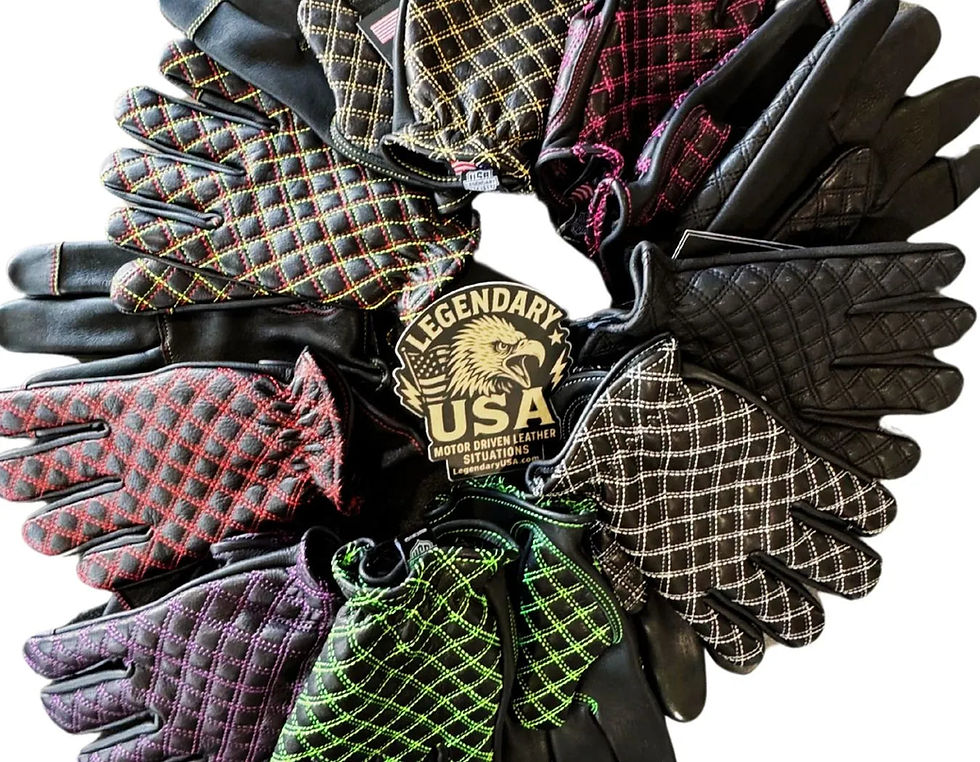
Bad Billy Black Goatskin Gloves, $69. Goatskin is the lighter, tighter hide, and a short wrist cut is right for a bike with wide flat bars and nothing shielding your hands. Harley prints no cooling description for the Fat Boy, so we will not tell you how it sheds its heat, but a 117 cubic inch twin at a standstill in traffic is warm work whichever way it does it, so a glove you will actually wear in July is worth more than a heavy one. Made in the USA.
Cockpit USA Victory Rider Horsehide Leather Jacket, from $940. If you want one jacket that suits the traditional lines of either bike and will outlast the motorcycle, horsehide is the hide. Cockpit USA is a genuine dealer brand rather than a house line, which is worth knowing when you are comparing prices. No rating, no armour.
The competitor to name here is Schott NYC, which has been building this category of American leather jacket for longer than either company has been building these two models, and which is the direct comparison for the horsehide above. Price them against each other on hide weight and cut rather than on brand. Nothing on this page carries a certification, and a rider who wants impact protection should be shopping armoured gear instead and saying so at the counter.
What the 139 pounds actually buys
It buys torque low down. The Fat Boy makes 126 ft-lbs at 3,000 rpm against the Scout Classic’s 82 ft-lbs at 6,300 rpm, and the rpm figure matters more than the ft-lbs. One of these bikes does its work just off idle and the other wants revs. Roll on in top gear at 40 mph and they behave like different classes of machine, which is the single biggest thing a test ride will tell you that the table above cannot.
It also buys 1.6 gallons of extra fuel, which is the practical difference on a long day. Neither company publishes a consumption figure we would print, so we will not convert that into miles, but 5 gallons against 3.4 is a real gap on a bike with no bags.
What it costs is everything to do with low speed. 694 lb against 555 lb is felt in a car park, on a camber, and every time the bike goes on or off a side stand. The 25.6 degree lean angle is the other cost, and it is the one riders discover on a good road rather than in a showroom. Harley lists no Softail with a lower figure, and the Scout Classic’s 33 degrees is most of a full class above it.
The disclosure gap, stated plainly
Harley publishes horsepower on every one of its MY2026 model pages, 103 HP in the case of the Fat Boy. Indian publishes horsepower for its Scout and PowerPlus families and none at all for any Thunderstroke model. In this particular matchup that works out unusually well, because the Scout Classic is a Scout, so both makers give you a figure and the power column is a real one. Move a step to either side, to a Chief or a Chieftain, and the Indian half of that column vanishes. Where this pair does leave a gap is cooling. Indian describes the Scout as liquid cooled and Harley prints no cooling description on the Fat Boy page whatsoever, so anybody telling you what cools a Fat Boy is telling you something Harley-Davidson does not.
The same discipline applies to sales. Harley-Davidson publishes no model level unit sales and neither does Polaris for Indian, so a claim that one of these outsells the other is a guess dressed up as a fact.
Which one to buy
Buy the Fat Boy if the shape is the point. Nothing else in either range looks like it, the 126 ft-lbs at 3,000 rpm makes it effortless at the speeds a cruiser actually gets ridden at, and the 5 gallon tank means you can use it. The conditions attached are $22,599, 694 lb and the lowest lean angle Harley lists.
Buy the Scout Classic if you want the traditional look without the mass or the money. At $16,699 it is $5,900 cheaper, at 555 lb in running order it is 139 lb lighter, its laden seat is within two tenths of an inch of the Harley, and it gives you 33 degrees of lean against the Fat Boy’s 25.6 on the right. The condition attached is that 82 ft-lbs at 6,300 rpm asks you to use the gearbox.
Ride both before you decide, because the seat height figures are so close that the usual tiebreaker is gone. What will separate them for you is bar reach and how the mass feels at walking pace, and no specification sheet from either company measures either one.
Related reading on MotoGearRater: the Indian Scout review and rating, Harley-Davidson vs Indian, the honest brand comparison, and the Milwaukee-Eight engine guide.