


2026 Indian Sport Scout vs Harley Nightster Special

Updated: Sep 28
Quick answer: The Harley-Davidson Nightster Special lists at $12,499, makes 72 ft-lbs at 5,750 rpm from the Revolution Max 975T, and weighs 483 lb in running order. The Indian Sport Scout lists at $13,499, makes 82 ft-lbs at 6,300 rpm and 105 hp from its 1,250 cc liquid cooled twin, and weighs 547 lb in running order. The Indian makes ten ft-lbs more and fourteen horsepower more, 105 against 91. The Harley is $1,000 cheaper and 64 lb lighter. Buy the Nightster Special if price and weight decide it. Buy the Sport Scout if you want the bigger engine and the lower seat.
Disclosure: MotoGearRater and Legendary USA have the same owner. Links to legendaryusa.com in this article go to our owner’s store, and are marked as sponsored. How we make money
MotoGearRater rates gear, not motorcycles on a dyno. We do not test engines, we read what the manufacturers publish, and where a company publishes nothing we say so rather than borrowing a figure from somewhere else. What this publication does rate is what you put on before you ride, and our reference point for that is Legendary USA, whose American made deerskin is the benchmark the rest of the market gets measured against on these pages.
The numbers, and what neither company gives you
Start with what each maker prints, because it shapes everything else. Indian publishes horsepower for the Sport Scout, 105 hp, and publishes 82 ft-lbs of peak torque at 6,300 rpm. Harley publishes 72 ft-lbs at 5,750 rpm for the Nightster Special and 91 HP beside it. Both columns are filled in on both sides of this particular pairing, which is not true everywhere across these two ranges, because Indian prints no horsepower at all for its air cooled Thunderstroke models. Here you can read both. On torque the Indian is ten ft-lbs ahead and asks for 550 more rpm to get there. On horsepower it is fourteen ahead, 105 against 91, from an engine 275 cc larger.
Displacement is published in different units, which is its own small lesson in reading spec sheets. Harley lists the Nightster Special at 59.5 cubic inches. Indian lists the Sport Scout at 1,250 cc. The engine names carry the answer without any arithmetic. Revolution Max 975T against a 1250. The Indian is the larger engine, and the torque figures follow from that rather than from any exotic difference in how the two are built.
Weight is a clean comparison for once. 483 lb against 547 lb, both in running order on both sheets. Indian also prints 527 lb as a dry figure for the Sport Scout, which is not comparable to anything Harley publishes and should not be used to close the gap. Sixty four pounds is a lot on motorcycles this size, and it is the strongest single argument the Harley has.
Fuel and lean angle split the difference. Indian gives the Sport Scout 3.4 gallons and 33 degrees of lean to the right. Harley gives the Nightster Special 3.1 gallons and 32 degrees. Neither gap is decisive on its own, but both run the Indian's way, and a third of a gallon on a tank this size is a real fraction of it.
What the extra thousand dollars buys, and where each family goes
Neither of these bikes exists on its own. Harley sells the plain Nightster at $9,999 with the identical engine, the identical 72 ft-lbs at 5,750 rpm and 481 lb, so the Special is a $2,500 walk for equipment rather than for performance. Above it sits the Sportster S at $15,999 on the Revolution Max 1250T, 76.4 cubic inches, 93 ft-lbs at 6,000 rpm, 502 lb, a 28.9 in laden seat and 35 degrees of lean. All prices in this comparison are base MSRP and exclude freight, destination and dealer charges.
Indian's ladder is denser. The Sport Scout Sixty starts at $10,499 with 85 hp and 65 ft-lbs at 6,500 rpm from 999 cc, at 549 lb in running order. The Sport Scout at $13,499 is the 1,250 cc version of the same idea. The 101 Scout at $16,999 takes the same 82 ft-lbs and adds power, 111 hp, plus dual 320 mm front rotors on four piston calipers against the Sport Scout's single 298 mm disc. Our Scout family review covers the whole range in one place.
Read those two ladders side by side and the shapes differ. Harley uses the same engine twice and charges for trim, then jumps displacement. Indian changes displacement first and power second, and gives you three genuinely different engines under $17,000.
The kit these two bikes actually ask for
Both are naked, both are liquid cooled, and both make their peak torque well north of 5,000 rpm, which is a polite way of saying you will be riding them harder than you would ride a big twin. That changes the gear conversation. On a bagger the question is wind. On these two it is grip, feel at the lever and hands that stay working through a longer, busier ride.
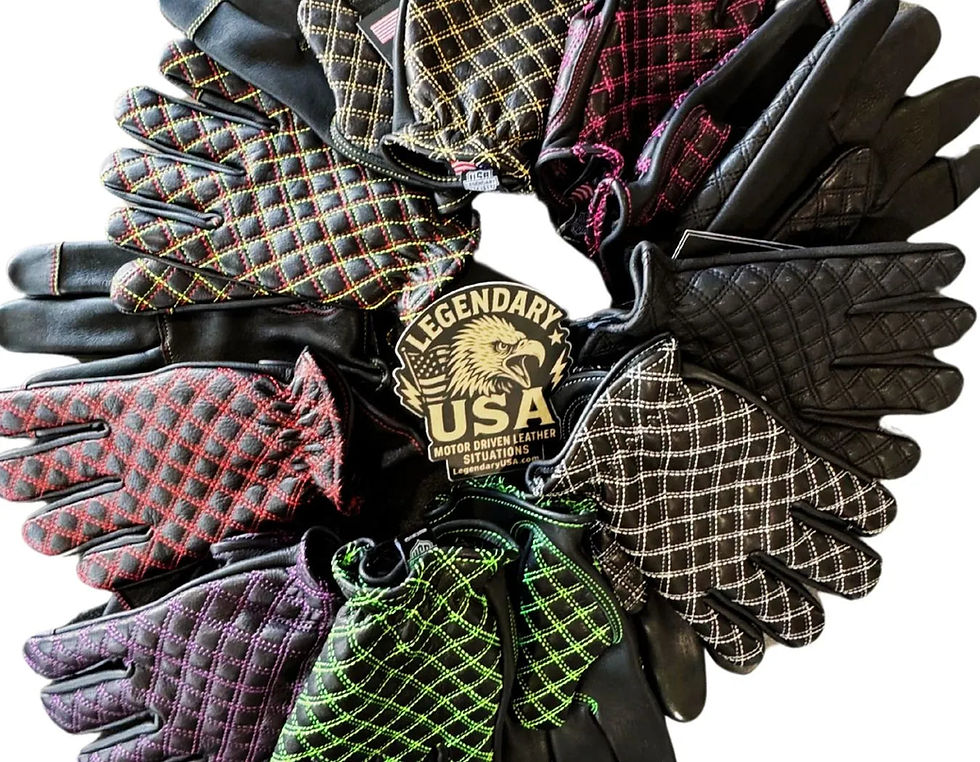
The Uppercut Knuckle Defense Gloves at $94 are the sensible lead here. They are ventilated American deerskin, made in the USA, with leather covered knuckle hardware built into the construction. That is construction and not certification, and it is worth stating plainly: no glove named on this page carries a protective rating and none is presented as carrying one. What the hardware gives you is a glove that keeps its shape and its coverage on a bike you actually use the revs on.
If you want a touchscreen panel as well, the Double-Diamond Touchscreen Deerskin Gloves at $143 are the top of the deerskin range and the pair to buy if this is going to be your only set. Both bikes here reward a rider who is not pulling a glove off at every stop.
Over the top, the Legendary Leather Club Vest at $180 is made in the USA and does the thing a jacket cannot on a bike with a 25.7 in seat and no fairing, which is to add a wind layer at the chest without adding bulk at the shoulder where you are already leaning on the bars.

Alpinestars is the obvious alternative for riders shopping these two, and it should be named without a sneer. The Italian company builds a deep technical range, it publishes what its products are rated to, and a rider who wants that documentation should go and buy it. Legendary is a different proposition and does not pretend otherwise. American hide, plain description, a price on the page, no rating claimed. Both approaches are legitimate and the motorcycle vests collection is worth a look if the second one is yours.
Seat height, weight and the confidence question
This is where the Indian makes its strongest case and where the two sheets need reading carefully. Harley lists the Nightster Special at 27.1 in laden. Indian prints 25.7 in for the Sport Scout without labelling it laden or unladen, and separately prints 26.8 in unladen. Whichever of Indian's two figures you take, the Sport Scout is the lower motorcycle, and by the more generous reading it is lower by well over an inch.
Set that against the 64 lb the Indian carries and you get the real trade. The Harley is easier to move around a car park. The Indian is easier to plant a foot on at a light. Which of those matters more depends entirely on your inseam and nothing on this page can decide it for you. Our Chief against Street Bob comparison runs the same test one class up if you are also looking at the big twins.
Which one to buy
Buy the Nightster Special if the numbers that matter to you are $12,499 and 483 lb. It is the cheaper motorcycle, it is meaningfully the lighter one, and the Revolution Max 975T making 72 ft-lbs at 5,750 rpm is not short of anything for the riding most people do on a bike this size. If you are stepping up from something small, the weight advantage is worth more than the ten ft-lbs you are giving up.
Buy the Sport Scout if you want the engine. 105 hp and 82 ft-lbs at 6,300 rpm from 1,250 cc is more motorcycle for $1,000, and it comes with the lower seat, the larger tank and the extra degree of lean. For a rider who is confident on the bike and wants the version they will not grow out of in two seasons, that is the better thousand dollars.
Do not let a sales claim break the tie. Neither Harley-Davidson nor Polaris publishes model level unit sales, so nobody can tell you which of these two sells better and anyone who does is inventing it. Our brand comparison sets out what the published filings genuinely support. Sit on both, note that one is 27.1 in and the other is 25.7 in, and buy gloves before you buy a pipe.

