Living With the Honda Rebel 1100: What Owners Report

Updated: Sep 28
This is not a road test. Nobody at MotoGearRater rode a Rebel 1100 for this piece. What follows is a synthesis of recurring owner reporting drawn from Honda Rebel owner forums, long term owner reviews and owner review aggregations, with numbers taken only from published specifications.
Disclosure: MotoGearRater and Legendary USA have the same owner. Links to legendaryusa.com in this article go to our owner’s store, and are marked as sponsored. How we make money
What the Rebel 1100 is

Honda launched the Rebel 1100 in 2021 using the Africa Twin's 1084cc parallel twin, an unusual starting point for a cruiser and most of the reason the bike is interesting. It arrived at $9,299 for the manual and $9,999 for the DCT automatic, with a 27.5 inch seat, 509 lb curb weight for the DCT, and three ride modes. It was the first genuine automatic in a mainstream American cruiser.
In 2023 Honda added the Rebel 1100T, a bagger version with a fairing and hard bags at $11,299 for the DCT. That was the year the Rebel stopped being an entry model and became a sub brand running from $4,749 to $11,299. The lineup was updated again for 2025. Honda US publishes no torque figure for this engine, so you will not find one here. The automatic is the reason this post exists.
What owners consistently praise
The DCT converts sceptics, and that pattern is clear enough in owner reporting to be the headline finding. A recurring shape in owner reviews is someone who bought the automatic reluctantly, or for a physical reason, and now describes it as the thing they would not give up. The praise is specific: no clutch and no shifting in stop and go traffic, noticeably less fatigue at the end of a long day, and the ability to stop and hold in gear without stalling.
Manual mode with the paddles gets more credit than expected. Owners on twisty roads report that holding a gear and changing it without a clutch is genuinely engaging rather than a compromise, and long term reports describe it as the setting that makes the bike fun rather than merely easy.
The engine draws consistent credit for not behaving like a cruiser motor. Owners describe it as willing to rev, strong low down and more characterful than the styling suggests. Fuelling is reported as well sorted, which matters more here than on a manual bike: with no clutch to smooth an abrupt throttle connection, a snatchy tune would be a real problem, and owners report that it is not.
Handling is praised relative to the class. Owners report the bike carries more lean than cruiser habits expect, and the three ride modes plus user configurable settings get used rather than ignored.
What owners consistently complain about
Low speed manoeuvring on the DCT is the most substantive complaint on this motorcycle and the most useful thing in the whole body of owner reporting. Without a clutch there is nothing to slip, so drive is either connected or it is not, and a handful of throttle in first gear produces immediate movement. The Rebel owner forums carry recurring threads specifically about U turns and car park technique on the DCT, and owners report low speed tip overs in garages and parking lots, most often with newer riders and most often in the sportier mode. The fixes owners converge on are technique rather than parts: drag the rear brake to load the driveline, select neutral before parking, and soften the throttle response in the settings. Some fit a left hand rear brake lever, borrowing a solution from Africa Twin DCT riders. Owners also describe the lowest gear shifts as clunky and the gearbox as shifting up early for economy. Anyone considering this as a first motorcycle should read those threads before signing anything.
Seat comfort at distance is the second consistent complaint, well attested across both owner reports and long term testing. The cruiser posture concentrates weight on the tailbone and base of the spine rather than sharing it through legs and arms, and the reported onset of real discomfort sits between one and two hours. An aftermarket seat is a common purchase.
The rider triangle draws consistent fire from taller owners. The relationship between the pegs and the bars, plus an engine case that intrudes on leg position, produces complaints from riders around six feet and above, with lower or slightly more forward pegs the usual request. Shorter riders rarely raise it, so read this one as height dependent rather than universal.
Engine heat is one of the better attested complaints on the bike. Distinct owner threads about heat radiating onto the rider's leg in slow traffic, about the fan running at every stop light, and about coolant temperature readings appear repeatedly across model years on the Rebel forums. Owners in hot climates and heavy traffic raise it most.
Wind protection is absent on the standard bike, and owners are clear that it limits a long day rather than the engine or the chassis. The 1100T's fairing does help at the chest and hands according to owner reports, but the screen is described as small and taller replacements are a common early purchase. Fuel range is short for a bike with touring pretensions, and owners plan stops more often than the machine's other abilities would suggest.
On the 1100T, the luggage draws unusually blunt criticism in both owner and long term reporting: limited capacity, latches that are awkward to close and do not reliably stay closed, and a right hand bag compromised by the exhaust routing. The parking brake release on the T is described as awkward and two handed. Suspension travel is short across the range, and owners report the rear skipping over a sharp bump taken mid corner. Pillion accommodation is basic. One further note, flagged as isolated rather than a pattern: an owner reported an ABS modulator failure at low mileage with a substantial bill. A single report is not a trend, but this bike carries expensive electronics.
Who it suits and who it does not
It suits riders with a clutch hand, wrist or shoulder that no longer enjoys traffic, and that group is the most enthusiastic in the entire body of owner reporting. It suits heavy stop and go commuting, riders who want a cruiser that actually handles, and returning riders who want less to manage. It also suits anyone drawn to an automatic who will spend the first few weeks learning the low speed technique deliberately rather than discovering it in a car park.
It does not suit a brand new rider who has not yet built slow speed control, and the reason for that caution is owner reporting rather than any flaw in the machine. It does not suit riders who want long days without first buying a seat and a screen. Taller riders should sit on one before committing, because the peg and bar relationship is the complaint that does not go away without parts. Riders who simply want a manual gearbox can have one, and it is the cheaper of the two at $9,299 against $9,999 for the DCT at launch.
The Rebel 1100 arrived in 2021, a year we covered in our rundown of the best selling motorcycles of 2021.

What to check on a used one
Confirm which transmission the bike has in person rather than from the advert, because listings describe DCT and manual carelessly.
On a DCT, spend the test ride at walking pace. Cycle through the modes, ride slow figure eights in an empty car park, and see how the drive take up behaves in the sportier setting. Then inspect for low speed drop damage: bar ends, lever ends, mirror stems, the exhaust and the engine case covers, which owner reporting makes the most likely damage on this model. Check that neutral selects cleanly, and on the 1100T that the parking brake works without a fight.
Ask whether the seat, screen and pegs have already been changed and whether the original parts are included. Given how common all three swaps are, a well sorted bike is worth a premium and a badly modified one is not.
Look for heat related history: fan operation at idle, coolant level and condition, and any overheating entries in the service record. On the 1100T, check the bag latches, the mounting hardware and whether water has been getting into the bags. Finally, get service records for the Africa Twin derived engine including valve clearance documentation at the correct interval, and ask a Honda dealer to confirm any software updates against the VIN.
The automatic is the most interesting thing about this motorcycle, and the owner verdict is more positive than the concept's reputation would predict, with one qualification owners keep making themselves: the DCT is easier than a clutch everywhere except at walking pace, where it asks you to learn a different technique and is unforgiving until you have. Owners who did that work are the ones writing the enthusiastic reviews. The rest of the list, seat, wind, heat and the rider triangle, is ordinary cruiser stuff and mostly answerable with parts.
The Glove Question on a DCT Bike
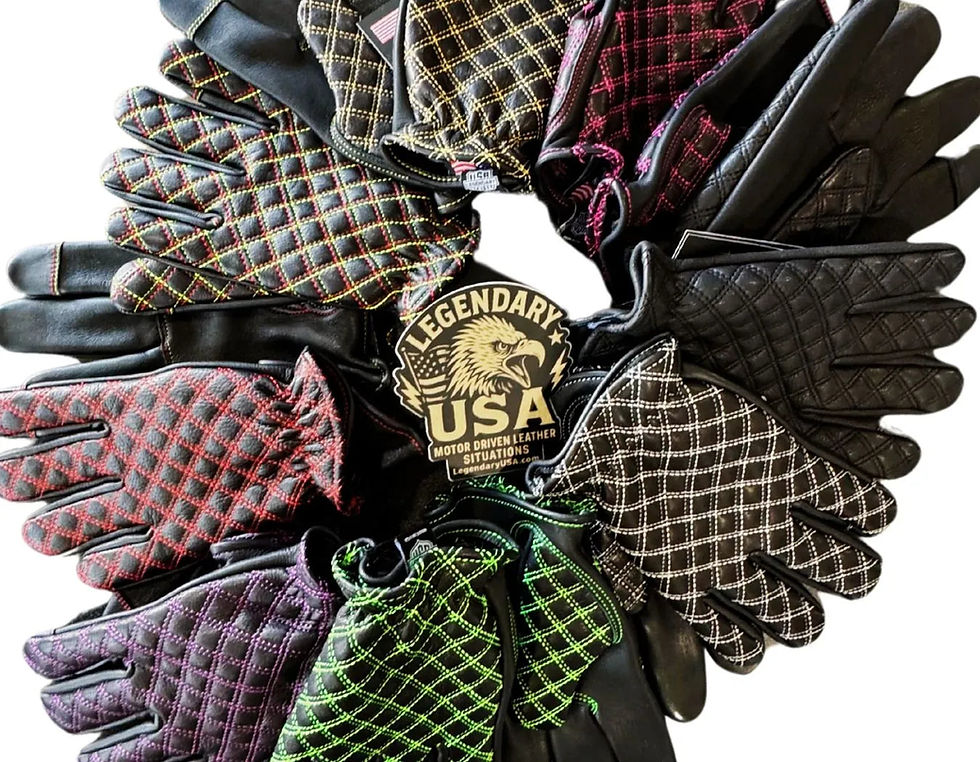
One consequence of the automatic that owners mention less often: without a clutch lever, everything you feel at the bars comes through the throttle and the brakes, so glove fit matters more rather than less. A loose glove that rotates on the palm blunts exactly the inputs this bike relies on. Legendary USA's breakdown of glove stretch and break-in explains why sizing up is the common mistake.
Cover photo: "2021 Honda Rebel 1100 MT" by Chanokchon, CC BY-SA 4.0, via Wikimedia Commons.