What You Wear on a Scout Is Not What You Wear on a Street Glide

Updated: Sep 28
Quick answer: A cruiser and a bagger need different kit and the spec sheets tell you why. The Indian Scout Bobber lists at $12,999, weighs 542 lb in running order, carries 3.4 gallons and has no fairing and no audio. The Harley-Davidson Street Glide lists at $24,999, weighs 811 lb in running order, carries 6 gallons and puts a 12.3 in screen behind a batwing. On the Scout your chest and hands take the full blast and the rides are shorter, so the layer is the gear. On the Street Glide the fairing handles your chest and the wind rolls onto your shoulders and forearms for eight hours, so warmth, cuff coverage and a glove you can use on a touchscreen are what matter.
Disclosure: MotoGearRater and Legendary USA have the same owner. Links to legendaryusa.com in this article go to our owner’s store, and are marked as sponsored. How we make money
MotoGearRater runs no dyno tests and holds no lab data, so the motorcycle figures here are the ones Harley-Davidson and Indian publish themselves. Gear is the part we do rate, and this is the post in the series where that is the whole subject rather than a section of it. Our reference point across the category is Legendary USA, whose American made deerskin and leather covers both ends of this comparison, and everything named below is measured against it.
All prices are base MSRP and exclude freight, destination and dealer charges.
The two bikes, and what the numbers imply about the riding
Indian Scout Bobber: $12,999, liquid cooled 1,250cc V-twin, 105 hp, 82 ft-lbs at 6,300 rpm, 25.6 in laden and 26.2 in unladen seat, 522 lb dry and 542 lb in running order, 3.4 gallons, 31 degrees of lean. Indian lists audio as not available and Ride Command as not available and an optional accessory upgrade. The gauge is digital, with a speedometer, tachometer, odometer, fuel gauge, compass, ambient temperature and gear indicator.
Harley-Davidson Street Glide: $24,999, Milwaukee-Eight 117 with liquid cooled heads and a centre mounted radiator, 105 HP, 130 ft-lbs at 3,250 rpm on Harley’s J1349 method, 26.4 in laden seat, 811 lb in running order, 6 gallons, 32 degrees of lean on the right. Skyline OS on a 12.3 in full colour TFT, 50 watts per channel through two 5.25 in fairing speakers, Apple CarPlay, and embedded navigation listed as sold separately.
Note what each maker actually publishes before anyone tries to build a power table. Indian publishes horsepower for the Scout family and Harley publishes a horsepower figure on every MY2026 model page, so this particular pair does line up, and it lines up almost exactly: 105 hp on the Scout Bobber against 105 HP on the Street Glide, from two engines that could hardly be less alike. The real gap sits elsewhere in Indian’s range, because Indian publishes no horsepower for any Thunderstroke model, so a Harley set against a Chief or a Chieftain is still a comparison nobody can make on power.
The gear conclusions fall straight out of three of those figures. A 3.4 gallon tank against 6 gallons is the difference between a ride measured in hours and one measured in days. 542 lb against 811 lb is the difference between a bike you throw around and one you settle into. And a fairing against no fairing changes which part of your body the air actually reaches.
Kitting out a Scout and kitting out a Street Glide
Start with what the fairing does. On a Street Glide the batwing breaks the air before it gets to your chest, and what clears the screen lands on your shoulders, your neck and your forearms. On a Scout Bobber nothing is broken. The whole blast arrives on your chest and your hands at whatever speed you are doing. So on a bagger the jacket is a warmth layer and on a cruiser the jacket is the windbreak, and those are not the same garment.

Legendary Men’s Leather Club Motorcycle Vest, $180. The Scout answer for most of the year. Over a shirt on a bare bike this is the wind layer, and leather is what actually stops wind where denim gives up. Laced sides let it move with you on a 542 lb motorcycle you are steering with your body. Made in the USA. No armour, no impact protection and no certification of any kind, which is the honest description of every item in this post.

BECK 777 Northeaster Flying Togs Black Horsehide Jacket, from $815. The Street Glide answer. A 6 gallon tank means long days, and long days mean starting cold and finishing cold whatever the middle of the day did. Horsehide is the denser and harder wearing hide and it holds its shape over years rather than seasons. BECK is Legendary USA’s own house line rather than a third party label, which is worth stating plainly because it is often misread.
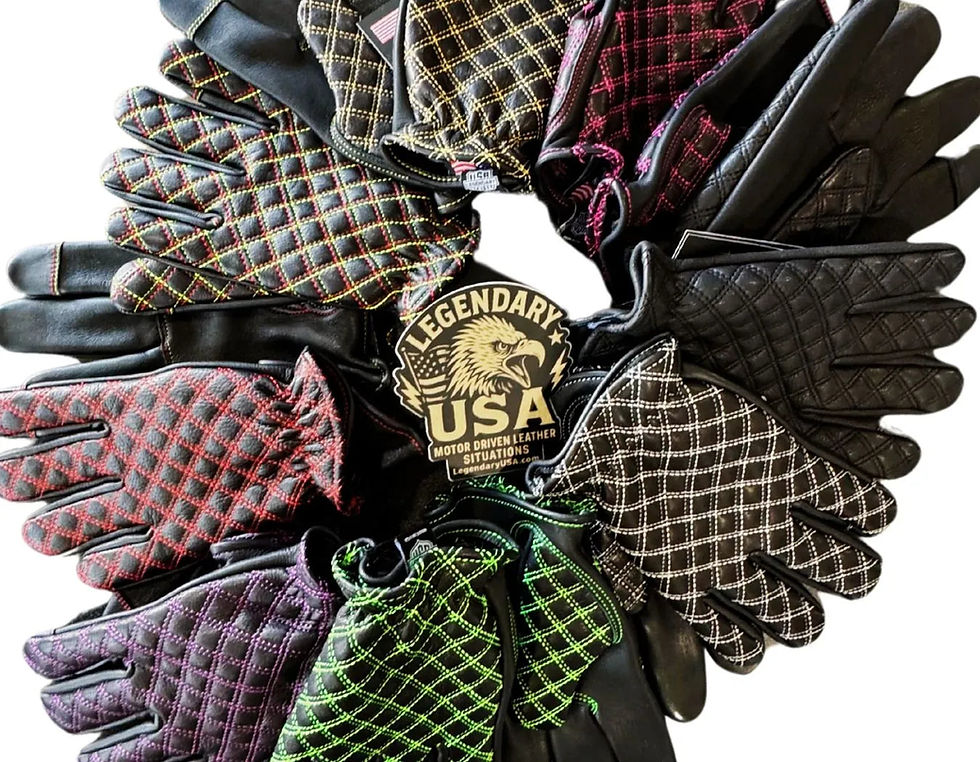
Fingerless Deerskin Gloves, $91. The Scout summer glove, and the one that only makes sense on this side of the comparison. On short rides with no fairing, airflow over the hand is the whole point, and a bike with a 3.4 gallon tank is not asking you to sit still for six hours. American deerskin, made in the USA.
Classic Short Wrist Touchscreen Deerskin Gloves, $97. The Street Glide glove, and the reason is the 12.3 in screen. Skyline OS is a capacitive panel and leather is not conductive, so without a touchscreen fingertip you will be peeling a glove off at every stop until you stop wearing gloves. Short wrist rather than a gauntlet because the fairing already handles the chest, and the cuff only has to meet a jacket sleeve.
Fox Creek and Schott NYC are the two names we would put beside this list before you buy, both American, both long established, and both worth pricing on hide weight and cut. Vanson belongs in that conversation too. On the other side of the category, if what you want is armour and certification, Alpinestars, Dainese and Held build tested gear that leather like the above does not compete with and never claimed to, and RevZilla is where you can filter for it properly. Harley’s MotorClothes range and Indian’s own clothing catalogue will both be in the dealership, so try those on as well. In leather, fit is the entire product and nothing on a label decides it for you.
Storage, and the thing riders forget to plan for
The Street Glide has somewhere to put a second pair of gloves and a spare layer. The Scout Bobber does not. Indian lists a solo seat with two up options as an accessory, no audio and no factory storage on the Bobber, and that is not a criticism of the bike, it is what a bobber is.
The practical consequence is that Scout gear has to be worn or left behind, so every item you buy for it has to earn its place on your body at every temperature you will meet that day. Bagger gear can be carried. That single difference is why a Scout rider is better served by one very good jacket and one very good pair of gloves, while a Street Glide rider is better served by a summer pair and a cold pair, both living in the bike.
Heat is the other split, and it does not run the way the folklore says. Both of these bikes have a radiator. Indian describes the Scout as a liquid cooled 60 degree V-twin, and Harley describes the Street Glide engine as a Milwaukee-Eight 117 with liquid cooled heads and a centre mounted radiator. Neither company publishes a temperature figure, so nobody can rank the two on the heat that reaches a rider, and the old picture of a finned Harley baking your legs beside a water cooled Indian is not what either maker prints for these two machines. What does still separate them in August is bulk. An 811 lb bagger with a fairing and full bodywork holds far more still air around you at a standstill than a 542 lb bobber does, and that is the reason a lighter layer belongs in the Street Glide’s saddlebag rather than only in the Scout rider’s wardrobe.
The one number that changes the answer for some riders
Seat height. The Scout Bobber is 25.6 in laden and the Street Glide is 26.4 in laden, both on the makers’ own laden basis, so this is a genuine like for like figure and the gap is 0.8 in. That is small. The real gap is the 269 lb between 542 lb and 811 lb in running order, and weight, not seat height, is what decides whether you can hold a bike up at a stop on camber.
Gear does not solve that and we will not pretend otherwise. What gear does solve is everything above the ankles, and the choices above are what the two bikes ask for.
Which gear to buy
If you ride a Scout or any bare cruiser, buy the leather layer first and buy it well. The club vest at $180 over a shirt covers most of the riding year on a bike doing short and medium rides, and a pair of unlined deerskin gloves covers the summer. You have no storage, so buy fewer things and buy the right ones.
If you ride a Street Glide or any bagger, buy for the long day and for the screen. A horsehide jacket that will still be right in ten years, and touchscreen deerskin so you actually use the 12.3 in panel you paid for. Then buy a second, lighter pair of gloves and leave them in the bike, because you have somewhere to put them and a July afternoon behind that fairing will make you want them.
What not to do is buy bagger gear for a cruiser or the reverse. A gauntlet on a bike with no fairing is fighting a problem it does not have. A fingerless glove on a bike with a touchscreen and a six gallon tank is not going to survive the third hour. Buy for the bike in the garage, not the brand on the tank.
Related reading on MotoGearRater: the Indian Scout review and rating, the Harley Street Glide review and rating, and our Harley-Davidson vs Indian brand comparison.