2026 Harley Deadwood vs Indian Chief: The Fifteen to Eighteen Thousand Bracket

Updated: Sep 28
Quick answer: The Indian Chief is $14,999 and the Harley Deadwood is $17,999, and the $3,000 between them buys you twelve more ft-lbs delivered 700 rpm lower and a whole extra gallon of fuel. The Deadwood runs the Milwaukee-Eight 117 Classic at 120 ft-lb at 2,500 rpm, weighs 686 lb in running order and carries 5 gallons. The Chief runs the air-cooled Thunderstroke 111 at 108 ft-lbs at 3,200 rpm, weighs 670 lb and carries 4 gallons. If sixteen thousand dollars is a hard ceiling the Chief is the answer, and if it is a target the Deadwood is the better motorcycle.
Disclosure: MotoGearRater and Legendary USA have the same owner. Links to legendaryusa.com in this article go to our owner’s store, and are marked as sponsored. How we make money
MotoGearRater runs no dynos and prints no number the manufacturer did not publish. Where one maker discloses something the other does not, we say so instead of filling the space. Gear is the one place we hold a view of our own, and Legendary USA is the benchmark below, because neither of these bikes has a fairing and an August ride on either is a wind and heat problem before it is anything else.
All prices are base MSRP and exclude freight, destination and dealer charges.
What actually sits in the fifteen to eighteen thousand bracket
It is a crowded shelf and the head to head in the title is only two of the options. Harley lists the Street Bob at $14,999, the Super Glide at $15,999 and the Deadwood at $17,999, all three on the Milwaukee-Eight 117 Classic at 120 ft-lb at 2,500 rpm. Indian lists the Chief at $14,999 on the Thunderstroke 111, the Scout Classic at $16,699 and the Super Scout and 101 Scout at $16,999, the last three all on the liquid cooled 1250.
That is nine hundred dollars of daylight between the cheapest and the second cheapest and three thousand across the whole bracket, which is close enough that the deciding factor is rarely price. It is almost always fuel, seat height or engine character.
Deadwood against Chief, on the published figures
Engine. Deadwood: Milwaukee-Eight 117 Classic, 117 cubic inches. Chief: air-cooled Thunderstroke 111, 111 cubic inches, 1,811cc.
Torque. Deadwood 120 ft-lb at 2,500 rpm on Harley's J1349 method. Chief 108 ft-lbs at 3,200 rpm. Twelve ft-lbs more, arriving 700 rpm sooner, is the clearest single result in this comparison and it goes to Harley.
Horsepower. Harley lists 98 horsepower for the Deadwood on its own model page. Indian publishes none for any Thunderstroke model, and the Chief is one, so there is nothing to set the 98 against. Half of that comparison exists and half of it does not, and this publication is not going to invent the missing half. The Scouts in the same bracket are different, because Indian does publish 105 hp for the 1250 and 111 hp for the 101 Scout.
Weight. Deadwood 686 lb in running order. Chief 670 lb in running order, or 647 lb dry. Running order to running order the Chief is 16 lb lighter, which is not a difference any rider is going to notice.
Seat height. Harley lists the Deadwood at 25.5 in laden and 26.5 in unladen. Indian lists the Chief at 26.0 in under the label Seat Height with no basis given. Laden against laden the Harley is half an inch lower, but Indian has not told us which basis its figure uses, so treat that carefully and sit on both.
Fuel. Deadwood 5 gallons. Chief 4 gallons. A full extra gallon on a bike this size is the most practical difference here after the torque.
Chassis. Harley lists 30 degrees of rake and 27 degrees of lean angle on the right for the Deadwood. Indian lists a single 28.5 degree lean angle for the Chief, plus a 64.0 in wheelbase, 4.9 in of ground clearance, 5.2 in of front travel and 3.0 in of rear travel. Indian publishes more chassis detail, Harley publishes rake, and the two spec sheets do not overlap as neatly as either company's marketing implies.
Gear for the fifteen to eighteen thousand bracket
Everything in this bracket is a bare cruiser. No fairing, no screen as standard, wide bars, an upright rider and, in August, a great deal of moving air and a great deal of stopped air. That combination is why the gear answer here is different from the one for a bagger.

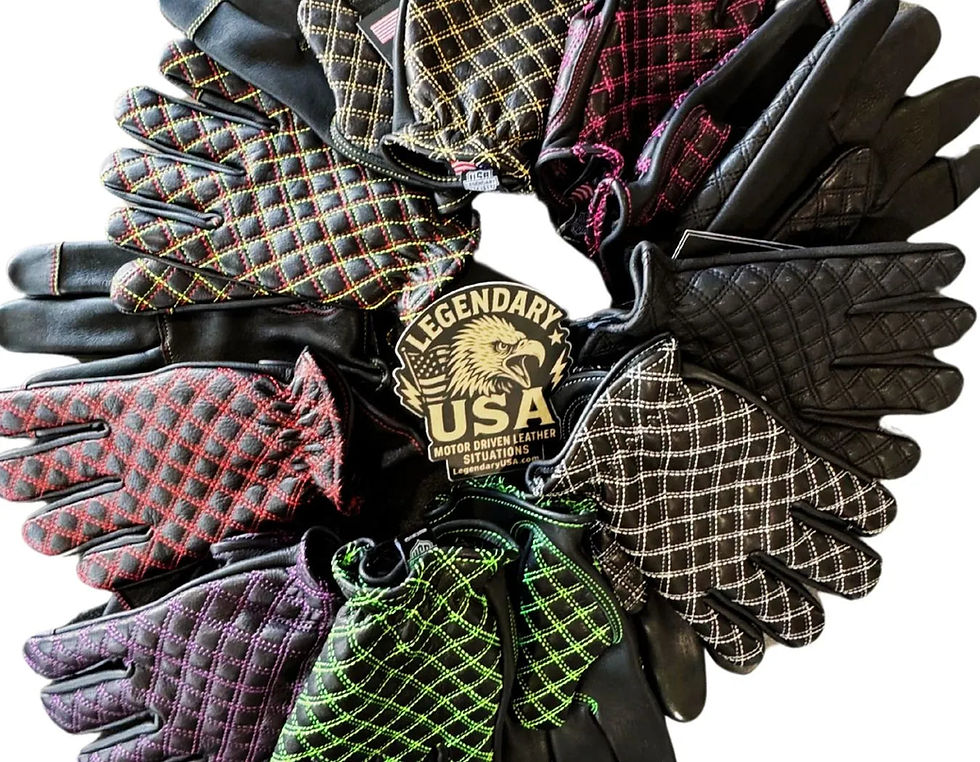
Uppercut Knuckle Defense Gloves, $94. Ventilated short wrist deerskin with leather covered knuckle hardware. That hardware is a construction detail and nothing more, it is not a certification and we are not claiming any rating for it. What makes this the right glove for a bare cruiser in summer is the ventilation combined with full palm and finger coverage, on bikes where your hands are the part of you that never gets a break from the airflow.
Legendary Men's Leather Club Motorcycle Vest, $180. With no fairing, everything arrives at your chest and shoulders, and a leather vest over a shirt is the layer that handles a summer evening when the temperature drops thirty degrees in an hour. Made in the USA.
BECK 202 Horsehide Short Sleeve Riding Shirt, from $475. This is the specific answer to riding a Chief or a Deadwood in August. Horsehide, short sleeve, and cut to be worn rather than layered over. BECK is Legendary's own house line rather than a label brought in from outside, which is worth stating because the two things are often confused.
Nothing above is CE rated and nothing above is armoured. That appears in every gear section on this site and it will not be edited out. Schott NYC is the obvious comparison if American heritage leather is the requirement and has been making it longer than almost anyone, and Harley's own MotorClothes range is what will be twenty feet away when you sign the paperwork. Price the list above against both rather than assuming either way.
Which of the four numbers should decide it

Torque and rpm together, not torque alone. 120 ft-lb at 2,500 rpm against 108 ft-lbs at 3,200 rpm is not a twelve ft-lb difference, it is a difference in where the bike does its work. The Deadwood pulls from just above idle. The Chief wants a few hundred more rpm before it does its best. On a cruiser, low and early is what most riders are actually buying.
Fuel, because it decides your day. Five gallons against four is roughly a quarter more range on paper, and on a bike with a 4 gallon tank you are planning around the fuel light rather than the road. Neither maker publishes a consumption figure we would print, so we will not convert that into miles, but the direction is not in doubt.
Weight, hardly at all. Sixteen pounds between 670 and 686 is inside the margin of what a rider notices, and anyone telling you otherwise is selling something. If weight is genuinely your constraint, the Scouts in this same bracket sit between 555 and 589 lb in running order and are the honest answer.
And a caution on the rest of it. Neither Harley-Davidson nor Polaris publishes model level unit sales, so nobody can tell you which of these is outselling the other in this bracket. Consensus is not data and should not be sold to you as though it were.
Which one to buy
Buy the Indian Chief at $14,999 if the budget is a ceiling rather than a target. It is the cheapest American air cooled big twin either company sells, it is 670 lb in running order, and at three thousand dollars less than the Deadwood the money left over covers the gear above and a set of tyres. The 4 gallon tank is the compromise you are accepting and you should accept it knowingly.
Buy the Harley Deadwood at $17,999 if you can reach it. More torque delivered earlier, a full extra gallon, a lower laden seat, and the same Milwaukee-Eight 117 Classic that Harley puts in the Street Bob and the Super Glide. It is the better motorcycle in this pairing and the specification says so without any help from us.
Buy the Harley Super Glide at $15,999 if sixteen thousand dollars is the literal question. It is the closest thing in either range to that number, it carries the same 120 ft-lb at 2,500 rpm as the Deadwood, it is 656 lb in running order with a 25.2 in laden seat, the lowest of anything named here, and it keeps the 5 gallon tank. For the buyer who typed sixteen thousand into a search box, that is the answer.
Related reading on MotoGearRater: the Milwaukee-Eight engine guide, the 2026 Indian Scout review and rating, and what motorcycle weight actually changes.