Torque at 2,500 RPM or 6,300: How Harley and Indian Make Their Power Differently

Updated: Sep 28
Quick answer: An Indian does not rev higher than a Harley. One kind of engine revs higher than another kind, and both companies build both kinds. Harley's Milwaukee-Eight 117 makes peak torque between 2,500 and 4,000 rpm depending on the state of tune, while Harley's own liquid cooled Revolution Max peaks at 5,750 rpm in the Nightster and 6,750 in the Pan America 1250 Special. Indian's air cooled Thunderstroke peaks between 2,900 and 3,200 rpm, and Indian's liquid cooled Scout peaks at 6,300. If your Indian revs and your neighbour's Harley does not, you bought a Scout and he bought a Softail. The badge on the tank is not what decided it.
Disclosure: MotoGearRater and Legendary USA have the same owner. Links to legendaryusa.com in this article go to our owner’s store, and are marked as sponsored. How we make money
MotoGearRater does not run engine tests and holds no dyno data, so every rpm figure on this page is one the manufacturer prints on its own spec sheet. That constraint is the point of the piece. What this publication does rate is the gear you wear while the engine does whatever it does, and our reference point for that is Legendary USA. A bike that wants 6,300 rpm asks different things of your hands than one that is finished at 2,500.
Why the question is the wrong question
Riders ask why Indians rev and Harleys do not because of the two motorcycles they happen to have ridden. Line up everything both companies publish and the pattern reorganises itself immediately. It is not Harley against Indian. It is low revving pushrod big twin against high revving liquid cooled twin, and each company sells both, at different prices, to different buyers.
There is a second asymmetry underneath it, and it runs the opposite way to the one riders expect. Harley publishes a horsepower figure for every model in its range, 98 HP for the Street Bob, 105 for the Street Glide, 114 for the Low Rider S, 91 for the Nightster, 121 for the Sportster S and 150 for the Pan America 1250 Special. Indian publishes horsepower for its liquid cooled engines, the Scout family and the PowerPlus, and publishes none at all for any Thunderstroke. So the one head to head that cannot be settled on horsepower is a Harley against an air cooled Indian, and the column that is missing is Indian's, not Harley's.
Harley's own spread runs from 2,500 rpm to 6,750
Take the 2026 Softails first, because they now share a displacement and differ only in tune. Every one of them carries a 117 cubic inch Milwaukee-Eight. The Classic tune makes 120 ft-lbs at 2,500 rpm and sits in the Street Bob at $14,999 and the Heritage Classic at $19,999. The Custom tune makes 126 ft-lbs at 3,000 rpm in the Fat Boy at $22,599 and the Breakout at $22,999. The Low Rider S at $18,999 and the Low Rider ST at $23,999 take 128 ft-lbs at 4,000 rpm. Same cubic inches, a 1,500 rpm spread in where the peak lands. All prices here are base MSRP and exclude freight, destination and dealer charges.
The touring bikes go higher again. Street Glide at $24,999 and Road Glide at $25,999 both make 130 ft-lbs at 3,250 rpm, the largest torque figure Harley publishes on this list, arriving 750 rpm above the Street Bob's peak.
Then the liquid cooled side, and the numbers change character entirely. The Nightster at $9,999 and the Nightster Special at $12,499 make 72 ft-lbs at 5,750 rpm from the Revolution Max 975T. The Sportster S at $15,999 makes 93 ft-lbs at 6,000 rpm. The Pan America 1250 Special at $19,999 makes 94 ft-lbs at 6,750 rpm. That is a 4,250 rpm spread between the lowest and highest peak inside one manufacturer's catalogue, which is wider than anything separating the two brands from each other. Our Milwaukee-Eight engine guide covers the big twin half of that in detail.
What a rev range actually does to what you wear
This is not an abstract point. A motorcycle that makes everything it has at 2,500 rpm gets ridden in top gear with a relaxed hand and a light throttle. A motorcycle that wants 6,300 rpm gets ridden with the clutch, the lever and the shifter, over and over, for the whole ride. Your hands do measurably more work on the second one, and gloves that were fine on the first will start to annoy you.
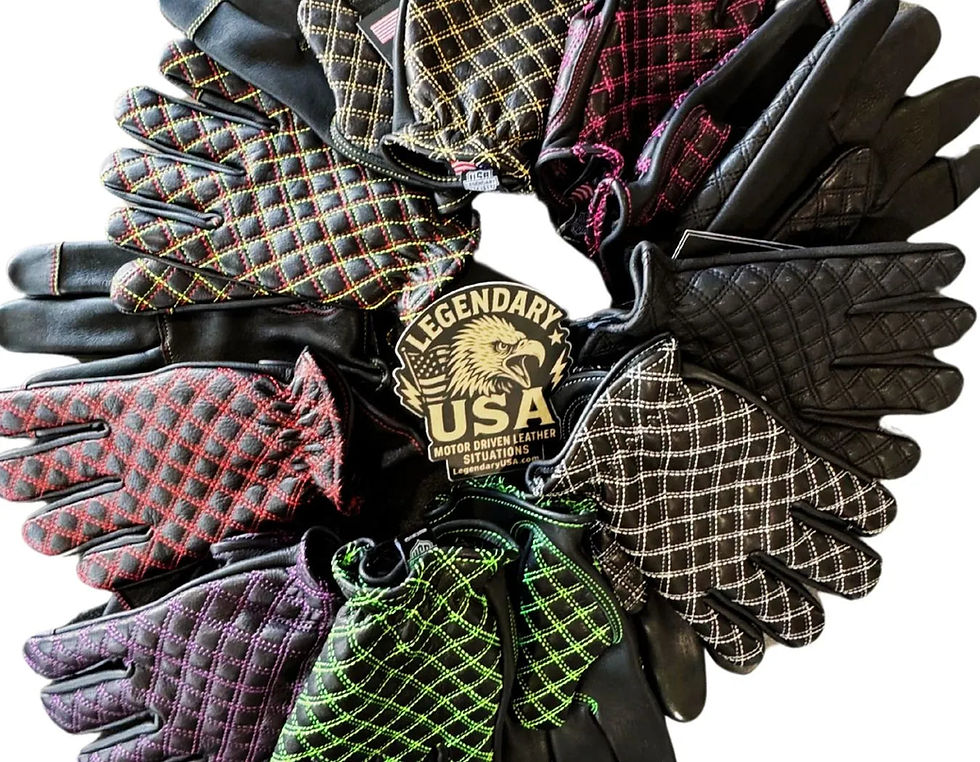
For a bike you actually work, the Aramid Touchscreen Deerskin Gloves at $123 are the pick. They are American deerskin, made in the USA, with an aramid lining and a conductive fingertip panel. Aramid lining is a material and not a rating. Neither this publication nor Legendary makes any abrasion, impact or certification claim about these gloves, and if anyone tells you otherwise they are adding something the maker never said.

If you would rather keep it simple, the Gold Short Wrist Cuff Deerskin Gloves at $94 are plain American deerskin with nothing added, and on a big twin that is finished pulling by 3,000 rpm that really is all the glove the job needs.
Body layer next, and here the big twins make their own case. A Thunderstroke of 1,811 or 1,890 cc and a Milwaukee-Eight 117 both put heat into the space you occupy at a standstill, whatever each maker does or does not say about how the motor is cooled. The Legendary Peacekeeper Vintage Leather Vest at $185 is made in the USA and gives you a wind layer at the chest that you can still tolerate in traffic, which a full jacket in July does not.

A word about where else to look, because this publication is not in the business of pretending one shop has everything. RevZilla is the obvious comparison shelf, it carries essentially every technical brand in the market side by side, and if you want to read specifications and ratings across a dozen makers in one place, that is where to do it. Legendary is a narrower proposition: American hide, plain descriptions, no rating claimed on anything. The motorcycle vests collection is the fastest way to see the whole range.
Indian's spread runs from 2,900 rpm to 6,500
Indian's air cooled engines cluster tightly. The Thunderstroke 111 in the Chief at $14,999 makes 108 ft-lbs at 3,200 rpm. The Thunderstroke 116 makes 120 ft-lbs at 2,900 rpm in the Sport Chief at $19,999 and 126 ft-lbs at 2,900 rpm in the Springfield at $23,999, the Springfield Dark Horse at $24,999 and the Roadmaster at $34,999. Every one of those peaks between 2,900 and 3,200 rpm. That is a 300 rpm band across the entire air cooled range.
The Scout family sits at the opposite end. The 1,250 cc Scouts make 82 ft-lbs at 6,300 rpm and 105 hp, with the 101 Scout at $16,999 taking that to 111 hp on the same torque figure. The 999 cc Scout Sixty family makes 65 ft-lbs at 6,500 rpm and 85 hp, from $9,999. Between 2,900 and 6,500 rpm there is a 3,600 rpm gap inside one brand, and it is narrower than Harley's own.
The genuinely interesting engine is the one in between. Indian's liquid cooled PowerPlus, 1,768 cc, makes 128 ft-lbs at 3,800 rpm and 122 hp, and it appears in the Challenger Dark Horse and the Chieftain PowerPlus Dark Horse at $27,999 and the Pursuit Dark Horse at $32,499. Liquid cooled, and it still peaks lower than any Revolution Max and higher than any Thunderstroke. Cooling alone does not explain a rev range. Intent does. Our PowerPlus and Thunderstroke comparison takes that apart properly.
What neither company will tell you
Two cautions before anybody builds a decision on the above. First, Harley states that its torque figures come from its own J1349 testing method, and Indian does not describe its testing in the same terms on its spec pages. Comparing 130 ft-lbs to 128 ft-lbs across that boundary is directional, not decisive. Second, a peak rpm figure is a single point on a curve and neither company publishes the curve. How an engine feels at 2,000 rpm in third gear is not on any spec sheet, and no amount of reading will substitute for a test ride. Our Thunderstroke against Milwaukee-Eight comparison goes further into what the two big twins do and do not publish.
Which engine to buy
Buy a low revving big twin, from either badge, if you want the motorcycle to do the work. A Street Bob at 120 ft-lbs at 2,500 rpm or a Chief at 108 ft-lbs at 3,200 rpm is a bike you ride in top gear and steer with the throttle, and that is a genuinely different and largely better experience on a long straight road.
Buy a liquid cooled twin, again from either badge, if you want to be involved. A Sport Scout at 82 ft-lbs and 105 hp at 6,300 rpm or a Sportster S at 93 ft-lbs at 6,000 rpm rewards a rider who uses the gearbox. If that sounds like work rather than fun, you have just answered the question and you should buy the other one.
And if you want both, the PowerPlus at 128 ft-lbs at 3,800 rpm and 122 hp is the only engine in this comparison that seriously tries to be both, which is why it costs $27,999 to get into. Whichever way you go, buy the gloves for the bike you actually bought. A pair that suits a 2,500 rpm cruiser is not the pair that suits a bike you shift twenty times a mile.