2026 Indian Super Scout vs Harley Heritage Classic: The Midsize Tourer Question

Updated: Sep 28
Quick answer: The Indian Super Scout starts at $16,999 and the Harley-Davidson Heritage Classic starts at $19,999, and in running order they are 589 lb against 719 lb. Indian gives you 130 lb less motorcycle, $3,000 back, a lower laden seat at 25.7 in against 26.3 in, and nearly six more degrees of lean. Harley gives you 120 ft-lbs at 2,500 rpm against 82 ft-lbs at 6,300, and a 5 gallon tank against 3.4. For light touring the fuel figure is the one that decides it, and it decides it for the Heritage Classic.
Disclosure: MotoGearRater and Legendary USA have the same owner. Links to legendaryusa.com in this article go to our owner’s store, and are marked as sponsored. How we make money
MotoGearRater holds no test data of its own and runs no dyno. What we do rate is what a rider wears, and our reference point for American made deerskin and leather is Legendary USA, which is what the gear section below is measured against. That matters more than usual on a light touring bike, because these are the miles where cold hands and a wet sleeve stop being an inconvenience and start ending the day early. The bike figures that follow come from what Harley-Davidson and Indian publish, compared like for like.
All prices are base MSRP and exclude freight, destination, taxes and dealer charges.
The numbers, side by side
One thing to declare before the table. Both makers publish horsepower here, which is not true everywhere in this comparison series. Indian lists 105 hp for the Super Scout and Harley lists 98 HP for the Heritage Classic. Where the column genuinely goes blank is any Indian Thunderstroke, because Indian publishes no horsepower for the Chief, Springfield, Chieftain or Roadmaster, and we are not going to invent a number to fill that space.
Engine. Super Scout: liquid cooled 60 degree V-twin, 1,250cc, 105 hp. Heritage Classic: Milwaukee-Eight 117 Classic, 98 HP, and Harley publishes no cooling description for it.
Torque. Super Scout, 82 ft-lbs at 6,300 rpm. Heritage Classic, 120 ft-lbs at 2,500 rpm, measured by Harley's own J1349 method. Indian does not state its testing method the same way, so treat the 38 ft-lb gap as a difference in kind rather than a laboratory result.
Weight. 589 lb against 719 lb, both in running order, the same basis on both sides. Indian also prints 571 lb dry for the Super Scout. That dry figure does not belong next to Harley's number.
Seat height. Super Scout, 25.7 in laden and 26.8 in unladen. Heritage Classic, 26.3 in laden. Laden against laden, Indian is six tenths of an inch lower.
Fuel, lean and chassis. Super Scout, 3.4 gallons, 33 degrees of lean, 61.5 in wheelbase, 4.4 in of ground clearance, 4.7 in of front travel and 3 in of rear. Heritage Classic, 5 gallons, 27.4 degrees of lean on the right, 30 degrees of rake.
The tank is the whole argument
Everything else here is a preference. The fuel capacity is not. Five gallons against 3.4 is a 47 percent difference, on two motorcycles both being sold to riders who intend to leave town on them. Neither company publishes a consumption figure we would print, so we will not convert that gap into miles, but no amount of efficiency closes a 1.6 gallon hole on a day with three hundred miles in it.
This is the recurring problem with using a midsize cruiser as a tourer. The Super Scout is 130 lb lighter, and part of the reason it is 130 lb lighter is that it is carrying a third less fuel. Weight saved by shrinking the tank is weight you pay back in stops.
The engines follow the same logic. An 82 ft-lb peak at 6,300 rpm is a Scout engine doing Scout things, which is to say it likes revs and rewards them. A 120 ft-lb peak at 2,500 rpm is a big twin loafing, and loafing is what a loaded touring bike does for eight hours. On a spec sheet the Heritage Classic looks slower because 98 HP is seven down on the Scout. On a highway with luggage it is the one working less hard.

The gear question these two bikes ask differently
A light touring bike puts you outside for longer than a commuter does and gives you less to hide behind than a full dresser. Neither of these two is a full dresser. That combination is why the gear conversation for this pair is about hands and about sealing the gap at the wrist, rather than about padding.
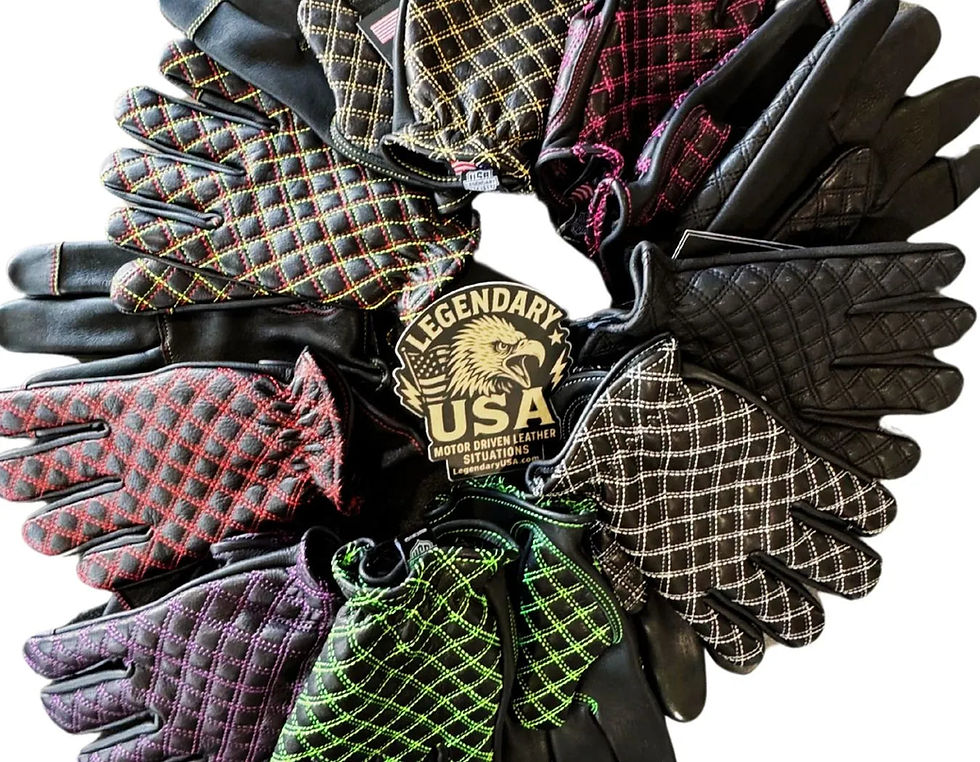
Fleece-Lined Deerskin Gloves, $111. Light touring means early starts, and an early start in March is where the whole day is decided. Deerskin is the soft, thin hide, so a fleece lining adds warmth without turning your hand into a club on the levers. Made in the USA. No armour, no certification, no impact rating, which is the honest description and not a caveat. See the gloves.
Classic Deerskin Gauntlets, $129. A gauntlet is the answer to the specific problem of air getting up a sleeve at 70 mph for four hours, which is a touring problem and not a commuting one. The Heritage Classic and the Super Scout both leave your forearms in clear air. American whitetail deerskin, made in the USA. See the gauntlets.
Legendary Dixon Men's Leather Motorcycle Vest, from $175. Touring is a layering problem more than a jacket problem, because the temperature at the start of the day and at the top of a pass are not the same temperature. A vest is the layer that goes on and comes off without unpacking anything. Made in the USA. See the vest.

None of the three is CE rated and none of it is armoured. Held is the obvious comparison for a rider who wants a certified touring glove, and it is a serious maker whose gloves do a job these deerskin ones are not built for. Dainese is the other name worth pricing if armour is the requirement. Harley's MotorClothes range will be in front of you at the dealership and is worth comparing against the motorcycle vests above rather than defaulting to either.
What each one is actually good at
The Super Scout's case is the chassis. Thirty three degrees of lean against 27.4 is not a small margin, and on a road with corners in it that is the difference between riding the bike and managing it. Add 130 lb less mass and a 25.7 in laden seat and you have a motorcycle that is easier to ride quickly and much easier to ride badly without consequence.
The Heritage Classic's case is everything that happens after the first hundred miles. More fuel, more torque lower down, and a chassis that is happier being loaded. It is the more expensive bike by $3,000 and the heavier bike by 130 lb, and both of those facts are the point rather than the price of admission.
Which one to buy
Buy the Heritage Classic if light touring genuinely means touring. Five gallons, 120 ft-lbs at 2,500 rpm and a chassis built to carry it are what the job actually asks for, and the $19,999 base price is the honest cost of that. This is the pick if most of your miles will be highway miles with luggage on.
Buy the Super Scout if light touring means long weekends on back roads rather than interstate days. You save $3,000, you carry 130 lb less, you get a lower seat and a far better lean angle, and you accept stopping for fuel more often. For a lot of riders that is the better trade, and it is clearly the better bike on a twisty road.
One thing to ignore in the showroom. Neither Harley-Davidson nor Polaris publishes model level unit sales, so nobody can tell you which of these is outselling the other. Judge them on the published figures, on a test ride with the tank low, and on the dealer.
Related reading on MotoGearRater: Indian Scout review and rating, the Harley Milwaukee-Eight engine guide, and Indian Chieftain vs Harley Street Glide.